Night at the Terminal: When a Storm Turns an Airport into a Village
They called it a travel nightmare; the people who lived it call it a strange kind of solidarity.
At Amsterdam Schiphol, the main departure hall — usually a river of rolling suitcases and impatient business travelers — had been refashioned overnight into a makeshift dormitory. Rows of camp beds glinted beneath high glass ceilings. Blankets were passed along like contraband. A woman in a fluorescent safety vest handed out boiled eggs and coffee, her voice steady but tired: “We’ll get you a croissant. We’ll get you home. For now, sleep.”
By morning, airport officials said roughly 700 flights had already been cancelled as Storm Goretti clawed across northwestern Europe. More cancellations were expected. More than a thousand people had spent the night at Schiphol — not in hotels, not by choice, but on cots and benches — and the airport had set up a rudimentary breakfast service to keep them going.
Numbers on the Board: Travel in the Time of Goretti
The disruptions were not confined to the Netherlands. Paris’s two major airports felt the sting: about 100 flights at Charles de Gaulle and another 40 at Orly were grounded, France’s transport minister said. Dublin and Cork reported cancellations for services bound for Amsterdam and Paris. Across Brussels, planes sat in lines for de-icing, the slow choreography of winter aviation.
“We are operating with severe constraints,” a Schiphol spokesperson told waiting passengers in a voice recorded for the public address system. “Please remain calm; staff are doing everything possible.” KLM, meanwhile, warned it was struggling to procure de-icing fluid for aircraft, saying delays to deliveries had tightened reserves. Schiphol countered that runway de-icing supplies were sufficient, though wing and tail de-icing for aircraft remained a bottleneck.
On the Ground in Paris
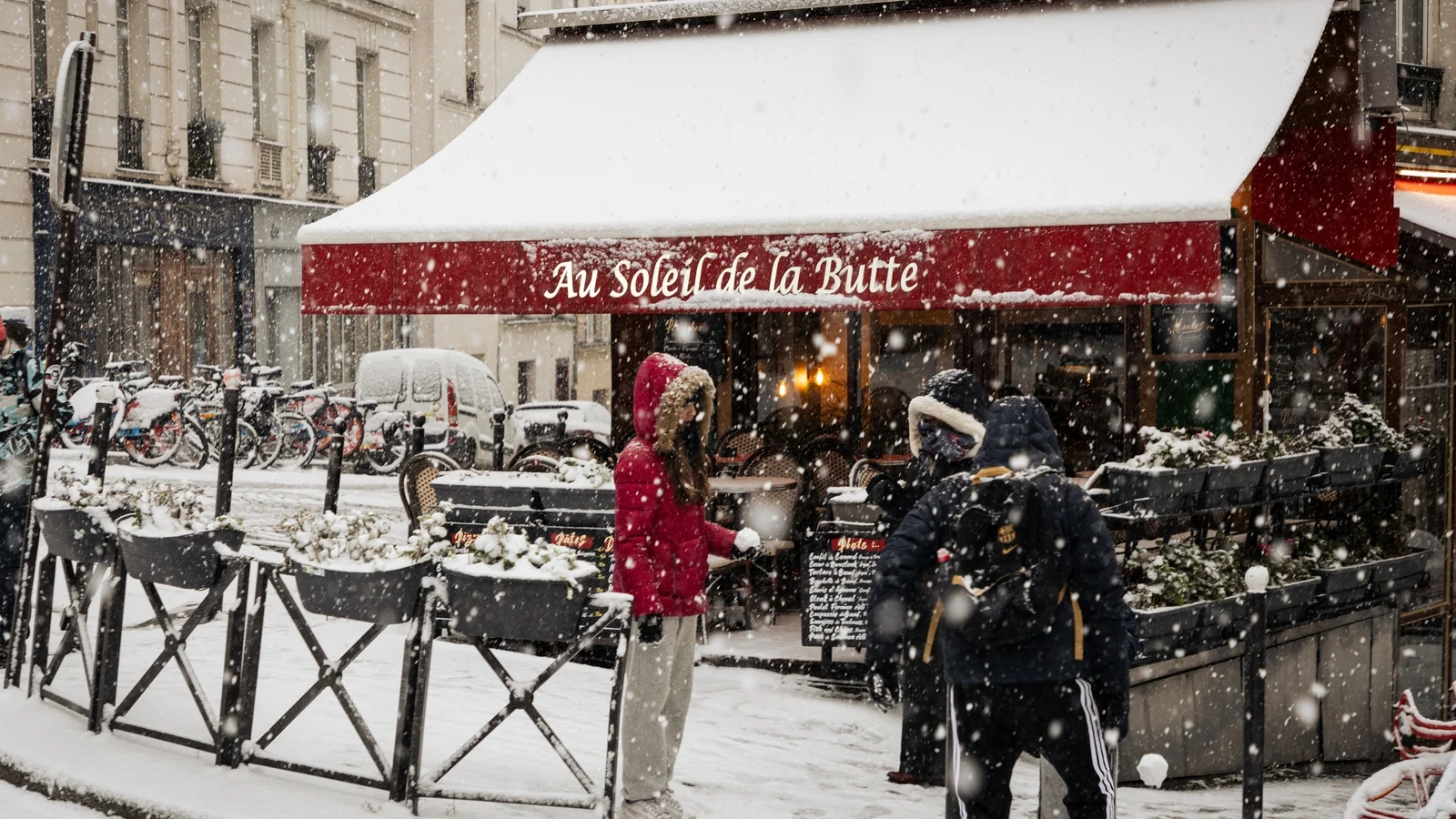
In Paris, the city woke to a scene more often associated with calendars than commuting: lamp posts and railings outlined in white, bus shelters bonneted in powder. Meteo France placed 38 of the country’s 96 mainland departments on alert for heavy snow and black ice. Snow accumulations of 3–7 cm were already being recorded in parts of the Île-de-France region — modest numbers, perhaps, but the agency called the cold snap “of rare intensity for the season.”
Some services were stopped altogether. Public buses across the Paris region and neighbouring suburbs were suspended because roads had iced over. Metro and suburban rail carried most of the load, but authorities urged people to avoid unnecessary journeys and to work from home when possible.
People Before Schedules: The Human Cost
There is a difference between a cancelled flight and a cancelled life’s rhythm. A nurse who had been due at a Paris hospital at 07:00 told me, “I live in the suburbs and I left at 04:30. The bus never came. I waited until dawn. My phone died at 05:45. I eventually walked to a metro station. I missed my shift.”
At Schiphol, a young couple on their honeymoon clutched a single suitcase and laughed as if they were in a movie rather than a chaotic real-life drama. “We planned for everything,” the groom said, “but not this grand romantic pause.” A volunteer from a local church handed them a hot sandwich and said, “We’ve had snow before. But people still need people.”
Alexandre Bompard, CEO of Carrefour, warned publicly that a ban on trucks and school buses — imposed in a third of French administrative departments — would ripple through supply chains, particularly fresh produce. “Perishables are especially vulnerable,” he said. “Customers will see the effects in days, not weeks.”
Beyond Borders: How Widespread Is the Disruption?
Storm Goretti’s fingerings reached further: southern Britain braced for the worst of the season across Thursday and Friday, with cold weather warnings blanketing large swathes of the UK. The Met Office kept ice alerts in place for parts of Scotland, though it said some warnings across England and Wales would lift later in the day.
Down in the Western Balkans, heavy snow and rain had already shut roads, cut power to villages, and swollen rivers past their banks. Emergency crews were on alert, and local officials warned of longer-term infrastructure damage in areas where flood defenses have been neglected for years.
Experts Weigh In
“We’re seeing a pattern of more volatile winters,” said Dr. Laila Mendes, a climate scientist at the University of Lisbon. “Warmer seas can carry more moisture, and when that moisture hits cold air masses over Europe, storms can intensify and dump a lot of snow in a short time. This isn’t just an inconvenience; it’s a stress test for transport networks and supply chains.”
Her view is supported by longer-term analysis: aviation networks already report rising costs linked to extreme weather — from fuel burn while circling to longer ground times for de-icing — and insurers are increasing premiums. The knock-on effects are measurable: delays cascade, workers miss shifts, shops run low on fresh goods, and the economic toll accumulates.
Small Acts, Big Comforts
For all the statistics and policy statements, what lingers are the small scenes. A Dutch barista reconfigured a coffee machine to make 200 cups in an hour for stranded passengers free of charge. An airport cleaner in Paris sang softly as she pushed a bin through a snowy concourse; a child woke and called out, “Are we camping?” and the crowd laughed like it was the best punchline.
One volunteer medic — bundled in layers — told me, “We treat panic the same as we treat frostbite. Both are cold and both need warmth.” The line paused. A man in a wool cap offered his scarf to a woman shivering on a bench. “It’s only snow,” he said. “But we look after each other.”
What Should Travelers Do?
If you’re planning to fly in the next 48 hours, here are some practical steps passengers can take:
- Check with your airline before leaving home; don’t assume the airport will have everything sorted.
- Pack basic essentials in your hand luggage — a warm layer, medication, chargers, and snacks.
- Have back-up plans for overnight stays and notify family members of potential delays.
Weather, Policy, and the Road Ahead
Storms like Goretti force an uncomfortable question: how resilient are our systems? Airports, trains, grocery supply chains, and emergency services all have thresholds. When weather pushes the systems past those thresholds, the social consequences fall unevenly — commuters without savings, food suppliers with fragile logistics, and rural areas with fewer resources to cope.
Policy responses will matter. Are we investing in better winter-proofing for transport? Do airports have diversified de-icing supply chains? Are governments ready to support vulnerable communities during cascading disruptions? These are not only technical questions; they are moral ones.
I left Schiphol as the storm paused, its breath held. The camp beds were still there. People were emerging, blinking into a gray sky, some laughing, some exhausted. A child tucked his face into his mother’s coat and sighed, “Can we go now, Maman?”
Storms pass. Systems falter and are repaired. But the habits we build in the lull — the compassion, the improvisations, the policy choices — will determine how we weather the next one. As you plan your week, ask yourself: what would I take in my carry-on if everything else went dark? And what would I do if the person next to me needed a blanket?