When Steel Falls from the Sky: A Night That Changed a Thai Countryside
It began, by all accounts, like an ordinary evening in Sikhio — a small district in Nakhon Ratchasima province, sunlight softening into dusk over cassava fields and low houses painted in the warm dust of Korat roads.
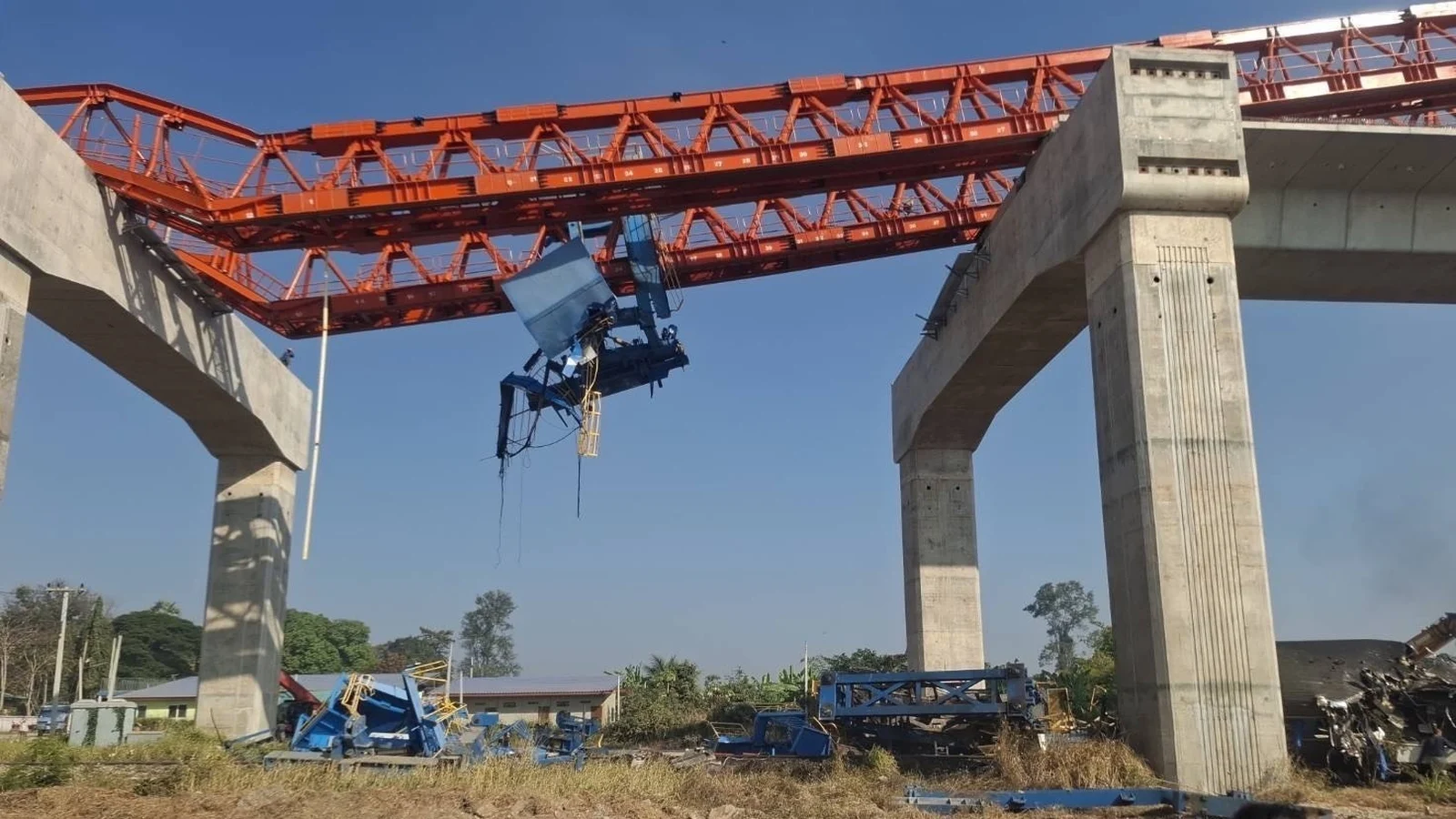
Then a thunderclap. Not from the heavens, but from a behemoth of human making: a construction crane, high above a new elevated track, gave way and plunged onto a passing passenger train. The sound, neighbors said, was like a tree collapsing across the valley: a wrenching, metallic groan, then the dull thuds of carriages buckling and the frantic clatter of people trying to flee the rubble.
The immediate toll
By the time rescuers stopped their initial search, at least 32 people had been killed and 66 more wounded, officials reported. There were 195 passengers aboard the service that had been making its way from Bangkok toward Ubon Ratchathani when the crane struck three carriages — two of which bore the brunt and where most of the fatalities occurred.
Transport Minister Phiphat Ratchakitprakarn, speaking shortly after the wreck, said he had ordered a full and transparent inquiry into what happened. “We will find the cause and we will hold those responsible to account,” he said, adding that teams from multiple agencies were combing the scene.
What rescuers found
Images and video from the site capture the immediate chaos: twisted aluminum, windows blown outward, carriages toppled into scrub and embankment, and firefighters working under a sky blackened with smoke to tamp down flames that briefly licked at scorched seats and insulation.
A rescue worker who helped pull people from a buckled carriage described the scene in stark, quiet terms. “We were working by feel,” she said. “There were people trapped who couldn’t move. The first priority was to get them out alive. We pulled children and elderly people; some were conscious, many were not.”
Local residents, some in flip-flops and stained shirts, formed an impromptu human chain to carry stretchers and hand over equipment to emergency crews. “It felt like the ground moved,” a fruit vendor near the tracks told me. “We ran toward the smoke; all we wanted was to help.”
How an elevated rail project turned tragic
The crane that fell was not working on the old line; it was part of an elevated high-speed rail project being constructed above the existing tracks. The ambitious program — designed to link Bangkok with cities across the northeast, then onward to Laos and ultimately to China — has become a centerpiece of Thailand’s modern infrastructure push.
Part of the line connecting Bangkok to Nakhon Ratchasima, authorities have said, is more than one-third complete; the full extension to Nong Khai on the Laotian border has been slated for completion by 2030. But as this disaster shows, long steel spans and soaring viaducts come with new kinds of peril.
At the crash site, a section of the collapsed crane remained wedged against the stanchions — the concrete columns erected to carry the future line — a grim monument to how construction accidents can cascade into public tragedies.
A tangled web of responsibility
China’s foreign ministry, responding to international attention on the project’s involvement of Chinese firms and financing frameworks, said it attached “great importance to the safety of projects and personnel” and was looking into the matter. “At present, it seems that the relevant section was under construction by a Thai enterprise. The cause of the accident is still under investigation,” spokesperson Mao Ning said at a briefing.
That remark highlights a complex reality: many of the region’s mega-projects are cross-border in finance, design, or labor. When things go wrong, lines of accountability can be messy. Who inspects cranes? Who signs off on safety protocols? Who is responsible for temporary works above operating railway lines?
Voices from the ground
Among the rescuers and locals, there is weary clarity about what the catastrophe means. A senior paramedic who declined to give his name said, “We are trained for rail incidents, but not when heavy equipment falls from above. It’s different. We had to be careful about stability; a second collapse could have been catastrophic.”
A high-speed rail safety analyst, speaking on condition of anonymity, framed the accident in broader terms: “Rapid infrastructure expansion is laudable, but the rush to meet timelines often compresses safety margins. Temporary works—like cranes, scaffolding, and makeshift platforms—require as much regulatory attention as the permanent structure.”
And then there are the quieter voices. An elderly woman who lost a nephew in the wreck sat on a plastic chair outside the local temple, her hands clasping a small amulet. “He called before he boarded,” she told me. “He joked about the new trains. Who would have thought…” Her sentence drifted off into the hum of community grief.
Why this matters beyond Thailand
Look at a map and the scene in Sikhio is not just local news; it sits at the intersection of global trends. From Southeast Asia to Africa and Eastern Europe, governments are pouring billions into railways, highways, ports and power — promises of futures knitted together by faster travel and stronger trade.
Those projects are often carried out by international consortia, financed through loans, and built at pace. They create jobs and opportunity. They also concentrate risk. When heavy machinery collapses onto moving trains, the result is a stark reminder that industrial progress must be married to rigorous oversight.
Are we, globally, striking the right balance between speed and safety? That is the question communities across the world must ask when the next crane is raised into a skyline of pillars and girders.
Lessons and long shadows
Investigations will take time. For the families who lost loved ones and for those recovering in hospitals — some with life-changing injuries — time is an inadequate salve. Authorities will comb maintenance logs, safety clearances, worker rosters, and the chain of command for decisions that allowed a crane to work above an active line. They will ask whether weather played a role; whether load limits were exceeded; whether signals or train timing could have been adjusted; whether cost pressures or schedule targets warped judgment.
Yet accountability matters not just for punishment, but for prevention. Emergency responder after emergency responder I spoke with echoed the same plea: better training, clearer protocols, and a culture that empowers workers to stop operations when something looks wrong.
How to look ahead
For readers far from Sikhio, this story might feel remote. But its lessons are universal. As nations modernize and erect the infrastructure of tomorrow, vigilance over the invisible scaffolding — the temporary structures, the contractors’ margins, the fatigue of workers — must not be sidelined by timetables and headlines.
What would you demand from a project that passes near your town — more safety inspectors, slower timelines, independent audits, transparency about contracts? Those are the conversations this disaster should force into the open in Thailand and beyond.
For now, the tracks at Sikhio sit scarred and silent, a line of concrete pillars casting long shadows across the scrub. Somewhere nearby, families light candles and pray. Somewhere else, steelworkers measure, re-tighten, and whisper about what must never happen again. The crane has fallen, but whether lessons rise from the wreckage will be decided in rooms far from the smoke and twisted metal.