Dawn in Asunción: a handshake that has been brewing for a quarter-century
It is early January and the Paraguayan capital hums with a peculiar electricity — not the city’s ordinary bustle, but a charged pause before something large and consequential is set into motion.
Flags line the boulevard near the presidential palace, a mosaic of blue, yellow and the bright green-and-gold of other nations. Vendors have set out trays of chipa — the cheese breads that taste of warm kitchens and family breakfasts — and the air carries the humid, tropical sweetness of the Paraguay River nearby. For a moment, the ceremony feels like a neighborhood festival. Then you remember the scale: when treaties are signed here this weekend they will ripple across continents, shaping prices on dinner tables from Paris to Porto Alegre to Brussels.
A pact written in patience
What will be signed on 17 January is the culmination of talks that began in 1999: a trade agreement between the European Union and Mercosur, the South American trade bloc whose founding members include Argentina, Brazil, Paraguay and Uruguay. Bolivia is associated with the bloc in other ways, but is not party to this particular text.
At its heart, the agreement is simple in promise and complex in consequence: it aims to remove tariffs on more than 90% of goods exchanged between the two economic zones, drawing a new highway for cars, tractors, wine bottles, beef cartons and soy containers alike.
Put together, the European Union and Mercosur represent hundreds of millions of consumers — roughly three-quarters of a billion people — and economies that, while uneven, carry outsized sway in regional and global markets. For decades the negotiations drifted, paused and then restarted as governments, industry groups and civil society argued about standards, safeguards and sovereignty.
Why now?
Leaders on both sides say their moment has come in a world that looks increasingly fractious: trade tensions flare, alliances shift, and countries are more openly debating whether to insulate their industries or to link up with partners. “We are signing not just a trade deal, but a statement — that interdependence still has value,” says a senior EU official traveling with the commission. “This is multilateralism in action.”
For South American leaders, the pact is also a diplomatic win: a formalized route to Europe for beef, sugar, rice, honey and soy, goods that underpin livelihoods in the pampas and the cerrado. For Europeans, the big prize is market access for automobiles, machinery, pharmaceuticals, and the intimate luxury of wine and spirits.
On the ground: real people, real concerns
In a leafy suburb outside Buenos Aires, Martín López, who runs a small cattle ranch, wipes his hands on his shirt and talks about generations of work. “We are hopeful,” he says. “If they open the doors, it could mean steady contracts and better prices for our beef. But hope needs rules. We need clarity on sanitary standards and logistics — a promise on paper isn’t enough.”
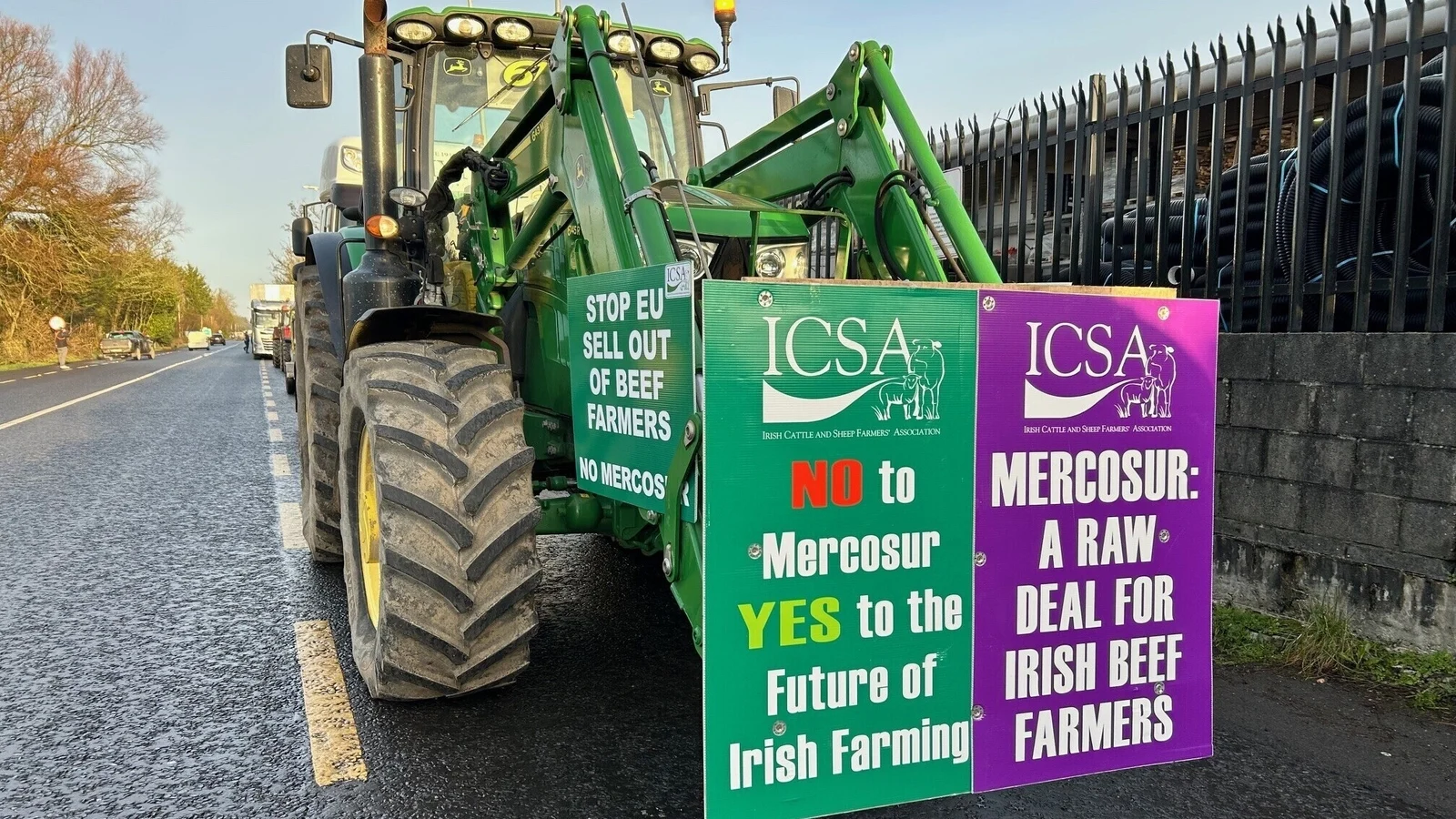
Contrast that with a tractor parked at a roundabout near Rouen, France, where peasant unions recently converged with banners: “Protect our farms” reads the cardboard. Marie Dubois, 52, has been driving tractors in protest across northern France. “Why should we compete with meat that may not follow our standards? We take pride in our methods. This deal puts families like mine at risk.”
These are not isolated voices. In recent weeks, thousands of farmers have demonstrated across Europe — from Ireland to Poland to Belgium — worried that a flood of cheaper imports could undercut domestic producers. Their grievances are economic, cultural and emotional: farming is not just a job, it is a way of life.
Numbers that matter
To ground the emotion in figures: the deal proposes tariff elimination on a vast majority of traded items between the two blocs. Annual goods trade between the EU and Mercosur has hovered in the tens of billions of euros in recent years, with the EU exporting machinery and vehicles while importing agricultural commodities from South America. The final text envisions preferential access for some of the region’s most emblematic products — Argentine beef, Brazilian soy, Uruguayan dairy — while opening markets for European industrial and luxury goods.
Yet these broad strokes hide important caveats. The agreement includes carve-outs and safeguards — temporary measures that allow either side to reintroduce tariffs if sudden surges in imports threaten domestic producers. The European Commission has also announced a crisis-support mechanism designed to cushion farmers during adjustment periods.
- Trade coverage: tariffs to be removed on over 90% of traded goods between the blocs
- Population reach: combined, the blocs touch roughly 700–750 million people
- Ratification hurdle: the treaty must still be approved by each Mercosur member and by the European Parliament — a process that is neither automatic nor guaranteed
Politics, resistance and the diplomacy of compromise
Inside Brussels, the vote to advance the agreement was not unanimous. A coalition of member states registered misgivings — driven largely by agricultural concerns and by domestic political calculations. Yet in the chess match of diplomacy, Italy’s decision to back the pact tipped the scales and allowed progress.
“Trade is politics made tangible,” says Dr. Ana Mendes, an international political economist. “Every tariff removed is a domestic constituency that gains access — and another that fears loss. This agreement is as much about signaling a return to global engagement as it is about tariffs.”
Within Mercosur, the treaty is being framed as an assertion of agency in an era where global powers alternately flirt with protectionism. “For the region it’s a chance to diversify markets,” a Paraguayan trade minister told me yesterday. “We are saying: we can be partners with Europe without forfeiting our independence.”
Environmental and social flashpoints
No modern trade deal can escape the environmental debate. Campaigners warn that greater agricultural exports from South America could amplify deforestation pressures unless strict traceability and sustainability commitments are enforced. Governments have countered with pledges to respect environmental standards, but trust is thin and monitoring will be crucial.
“If we’re serious about climate resilience, trade policy must be linked to land use and workers’ rights,” says Laila Ferreira, a sustainability analyst in São Paulo. “Otherwise, we risk exporting deforestation and importing consumption guilt.”
So what happens next?
After the ceremony in Asunción, the document will enter the political labyrinth: debate in domestic parliaments, scrutiny in the European Parliament, and public hearings in capitals across both continents. Some amendments, safeguards and supplementary accords are likely before the ink truly hardens into binding law.
And yet, regardless of the final legal pathways, the image itself — ministers from Buenos Aires to Brussels sharing a negotiating table, a handshake under the Paraguayan sun — will be a signal. It will say that, even in a time of fragmentation, large-scale cooperation is still possible.
Questions for the reader
What do you think: should trade open at the price of local disruption, or are there smarter ways to pair global markets with local protections? How should governments balance the livelihoods of farmers with the benefits of cheaper imports and increased exports for other sectors?
These are not technical questions: they are the questions of community identity, of how we feed cities, of how we value land and labor. The EU–Mercosur accord is more than a line in a ledger. It is a story in which millions of lives will write the next chapters. Will those chapters be equitable, green and prosperous — or will they reveal the limits of deals made at dawn beneath foreign flags? The signing on 17 January sets the stage. The work after the applause — that is where the real test lies.