When the lights go out: Kyiv’s winter under siege
The city felt smaller, a little more fragile, as night fell. Windows that once glowed with the yellow comfort of kettles and televisions now offered only the dim bluish reflections of phone screens. In one ninth-floor apartment on the left bank, a mother pressed a row of stuffed animals into the gap where cold wind streamed through a warped window frame — not toys, but battlefield implements against frost.
“You don’t think about hypothermia until you see it in your children’s chapped cheeks,” said Olena Petrenko, a primary school teacher who lives near Maidan Nezalezhnosti. “We are rationing heat like it’s food.”
This is Kyiv in mid-January: a capital that needs roughly 1,700 megawatts to keep its hospitals running, subways ventilated, boilers heated and millions from freezing. That figure — the electricity required to sustain a city of about 3.6 million people — is not an abstract model. It is the tally the mayor’s office has used to measure what is, in their words, the toughest energy emergency since the Russian invasion began nearly four years ago.
What happened
In a new wave of missile and drone strikes across Ukraine, critical parts of the country’s energy system were sabotaged. Repair teams — some sent by Kyiv’s international partners, some improvised from local brigades — have been running around the clock. Thousands of homes in Kyiv and frontline regions, including Dnipropetrovsk, Kharkiv and Odesa, were plunged into darkness. Authorities say a strike last week disrupted heating for around 6,000 apartment buildings; about 100 buildings remain without warmth.
“We are fighting a war of seconds,” sighed Vitali Klitschko, the mayor of Kyiv, during an interview in his office. “For the first time in our history, a city in such severe frosts has found most of its residents without heating and with a huge shortage of electricity.”
That shortage has translated into blunt, practical measures. Streetlights were dimmed to just 20% of normal intensity. Schools in the capital were ordered to close from January 19 until February 1 because classrooms cannot be heated reliably. Generators — the humming, hot-hearted machines of emergency life — have become currency, and the international community has rushed them to Ukraine.
The human toll
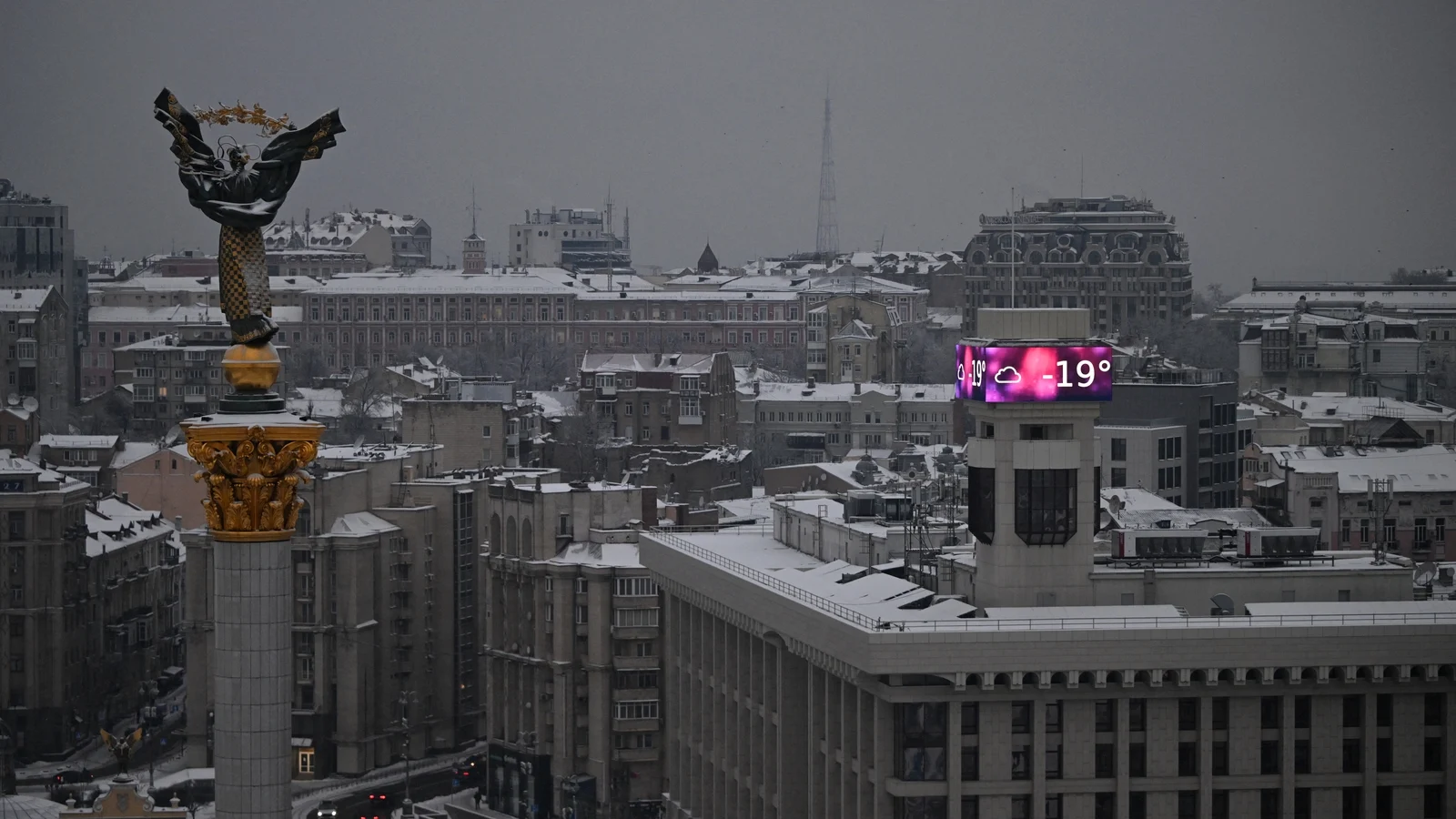
The statistics are sharp and clinical; the reality is ragged and cold. At night, temperatures around Kyiv have dipped to roughly -18°C. Hypothermia, frostbite and respiratory illnesses spike when heating falters and power is intermittent. Water supplies have been disrupted when pumping stations lose electricity. Hospitals strain to keep critical care devices online. A newborn in a neonatal unit, a dialysis patient, a school canteen that keeps warm soup flowing — all of them are vulnerable when the grid goes dark.
“Children and families are in constant survival mode,” Munir Mammadzade, UNICEF’s country representative in Ukraine, told reporters in Geneva. “People are trying to stay safe from strikes on high-rise buildings while temperatures plunge. We are racing to restore water and heating where we can.”
Jaime Wah, deputy head of the International Federation of Red Cross and Red Crescent Societies’ Kyiv delegation, added a stark human note: “It’s unbearable to live in apartments with no heating or electricity. Families are resorting to consider leaving the city.”
In some apartment blocks, neighbours huddle in a single warm room. In a high-rise on the left bank, two grandmothers and four children rotate between a rarely used electric kettle and a portable heater donated by a charity. “We sit close together and tell stories,” said Mykola, 68, who worked in the metro system for decades. “It keeps us warm in more ways than one.”
Supplies and limits
Kyiv’s energy precariousness is being managed on two ticking clocks. One is the availability of fuel: Ukraine’s energy minister has said the country has more than 20 days of reserves — a stretch that buys time but not certainty. The other is the availability of equipment and funding. Pre-positioned stockpiles of sleeping kits, generators and repair materials are running low because needs have ballooned and financing is strained.
UN agencies have sent high-capacity generators to hospitals and some schools, humanitarian groups report, but they warn that these are stopgaps. Repair crews need spare parts, transformers and protective equipment. The worry is blunt: without secure supplies and additional funding, more people will be pushed into danger by a long, freezing winter.
Politics, aid and the quest for a longer peace
Amid the chill and the blackouts, Kyiv’s political leaders have been shuttling between war rooms and international summits. President Volodymyr Zelensky’s team is en route to the United States for talks on security guarantees and a post-war recovery package, hoping to clinch documents on the sidelines of the World Economic Forum in Davos. Kyiv estimates that reconstruction will cost on the order of $800 billion — a jaw-dropping figure that would reshape conversations about European security and geopolitics for decades.
There are also tense diplomatic manoeuvres under way. Washington has pushed for a peace framework that it would then present to Moscow; Kyiv and many European partners insist a viable deal must ensure Ukraine cannot be attacked again. “Each strike against our energy infrastructure shows Russia’s real intentions,” Mr Zelensky said this week, arguing that recent attacks undercut any notion Moscow wants a negotiated peace.
Inside that debate are immediate operational needs. Mr Zelensky appealed for more air-defence munitions to protect the power grid and civilian infrastructure. “Some air-defence systems were left without missiles before a new aid package arrived,” he said. “We need to fight for these packages with everything we have — it is literally a matter of lives.”
What this means beyond Ukraine
When a capital’s lights go out, it is not only a local catastrophe. It is also a global signal: modern warfare increasingly targets the infrastructure that sustains daily life — not only military installations, but power plants, pumping stations and the arteries of civic life. That trend poses a profound humanitarian problem and a policy challenge for donors, insurers and governments worldwide.
How should cities build resilience when their utilities become targets? How do international law and humanitarian aid evolve when winter becomes another weapon? How do ordinary citizens — teachers, gas station attendants, grandparents — continue to live fully when the rules of peacetime are suspended?
These are not theoretical questions. They are the ones facing families in Kyiv right now as they swivel between cold and emergency warmth, news of diplomatic progress and the boom of distant strikes.
On the street
Outside, the city still hums in a skeletal way. A children’s playground in Lviv stands cordoned off after a falling drone. A bakery in Podil keeps its oven burning for those who come seeking hot bread and conversation. Volunteers organize routes to ferry generators across town. A patrol of electricians, bundled in reflective jackets, trudges toward a power substation with spare transformers on a flatbed truck.
“We are tired and cold,” said Hanna Kovalenko, a volunteer coordinator who has turned her living room into a distribution hub for heaters. “But we also know how to share. When the lights come back, it won’t be because of one person. It will be because a thousand small acts of care kept people alive.”
What you can do — and what policymakers must consider
- Support humanitarian agencies: UNICEF, the Red Cross and local charities are on the ground supplying generators, blankets and medical supplies.
- Push for investments in hardened infrastructure: insulated power lines, decentralized microgrids and protected pumping stations reduce single points of failure.
- Demand clearer diplomatic mechanisms: long-term security guarantees must be part of any recovery plan, otherwise reconstruction becomes recurring emergency relief.
When you scroll past footage of Kyiv’s darkened skyline, remember these details: the newborn in neonatal care, the teacher with stuffed animals in the window, the repair crew who have not slept. They are not statistics. They are the ledger of a winter that will test how the world protects civilian life in an age when war reaches deep into the systems we take for granted.
What would you do if the heat went out? How would you keep your neighbours safe? Kyiv’s winter asks these moral and practical questions of us all.