When Tariffs Meet Ice: How a Twitter-Style Ultimatum Threw Greenland and Europe into Crisis
On a winter afternoon that felt ordinary to the untrained eye, a short, blunt message set off a chain reaction that stretched from the fjords of Nuuk to the marble halls of Brussels.
The message came not from a formal diplomatic channel, but from a social media post: the U.S. president declaring a schedule of escalating tariffs against a list of European countries — unless Washington was allowed to buy Greenland. The words landed with the force of a thunderclap. Within hours, ambassadors from the EU’s 27 member states were summoned to an emergency meeting being convened under the six-month rotating presidency of Cyprus.
A sudden summons and a continent on edge
Cyprus’s late-night notice called EU envoys to an emergency session, set for 5pm local time. For diplomats used to hours of behind-the-scenes consultations and carefully calibrated communiqués, the speed of the response was itself a signal: something in the transatlantic relationship had broken open.
“We had to act immediately,” said one EU official speaking on condition of anonymity. “This wasn’t a policy paper or a phone call. It was a unilateral digital threat that could reshape trade and security in one paragraph.”
Why did Europe react so fast? Because the stakes were large and practical. The threatened tariffs — a 10% levy imposed from the start of February, rising to 25% from June — would hit imports from a list that included Denmark, Norway, Sweden, France, Germany, the UK, the Netherlands, and Finland. For many industries, that could mean disrupted supply chains, higher consumer prices, and a chilling effect on investment.
Greenland: more than ice and myths
To those who picture Greenland as empty white space on a map, the dispute is a sharp reminder that territory is never merely geography. Greenland is roughly 2.16 million square kilometers of ice and rock — the world’s largest island — and home to around 56,000 people, many of them Inuit (Kalaallit) who trace their presence there across centuries.
Greenland is part of the Kingdom of Denmark. It has internal self-rule and control over much of its domestic affairs; foreign policy remains a complicated dance between Nuuk and Copenhagen. That complexity, and the island’s strategic location in the Arctic — a region of increasing geopolitical attention as ice melts and new sea routes open — quickly turned what might have been a private negotiation into a continental confrontation.
“Our future should be decided by Greenlanders,” said a shopkeeper in Nuuk, who asked to be identified only as Marius. “Not by a list of tariffs or auctioneers from far away.”
Security anxieties and raw political theater
Washington’s message framed the threat as a matter of security: the island, the U.S. argued, could not be allowed to fall under the influence of competitors like China and Russia. But European officials pushed back, urging a recognition that Greenland’s status is enmeshed in NATO obligations and the political sovereignty of the Kingdom of Denmark.
“Applying economic punishment to allies for pursuing collective security is counterproductive,” said Britain’s prime minister in a public message. “This is not the route to stable relations among NATO partners.”
Across the Channel, France’s president declared the notion of such a purchase both unacceptable and threatening. “No intimidation will make Europe change course on matters of sovereignty or security,” he said, summing up a mood that shifted from disbelief to defiance in less than a day.
What legal levers are in play — and how fragile are they?
One of the most jarring aspects of the episode was the ambiguity. The U.S. leader issued the tariff timetable without citing a clear legal mechanism. Would the administration lean on national-security trade statutes, emergency powers, or some other authority? The absence of an immediately transparent legal path left lawyers, markets, and governments scrambling.
“Historically, presidents have invoked broad national-security provisions when they want to act fast on trade,” said a trade policy analyst who asked not to be named. “But those moves get litigated, and a domestic court could very well end up deciding how much power the executive really has.”
Indeed, the question of executive trade power is already the subject of fierce debate in U.S. courts and legislatures. Any attempt to put tariffs of 25% on favored trading partners would invite legal challenges — and a political backlash that could ripple through upcoming elections and transatlantic institutions.
Economy, politics, and the human cost
Beyond legal wrangling, the tariff threat has practical consequences. European automakers, agricultural exporters, and high-tech firms rely on steady access to U.S. markets. Small businesses that import specialty components could be crushed by sudden levies. Consumers might see price spikes. Economists warn of a classic tit-for-tat: a trade spiral that chills cross-border trade, investment, and trust.
“It’s not just numbers on a spreadsheet,” said an EU trade adviser. “There are factories, jobs, and families behind every percentage point.”
- Possible tariff levels announced: 10% from February; 25% from June.
- Targeted countries: Denmark, Norway, Sweden, France, Germany, the UK, the Netherlands, Finland.
- Greenland: ~2.16 million km²; population ~56,000; part of Kingdom of Denmark.
Voices on the ground and the protests that followed
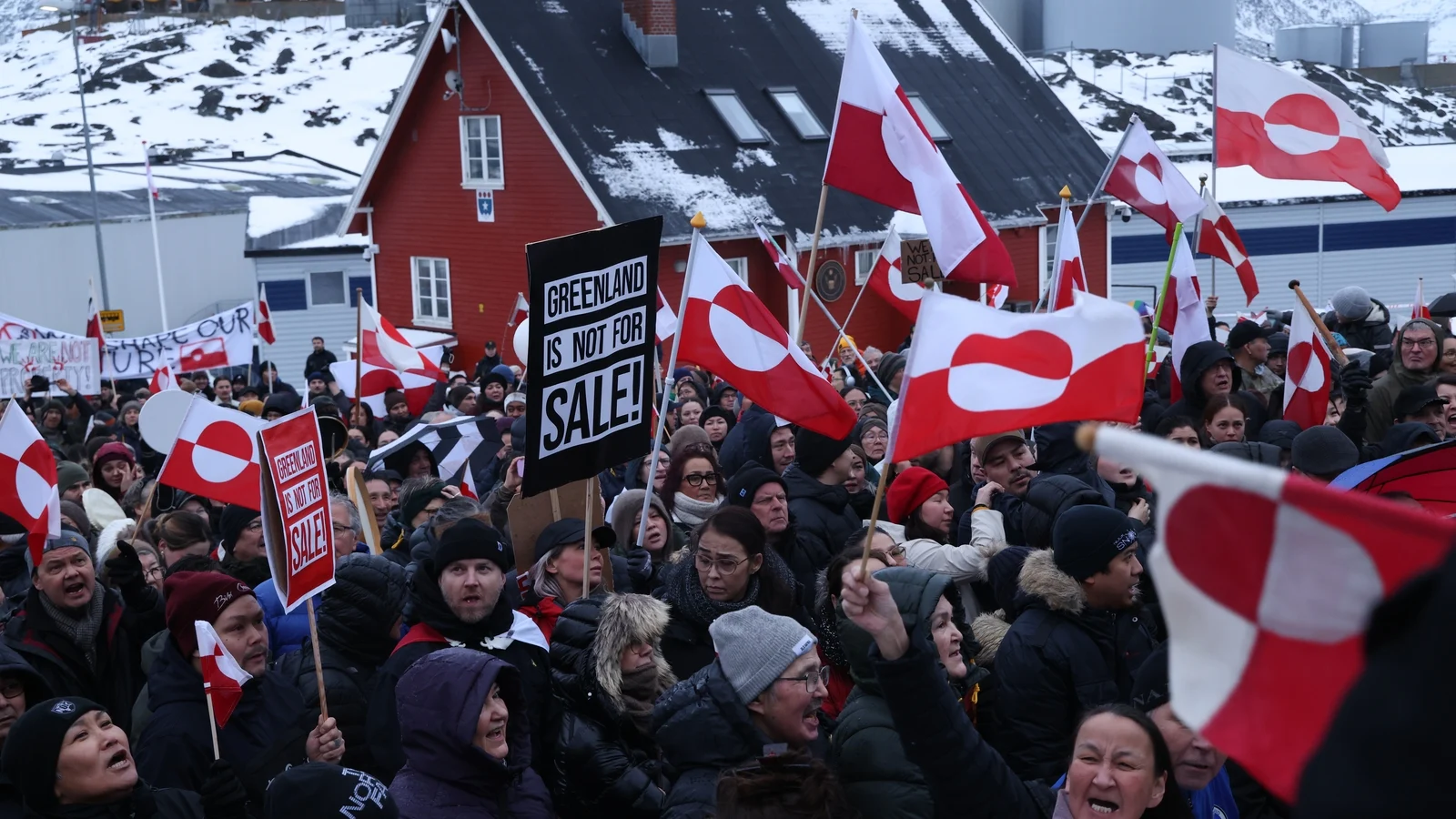
In Copenhagen, demonstrators poured into the streets chanting for diplomacy and dignity. In Nuuk, locals gathered to assert that their destiny belonged to them — not to foreign bargaining chips. A group of students organized a vigil, lighting candles and reading statements about indigenous rights and environmental stewardship.
“We are surrounded by the world’s largest ice sheet,” a student leader said. “Our climate, our economy, and our language are not negotiable.”
These scenes underscore a broader trend: across the globe, communities are refusing to be framed as objects of geopolitical chess. Indigenous governance, self-determination, and climate justice are part of the conversation now.
What happens next?
For now, the EU has pledged unity. The European Commission’s president warned that weaponizing tariffs against allies “would undermine transatlantic relations and risk a dangerous downward spiral.” The emergency meeting was meant to coordinate a response — whether diplomatic, economic, or legal.
But the larger question is less procedural and more philosophical. When great powers issue public ultimatums via social platforms, do we accept a new, noisier normal in which international law and precedent are replaced by instantaneous threats? Or do democracies find ways to reinforce institutions — alliances, trade frameworks, and courts — that can resist the drama of a single afternoon’s decree?
Ask yourself: would you want your country’s future decided in the same swift, unilateral way? What price are we willing to pay in trade, security, and trust to settle a territorial fantasy?
Beyond Greenland: a test for alliances and norms
This episode is about more than Greenland. It’s a litmus test of the rules that have governed international relations since the mid-20th century: mutual respect, predictable dispute settlement, and the idea that allies manage disagreements without threatening mutual ruin.
In a world where climate change is opening new strategic spaces and supply chains bind continents together, the old binaries — friend vs. enemy, home vs. foreign — are fraying. The response from Europe, from the Arctic, and from businesses and courts will help define whether decorum or disruption wins.
For now the ice remains, massive and indifferent, but what surrounds it — the people, the treaties, the commerce, and the alliances — is suddenly very fragile indeed.