Why a Vast, Icy Island Keeps Superpowers Dreaming — and Why That Matters to You
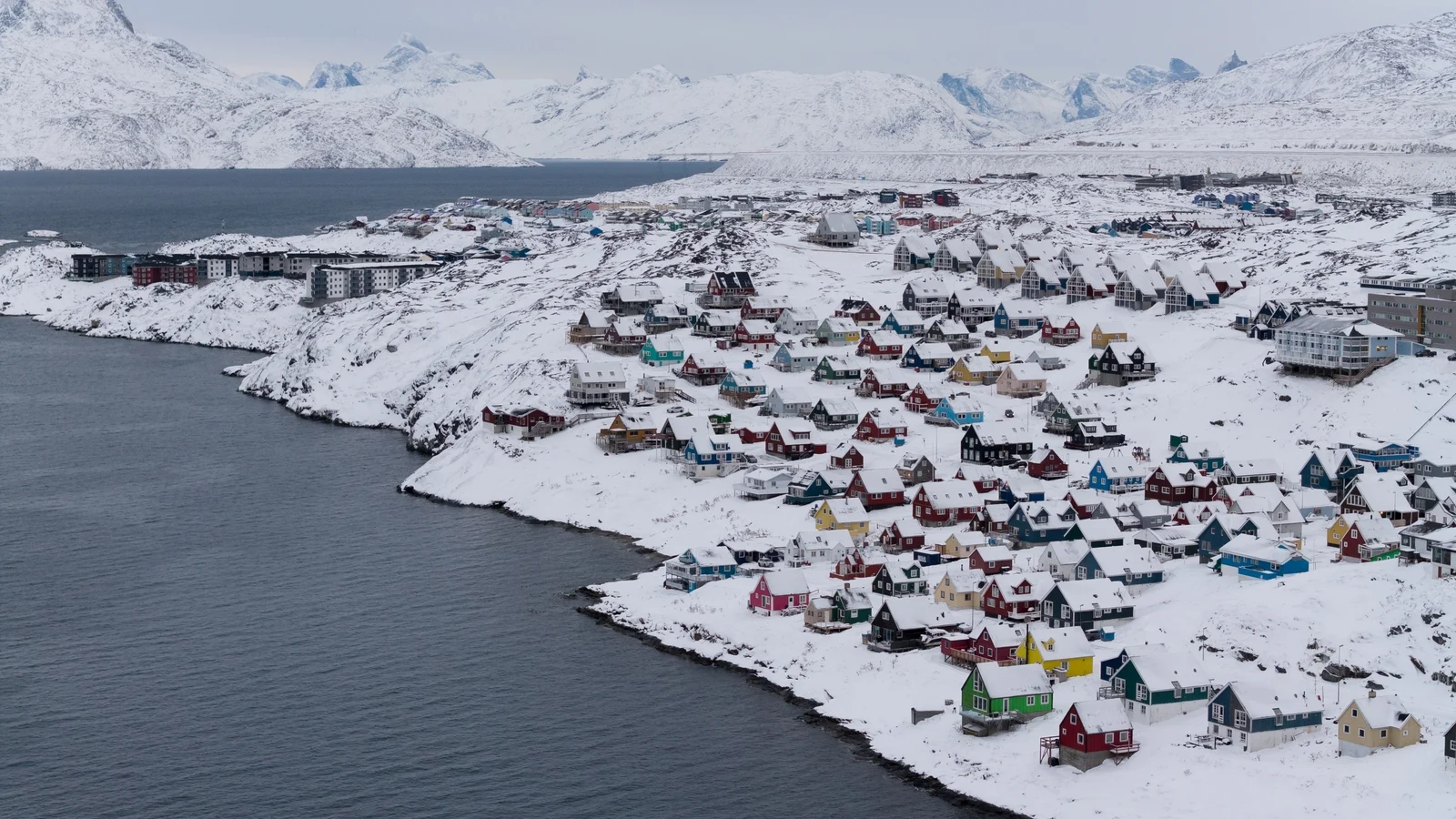
On a blustery morning in Nuuk, the capital’s seaside slope is a patchwork of brightly painted houses, fishing boats tied like beads along the quay, and the faint hum of a community that has always negotiated the edge of the world. A woman in a thick anorak cuts a piece of dried fish, hands it to a child, and glances at her phone. “They talk about buying our home like it’s real estate,” she says, shrugging into her scarf. “But this place is people and language and history.”
That blunt image — of Washington politicians eyeing a remote island as a strategic prize — returned this week when former President Donald Trump insisted, in stark terms, that “the world is not secure unless the United States has Greenland.” For anyone who follows geopolitics, it was familiar rhetoric: blunt, provocative, and designed to rip the conversation away from nuance and into headlines. But beneath the sound bites lies a knot of geography, climate change, indigenous sovereignty, and global power politics that matters far beyond Greenland itself.
A reminder of 2019, and a new echo in 2026
Those who remember 2019 recall the audacious episode: the U.S. president publicly musing about buying Greenland from Denmark. Prime Minister Mette Frederiksen of Denmark called the idea “absurd,” and the plan collapsed amid bemusement and anger. Yet the episode never really vanished. It resurfaced this week as politicians and commentators replayed older arguments with fresh urgency: Who controls the Arctic? Who has rights to its resources? And how does melting ice redraw the map of strategic advantage?
“It’s not just nostalgia for a headline,” a senior diplomat in Copenhagen told me off the record. “This is a strategic conversation disguised as an attention-grab. The Arctic is opening. New shipping lanes, new mineral claims, new military considerations — it’s all accelerating.”
Facts that anchor the drama
To understand why a roughly 2.16 million square kilometer island punches above its weight, here’s what matters:
- Greenland’s landmass: about 2.16 million km² — larger than India or Argentina, though more than 80% is covered by the Greenland Ice Sheet.
- Population: roughly 56,000 people, concentrated along the ice-free coastline in towns like Nuuk, Sisimiut, and Ilulissat.
- Political status: an autonomous territory within the Kingdom of Denmark, with control over many domestic affairs but with defense and foreign affairs historically handled by Copenhagen.
- Military footprint: the U.S. operates Thule Air Base (Pituffik) in northwest Greenland, a Cold War relic that now plays into missile warning and space-domain awareness.
Those bare facts are the soil beneath the rhetoric. But facts alone do not capture the lived reality of a place where the calendar follows the rhythm of the sea and the ice.
Local color and local voices
Walk any dock in Greenland and you hear a chorus: Norwegian-influenced Danish, Kalaallisut (Greenlandic), and a cosmopolitan mix of European and North American accents. You taste the sea in meals of halibut and king crab and see centuries of adaptation in sled lines, seal-processing sheds, and songs sung in small community halls.
“We have been asked the same question for centuries — who will decide our fate?” a community elder in Sisimiut told me, fingers tracing the worn knot of a dock rope. “It is one thing for distant capitals to debate maps. It is another thing entirely to decide if our mining lands will be opened for foreign companies, or if our culture will be traded like a coin.”
For many Greenlanders, the discussion is not abstract. Proposals to expand mining, especially projects targeting rare earth elements and uranium-bearing deposits (such as the controversial Kvanefjeld site), have split communities. Some see economic opportunity; others fear environmental damage and a loss of cultural autonomy.
Geopolitics on ice: why Greenland matters to world powers
There are several overlapping reasons Greenland is suddenly not just a dot on any map:
- Strategic location. Greenland sits astride the shortest transatlantic routes between North America and Europe, and has long offered high ground for surveillance and defense.
- Resources. Melting ice reveals new geological prospects — oil, gas, rare earth minerals — that are essential for modern technologies and green-energy transitions.
- Climate dynamics. The Greenland Ice Sheet is one of the largest contributors to global sea-level rise as it loses mass. How Greenland manages its environment affects coastal cities worldwide.
- Great-power competition. The Arctic is no longer a quiet neighborhood. NATO members, Russia, China, and the U.S. all have strategic reasons to be active in the region.
“If you want to talk about global security in the 21st century, you cannot ignore the Arctic,” a policy analyst in Oslo said. “From satellite control to undersea cables to shipping lanes — it’s all interconnected.”
What the rhetoric hides
When a leader says “the world is not secure unless we have X,” the clause obscures a smaller, sharper fact: sovereignty is not a commodity. For Greenlanders, sovereignty is not merely the right to be counted in global equations but the right to decide how development happens. The autonomy granted by Denmark in 2009 gave Greenlanders more control over domestic affairs — but foreign pressure remains a daily reality.
Consider the human scale: a young nurse in Ilulissat told me about friends who left town for university in Denmark and didn’t return, lured by jobs and education. “We watch our children drift to the south,” she said. “We need opportunities here. But opportunities that make room for our language, for our elders, for the sea.”
Questions for the reader — and for leaders
What do we mean by “security” in a warming world? Is it primarily military dominance, or is it the resilience of communities, ecosystems, and food systems? How should wealthy nations balance strategic interest with respect for indigenous rights and democratic self-determination?
These are not hypothetical queries. They are decisions that touch neighborhoods as remote as Upernavik and as urban as New York. The choices made in capital corridors cascade into the lives of fishermen, shepherds, and students in Greenland.
Paths forward — and the stakes
There are no easy answers, but there are approaches that can reduce friction and raise shared benefit:
- Center Greenlandic voices in decisions about land use and foreign investment; meaningful consent matters.
- Invest in local education, health, and infrastructure tied directly to community priorities rather than extractive projects dictated by outside firms.
- Increase transparency about military activities and ensure they do not undermine civilian life or environmental protections.
- Coordinate internationally on Arctic protection regimes that balance economic needs and ecological limits.
“We need partnership rather than purchase orders,” a Greenland-based environmental campaigner told me. “Security isn’t achieved by owning land; it’s achieved by ensuring communities can thrive in place.”
Why the story matters beyond headlines
Talk of territorial acquisition may feel like a relic of 19th-century diplomacy, but the underlying currents are unmistakably modern: strategic competition fused with climate urgency and the struggle of indigenous peoples to control their futures. When a former U.S. president asserts that global safety depends on possessing Greenland, it forces a question: Are we defining security narrowly enough?
As the summer sun slides across the fjords and the ice continues its slow, undeniable retreat, Greenland will remain at the crossroads of many global dilemmas. The island’s fate is not a spectacle to be bought or a toy for television debates. It is the living story of a people and a landscape that, for better or worse, will shape the safety and seas of us all.