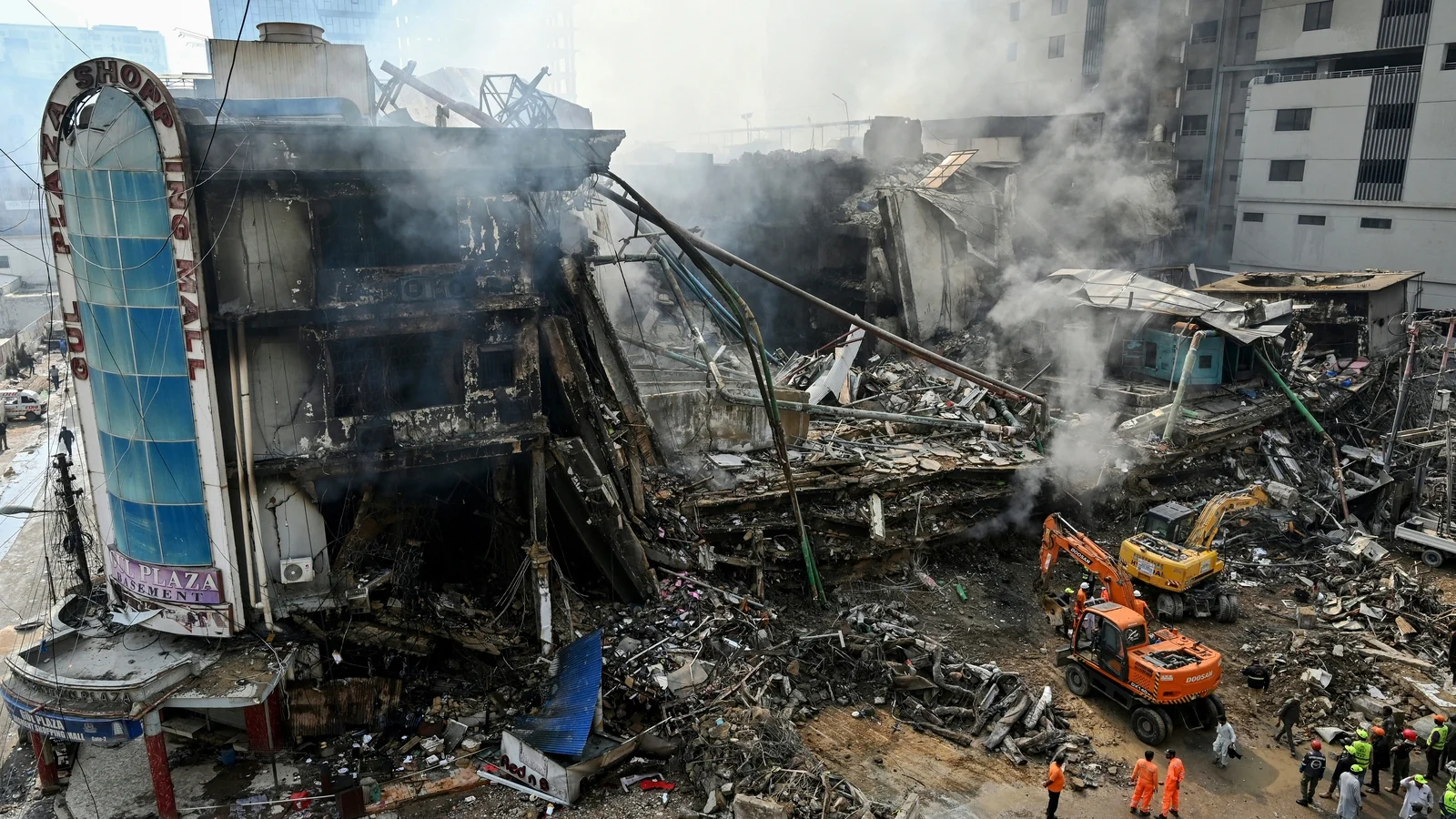
When a Mall Became a Furnace: The Night Karachi Lost Part of Itself
There are images that clamp onto the mind: a sky bruised orange, shop signs sagging like wounded teeth, a rain of molten metal pattering onto the street. That was Karachi on Saturday night — the historic heart of this vast, humming city lit not by neon but by a blaze that consumed Gul Plaza, a multi-storey market the size of a football field and home to roughly 1,200 small businesses.
The blaze and the long, hot rescue
The first emergency call came at 10:38pm local time. By the time the fire crew arrived, flames had already leapt up the façade and into floors above, turning corridors into tunnels of smoke. Firefighters wrestled with the inferno for more than 24 hours; only after they cooled and shored up the remains did cranes begin pulling down what was left — not just to salvage evidence, but because the building threatened to collapse.
Officials say at least 21 people are dead and dozens remain missing; rescue teams were still recovering bodies today, placing human remains into sacks for DNA testing. Mohammed Ameen, coordinating operations for the Edhi emergency services in the chaos of the site, said simply, “We’re finding what the fire leaves us. We’re finding pieces that must be matched to names.”
Hundreds — relatives, vendors, neighbours — circled the rubble, watching as teams cleared twisted metal, boiled-off air-conditioning units, and charred shop fronts. “I can’t describe it,” said Yasmeen Bano, a shopowner whose fabric stall had stood for 20 years. “Twenty years of work, gone in one night. We have nothing left.”
Faces of loss and fury
Among the missing are entire family groups. Qasir Khan told reporters his wife, daughter‑in‑law and her mother had gone shopping at Gul Plaza on Saturday evening and never returned. “The bodies will come out in pieces from here. No one will be able to recognise them,” he said, his voice a combination of fear and accusation: “They could have saved a lot of people.”
Grief lived side-by-side with anger. When Karachi’s mayor, Murtaza Wahab, visited the scene, the crowd chanted anti-government slogans, demanding answers about response times and safety enforcement. “They could have been here sooner,” a woman shouted. “My sister phoned and said they would be home in 15 minutes. That was the last we heard.” The woman, Kosar Bano, said six of her relatives had gone to shop for a wedding; now the family waits for what the forensics will reveal.
What went wrong: smoke, wiring, and cramped corridors
Firefighters at the scene described how Gul Plaza’s lack of ventilation turned corridors into smoke-traps. Thick, toxic fumes filled stairwells and choked rescue efforts; the heat made every minute feel like an hour. Provincial police chief Javed Alam Odho suggested an electrical fault may have triggered the fire, but Sindh’s chief minister, Murad Ali Shah, cautioned that the exact cause was still under investigation. “I’m admitting that there are faults. I can’t say whose fault this is. An inquiry will be conducted and heads will roll,” he said — a promise that has become ritual after urban tragedies.
Structural hazards multiplied the danger: stacked merchandise, narrow aisles, and blocked emergency exits—conditions common across many older markets where safety regulation is, at best, inconsistently enforced. A firefighter on rotation, wiping sweat from his brow, said, “You can train all you want, but when every corridor is full of goods it becomes a coffin.”
Rescue, recovery, and the small army of volunteers
Right alongside official crews were volunteers – charity ambulance teams, neighbors with flashlights, and the well-known Edhi volunteers who move through Karachi’s tragedies with practiced calm. “We carried people out, we comforted families, and now we help find the names,” said Ameen of Edhi. “This is what Karachi does — we hold each other when it hurts.”
Medical services reported about 80 injured, with some already released. Recovery teams, exhausted from heat and smoke, paused often to drink water and steady themselves. Forensic teams face the grim task of identification: many bodies must be matched through DNA, a process that may take weeks and will demand both patience and dignity.
Echoes of a darker history
This is not the first time Karachi has watched a fire consume livelihoods. The city’s largest blaze in recent memory tore through an industrial site in 2012, killing more than 260 people; a court later concluded that disaster involved arson. Fires in dense urban centers expose a recurring tension: the informal economy that makes cities like Karachi vibrantly alive also makes them dangerously flammable.
Karachi today is a metropolis of roughly 16 million people — a mosaic of languages, trades, and neighborhoods built partly out of necessity and partly out of entrepreneurial grit. Markets like Gul Plaza are microcosms of that economy: clothing vendors shoulder the city’s sartorial needs; electronic shops rewire countless homes; tailors, seamstresses and couriers weave livelihoods that feed families across the country.
What must change?
Stories like this force hard questions: How do we protect lives and livelihoods in crowded cities? How do we ensure that building codes don’t become suggestions? How do emergency services get the resources and infrastructure they need to respond before a fire becomes a catastrophe?
- Stricter, enforced building inspections focused on emergency exits, electrical safety and ventilation;
- Mandatory fire suppression systems and accessible escape routes for multi‑storey markets;
- Training programs for shopkeepers and market managers in evacuation and fire prevention;
- Investment in city firefighting capacity — faster dispatch, better equipment, and more hydrants in dense commercial zones.
Dr. Amina Nasir, a fire-safety engineer who has studied urban markets in South Asia, told me, “Regulation without enforcement is like a textbook in a locked room. You can have all the codes, but if there’s no follow-through, people pay with their lives.”
Holding the scene, holding each other
In the coming days, families will gather around makeshift lists of the missing, the tired will sleep in shifts at entrance gates, and forensic technicians will try to reconstruct identities from fragments. There will be official investigations, promises, and perhaps a report that draws lines of blame. There will also be ordinary acts of care: neighbors bringing hot tea, shopkeepers pooling money to feed the rescue teams, volunteers staying past exhaustion to sort through papers and photos.
As you read this from wherever you are — a city of glass towers or a town with one central market — consider the fragile architecture that connects people to their livelihoods. What would you do to protect a marketplace in your neighborhood? What systems would you demand be in place so a single spark cannot erase decades of work?
For the families outside Gul Plaza tonight, the questions are more immediate: which hands will be found? Which names will be called? For a city that survives on the work of millions, the answers will shape how Karachi rebuilds — not only brick by brick, but in the laws and practices that decide whether a market is safe or a trap.
And so the city waits — for bodies to be named, for investigations to begin, and for a quieter kind of reckoning: the one that decides whether an avoidable tragedy truly becomes a turning point.