A Trade Pact in the Balance: Europe, South America and the Two-Year Pause
There was a hush in Brussels that felt more like the held breath of a continent than a single institution. On paper, the European Union had just signed what officials called its biggest trade agreement ever with four South American partners—Argentina, Brazil, Paraguay and Uruguay. In practice, European lawmakers pressed the pause button.
By a slender margin—334 votes to 324—Members of the European Parliament voted to refer the deal to the Court of Justice of the European Union (CJEU) to seek clarity on whether the agreement fits the bloc’s legal and policy framework. The move does not kill the pact outright, but it is likely to stall implementation for roughly two years, the typical time the court takes to offer an opinion.
Why the Referral Matters
At heart this is a story about competing visions of trade. Brussels touts a pact that would tear down tariffs on more than 90% of bilateral trade between the EU and Mercosur, promising easier market access for European cars, wine and cheese and broader economic ties across an economic area that together accounts for about 30% of global GDP.
Opponents, led politically by France and echoed by Ireland, Austria, Hungary and Poland, warn that the treaty will flood European markets with cheaper South American beef, poultry, sugar and soy—products that could undercut local farmers and accelerate environmentally harmful land use practices. “This is not just about prices,” said a French dairy cooperative leader in Brittany. “It’s about the future of our villages, our cheese, and the way we farm.”
A legal knot
A group of 144 MEPs has lodged a formal challenge asking the CJEU to determine whether parts of the agreement can be applied provisionally before every member state completes full ratification, and whether the treaty would restrict the EU’s ability to set future environmental and consumer-health protections.
“We need to be certain that the EU retains full sovereignty to enact stricter climate rules, food standards, and protections for biodiversity,” said an environmental policy adviser in Brussels. “Handing over commercial breathing room that could block those laws would be reckless.”
On the Ground: Kitchens, Pastures and Protest Lines
Walk through a market in Lyon or Bordeaux and you will smell warm bread and melting cheese; walk the streets of Buenos Aires and you will find the smoky scent of asado—grilled beef—wafting from parrillas. Trade pacts like this one are not abstract documents. They rearrange what ends up on family tables and alter livelihoods from village cooperatives to export-oriented agribusinesses.
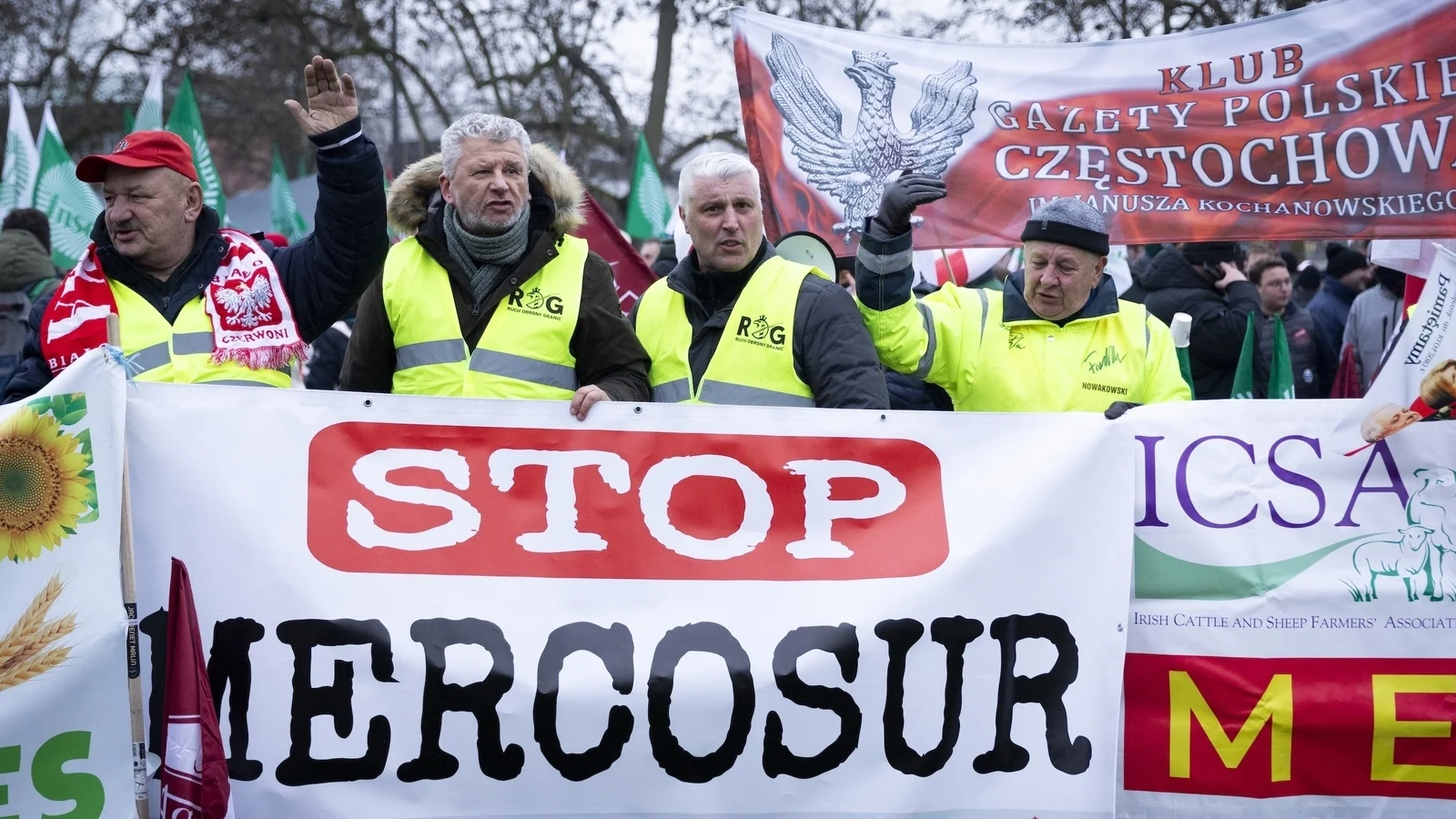
In recent weeks, thousands of farmers have taken to the roads in France, Ireland, Austria, Hungary and Poland. Tractors have clogged roundabouts, hay bales have been parked in front of government buildings, and the message has been blunt: European agriculture is fragile and price-sensitive. “We welcome trade, but not at the cost of our ability to survive,” said a young dairy farmer in County Cork, Ireland, who joined a demonstration with a banner that read, “Fair Trade, Not Cheap Goods.”
On the other side of the Atlantic, exporters see opportunity. A soybean cooperative president in northern Argentina told me, “For years we have produced more than we could sell locally. Opening to Europe is a chance for farms here to stabilize and grow.” Yet even in South America, concerns simmer. Smallholders recall past waves of commodity demand that enriched large exporters while leaving local communities facing deforestation and volatile prices.
Local color and stakes
The cultural texture of this debate matters. In France, protecting terroir—the unique taste of a region’s wines and cheeses tied to place and tradition—has become shorthand for defending identity. In Brazil and Argentina, the pampas and cerrado carry histories of land use, migration and modern agribusiness expansion. Those landscapes are also frontline battlegrounds in the climate crisis: agriculture accounts for a substantial share of greenhouse gas emissions globally, and changes in land use are a leading driver of biodiversity loss.
What the Agreement Would Do—and What It Wouldn’t
Here are the headline mechanics that animate the dispute:
- Tariff elimination: The treaty foresees scrapping duties on more than 90% of bilateral trade, which would ease the flow of goods both ways.
- Winners and losers: European exporters of cars, machinery, wine and cheese stand to gain greater access. South American suppliers of beef, poultry, sugar, rice, honey and soy would find it easier to sell into EU markets.
- Legal and environmental questions: Opponents argue the text could limit the EU’s future regulatory freedom on issues such as pesticide bans, meat production standards and deforestation-linked imports.
The European Commission said it regrets the Parliament’s decision to seek an opinion and insisted the deal is compatible with EU policy. “We remain committed to making trade work for people, for the planet and for European businesses,” a Commission spokesperson said in a statement. But regret does not equate to immediate action; the referral hands the clock to the judiciary.
Beyond Tariffs: A Test of Values
This is more than economics. It is a test of whether trade policy can be married to environmental and social aspirations. In a world confronting a faster-warming climate, accelerating biodiversity loss and rising inequality, the pressure on trade agreements to embed safeguards is fiercer than ever.
“Trade is a blunt instrument if it only measures profit,” reflected a Geneva-based trade scholar. “We have learned from past deals that without enforceable standards, the benefits tend to concentrate and the costs are social and ecological.”
Two Years of Uncertainty—What Comes Next?
With the CJEU review likely to take around two years, stakeholders will have time to lobby, protest, and rethink. Member-state ratifications will still be required. That interregnum may be used to reopen political conversations about how to strengthen environmental clauses, ensure traceability of supply chains and build transitional measures for vulnerable farmers.
Will that be enough to bridge the gap between Brussels and rural France, between Buenos Aires exporters and Amazon stewards? Only time will tell. But the referral has at least bought a continent a breathing space to ask the harder question: what kind of globalization do we want?
As you read this, consider your own plate. Where does your cheese come from? How far did that steak travel? Trade deals shape the food on our tables, the air we breathe and the futures our children inherit. The debate over this pact is not just a parlamentarian tussle; it is a public conversation about values. Will governments write trade rules that privilege short-term growth, or can they build bargains that protect communities and the living planet?
There will be rallies and rejoicing, columns and counter-briefs, and perhaps a verdict from the court that changes the shape of the agreement. Whatever happens, the story of this pact will be a prism through which we can see how the world balances commerce with care. Will policymakers listen to the market—and to the people who live in farmhouses and favelas alike? The coming months will tell.