Char and Silence: Inside the Gul Plaza Tragedy and a City That Knows This Pain
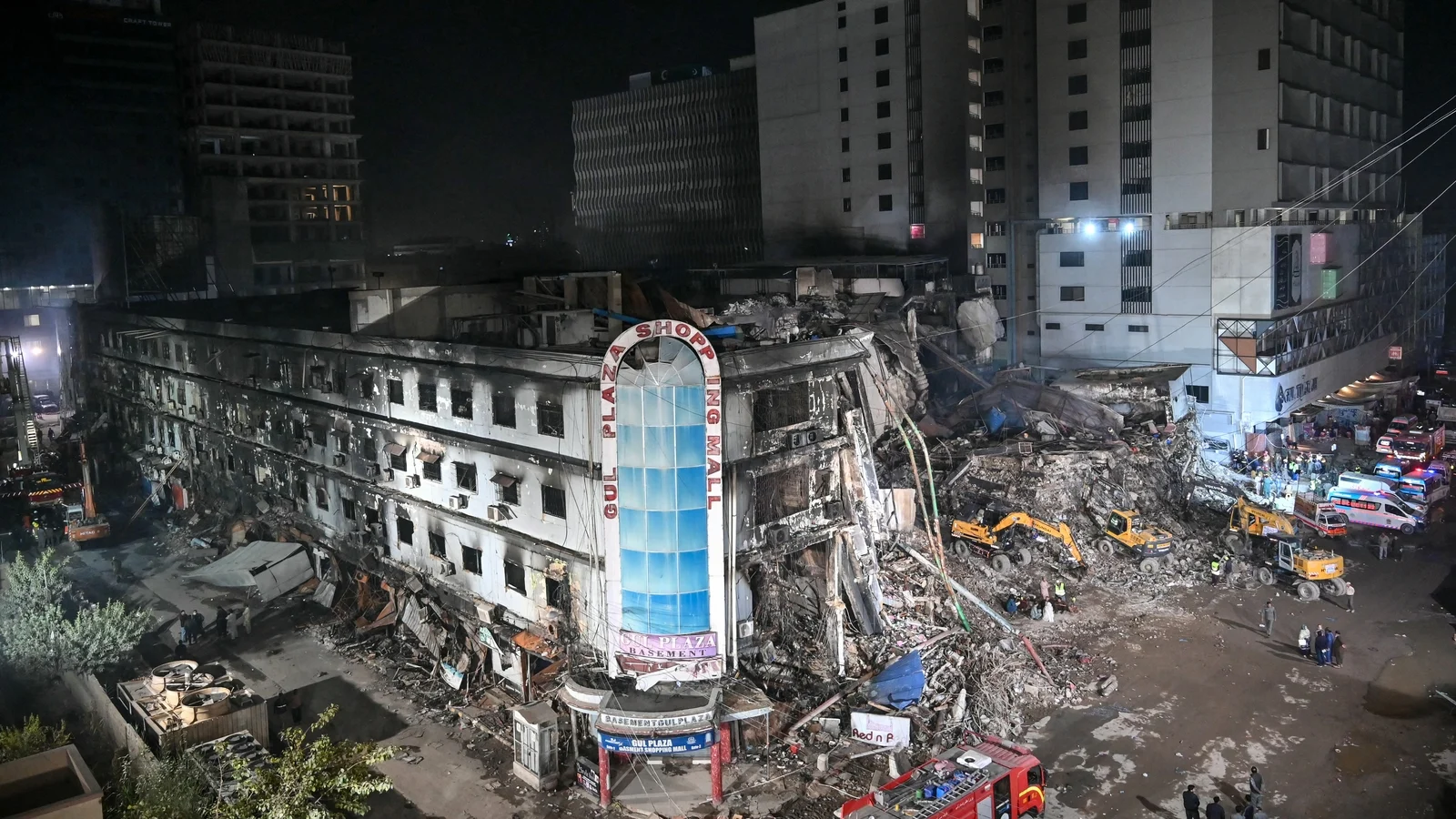
The air in south Karachi tastes like ash and questions. Blackened metal frames jut from the gutted facade of Gul Plaza, a modest three-storey shopping complex that until Saturday night thrummed with cloth merchants, small electronics stalls and the low, familiar hum of commerce in Pakistan’s largest city.
By the time the flames were doused, at least 55 people had been confirmed dead and dozens more were unaccounted for, officials said. Rescue teams, police and stunned families have been working through the rubble ever since—searching, cataloguing, calling names into scorched corridors where the world still echoes of lives abruptly stopped.
Scenes of grief at the mortuary
Outside the Civil Hospital Karachi mortuary, crowds gather with the sort of quiet that feels intolerably loud. There are mothers with scarves tied tight under their chins, children holding onto relatives’ sleeves, men who pace or sit with their faces in their hands. Dozens have provided DNA samples to help identify remains that are, in many cases, too badly burned for visual recognition.
“I just want them back. If it is a hand, a shoe, anything—let us bury them. Let us say goodbye properly,” said Faraz Ali, his voice thin and urgent. He is one of many who lost family members; his father and his 26-year-old brother had been at the mall. “We need to know who is where. We need to have some peace.”
Provincial health official Summaiya Syed told journalists that more than 50 families had provided DNA samples so far, a painstaking process that delays the last small mercy of closing a life with a name and a burial. “We will hand over the remains once DNA samples are matched,” she said, underscoring the grim, clinical work that accompanies sorrow in disasters like this.
What happened — and what we still don’t know
At the moment, the exact spark that turned a busy shopping centre into a tomb remains unclear. A government committee has been formed to investigate, and forensic teams are combing through wiring, signage and survivor testimony for clues. Fire experts and witnesses point to a combination of factors that frequently conspire to make urban fires catastrophic: overloaded electrical systems, lack of functioning fire exits, congested stairwells stacked with goods, and delayed emergency responses.
“When a building is packed with stock and people, and exits are blocked or nonexistent, a small ignition can become lethal in minutes,” said Dr. Aisha Mir, a structural safety researcher who has studied urban fires in South Asia. “What often gets ignored is prevention—inspections, enforcement of building codes, simple things like keeping escape routes clear.”
Data and context
Karachi is a metropolis of roughly 16 million people, a city whose density and informality are part of its energy—and its vulnerabilities. Fires occur across Pakistan’s cities with worrying frequency, particularly in markets and informal industrial zones where oversight is weaker. While large-scale infernos like Gul Plaza remain relatively rare, smaller fires that claim lives or devastate livelihoods are tragically common.
Official statistics on urban fire incidents in Pakistan are fragmented; many local governments lack comprehensive, public databases. But the pattern is unmistakable to anyone who tracks infrastructure failures: regulatory gaps plus aging electrical grids plus ever more crowded commercial spaces create a tinderbox.
Voices from the rubble
At the scene, survivors and rescuers share a vocabulary of shock—the smell of burning plastic; the impossible warmth of metal rails even hours after flames have cooled; the reverberating sound of someone calling a loved one’s name into a pile of twisted shops. Shopkeeper Yasmin Bibi, who manages a small textile stall two blocks from Gul Plaza, spoke of a neighborhood in mourning.
“We have been coming here for twenty years,” she said, wiping her eyes. “These were not only businesses—these were people’s lives. We are a community. When one shop burns, everyone feels it.”
A volunteer firefighter who has worked in Karachi for over a decade, requesting anonymity, was blunt about the systemic problems. “We do our best, but we are under-resourced. We need better equipment, more training, and the municipality must enforce codes. Until that changes, nothing about this will be surprising.”
Beyond the immediate: accountability, prevention, and what the survivors need
Calls for accountability are rising even as rescue teams continue the grim task of recovery. Families want more than explanations; they want tangible changes that reduce the chance this will happen to someone else. They want swift identification and dignified handovers so they can bury their dead and begin to grieve publicly rather than in limbo.
“Talk of investigations comforts no one until results come and something changes,” said Naveed Khan, a local civil society activist who has campaigned on building safety. “We need transparent timelines, public audits of the building code compliance of all such complexes, and immediate relief for the victims’ families.”
In practical terms, victims will need legal aid, counselling, and financial support—particularly in a local economy where small shop earnings are family lifelines. International donors and non-profits often step in after disasters, but long-term prevention requires a sustained political will at the municipal level.
What can be done?
- Regular, public safety inspections of commercial buildings and markets, enforced with penalties and closure orders where necessary.
- Upgrading electrical infrastructure and training shop owners in basic fire-risk reduction.
- Investment in municipal firefighting capacity—both equipment and staffing.
- Community education campaigns so residents know evacuation routes and how to act in the critical first minutes of a fire.
Looking outward: a city’s resilience, a global pattern
This is not just a Karachi story. Around the world, fast-growing cities in the Global South wrestle with infrastructure that struggles to keep pace with population, commerce and climate stress. When governance, enforcement and investment lag, small failures become disasters.
So, what should you feel as you read this, sitting miles away? Maybe helplessness. Maybe anger. But ask this other question: what would your city do differently? If the insurance, zoning, and emergency systems were on trial, would your neighborhood pass?
Closing—small rituals, larger hopes
For now, rituals of mourning are beginning. Relatives are making frantic phone calls, clerics are beginning the prayers for the dead, and neighbors are offering space, food, and shelter. The DNA testing will take time; identities will be confirmed, and funerals will come. And after the immediate fall of ash and grief settles, the harder work will begin: demands for accountability, the slow grind of policy change, and, one hopes, real efforts to prevent another fiery morning that ends too soon.
“We don’t want promises; we want measures,” said Yasmin as she folded a small cloth into a fist. “If this place can burn like that, any place can. We want our city to be safer for our children.”
Gul Plaza is still a smoldering silhouette on the south Karachi skyline. The city will rebuild—it always does—but the question that lingers is whether it will rebuild differently. Will lessons be learned, or will the next headline trace out the same terrible lines? The answer will say as much about Karachi’s future as the smoke that now hangs over it.