When the Sky Turned Red: Riding a River of Light from Space to Shore
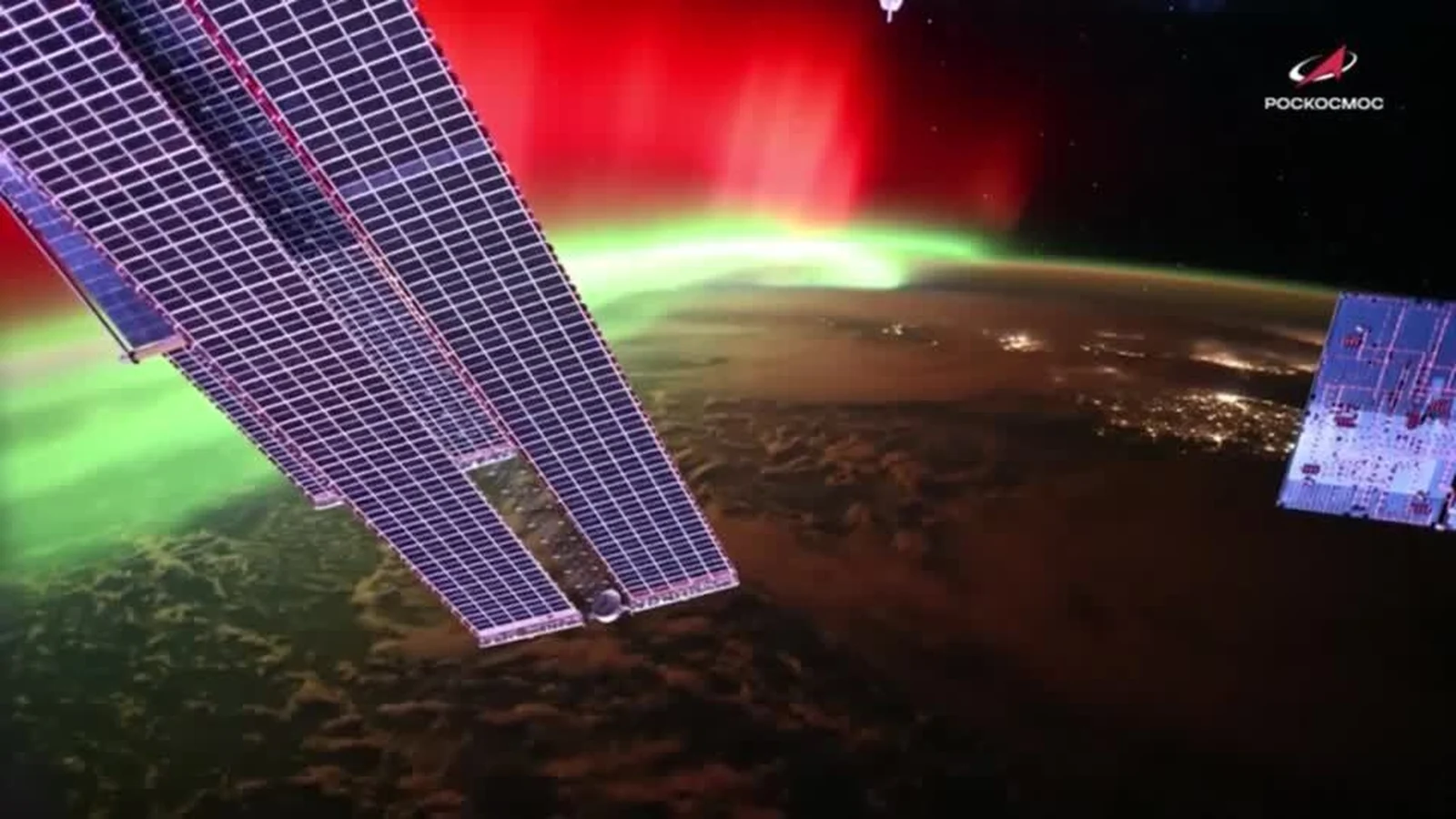
It began as a whisper on social feeds — a streak of crimson unfurling above the curvature of Earth — and quickly became a chorus. High-definition video from the International Space Station showed bands of light folding and flowing like a slow, otherworldly ocean. Back on the ground, people stepped out of kitchen doors and pubs, phones held up against cold air, mouths open in that soft, stunned silence that comes when something ordinary is made sacred.
“We were sailing inside that light,” wrote one of the crew members aboard the station, describing the sensation of watching the aurora from orbit. The video he sent — miles of red and green spilling beneath the ISS — made the familiar scientific explanation suddenly intimate: charged particles from the Sun, racing across space, colliding with atoms high in our atmosphere and turning invisible energy into color.
Why the lights looked like fire
Auroras are not a light show orchestrated for Instagram. They are the visible signature of space weather: when the Sun spews plasma in a coronal mass ejection or intensifies its solar wind, electrically charged particles spiral along Earth’s magnetic field and slam into oxygen and nitrogen atoms. The specific colors you see depend on which gases are struck and how high up the encounter happens. Oxygen gives us the familiar neon-green at roughly 100–150 kilometers above the surface; at higher altitudes, rarefied oxygen can yield an eerie red. Nitrogen supplies blues and purples.
“People marvel at the prettiness, but the physics is brutal and beautiful,” said Dr. Elena Vargas, a space-weather researcher. “What you’re watching is particles, sometimes traveling hundreds of kilometers per second, dumping energy into the atmosphere. The scale of that transfer is enormous.”
Storms, scales, and what “strongest in two decades” really means
News feeds called it the most intense geomagnetic storm in roughly 20 years — a shorthand that captures public imagination. In the technical language of space weather, storms are measured by indices such as Kp and categorized from G1 (minor) to G5 (extreme). When the aurora reaches latitudes normally reserved for mid-latitude countries — when people in Dublin or northern England see shimmering curtains — it generally signals a major disturbance in Earth’s magnetic environment.
These disturbances are more frequent during the Sun’s 11-year activity cycle. We are currently living in the upswing of Solar Cycle 25, which has produced above-average activity compared with some past cycles. That rising activity makes dramatic auroral displays a more common headline than they might have been a decade ago.
From the ISS to the Irish coast: moments and voices
The footage from space was arresting, but the human stories down below made it real. In a seaside town on Ireland’s west coast, a fisherman named Sean O’Mahony left his nets and walked out onto the pier with his wife and toddler.
“We’ve had Northern Lights before, but this — it looked like the sea had climbed the sky,” he said. “Molly wouldn’t stop laughing; she kept pointing and shouting, ‘more, more!’ It’s something you keep.”
In Galway, an amateur photographer named Aoife Brennan described balancing a tripod between gusts of wind to capture streaks of crimson above the distant outline of Connemara mountains. “People at the pub spilled out and began clapping like it was a concert. Someone started singing an old sean-nós tune. It felt like the whole town forgot its phone bills and went to look at the sky.”
Local color and folklore: how communities make meaning
Across cultures, auroras carry stories. In Irish folklore, the lights have been linked to the Otherworld — omens of change or the handiwork of fair folk. In the Arctic, Sámi and Inuit traditions have long woven auroral displays into myth, sometimes seeing them as spirits of the dead or as a sign to be treated with respect. Those narratives don’t clash with science; they layer human meaning atop cosmic mechanics.
Not just beautiful — potentially disruptive
For all the wonder, space weather has teeth. Strong geomagnetic storms can induce currents in long-distance power lines, interfere with GPS and satellite communications, and increase drag on low-Earth-orbit objects. Airlines sometimes reroute polar flights to avoid communication blackouts. In 1989, a geomagnetic storm collapsed Quebec’s power grid for hours. In 2003, the “Halloween storms” knocked out satellites and disrupted radio.
“A spectacular aurora is a telltale of energetic processes that can affect infrastructure,” warned Dr. Vargas. “We’re seeing more of these events as the Sun wakes up, and it’s a reminder that our technologies are embedded in a space environment.”
- Quick facts: Auroras occur in roughly oval regions around Earth’s magnetic poles called auroral ovals.
- Oxygen emissions: green at about 557.7 nm; red emissions at higher altitudes produce crimson tones.
- Geomagnetic storm scale: G1 (minor) to G5 (extreme); the Kp index ranges from 0 to 9.
Why this matters beyond the spectacle
There’s a larger arc to this story: humanity’s relationship to a star that both sustains and sometimes disrupts modern life. As our dependence on satellites, global positioning systems, and electrical grids grows, so does our vulnerability to solar tantrums. Yet those same solar storms gift us some of the most profound natural beauty many of us will ever see.
Does that contradiction — vulnerability and beauty in the same event — change how we think about technology and nature? Perhaps. It nudges us to treat the sky not as a backdrop but as an active participant in our shared infrastructure and culture. It also requires investment: better forecasting, hardening of critical systems, and international cooperation to protect assets in space and on Earth.
When the next curtain falls
As you read this, scientists on the ground are combing through data from satellites and magnetometers, translating flickers on a screen into actionable forecasts. Amateur skywatchers are cleaning lenses and checking forecast maps. And somewhere, a child who watched the sky catch fire is likely to be a little more awake inside, carrying that image forward.
So, what will you do the next time the night seems to glow unnaturally? Will you step outside and wait with your neighbors? Will you look up and let a celestial phenomenon remind you how small and connected we all are?
When the Sun reaches for us with particles and light, the Earth answers with color — green, red, blue — and a moment of communal awe. In those moments, the border between science and story dissolves, and every observer becomes, briefly, a witness to the conversation between our planet and its star.