A Syringe, a Scream, and a City Holding Its Breath
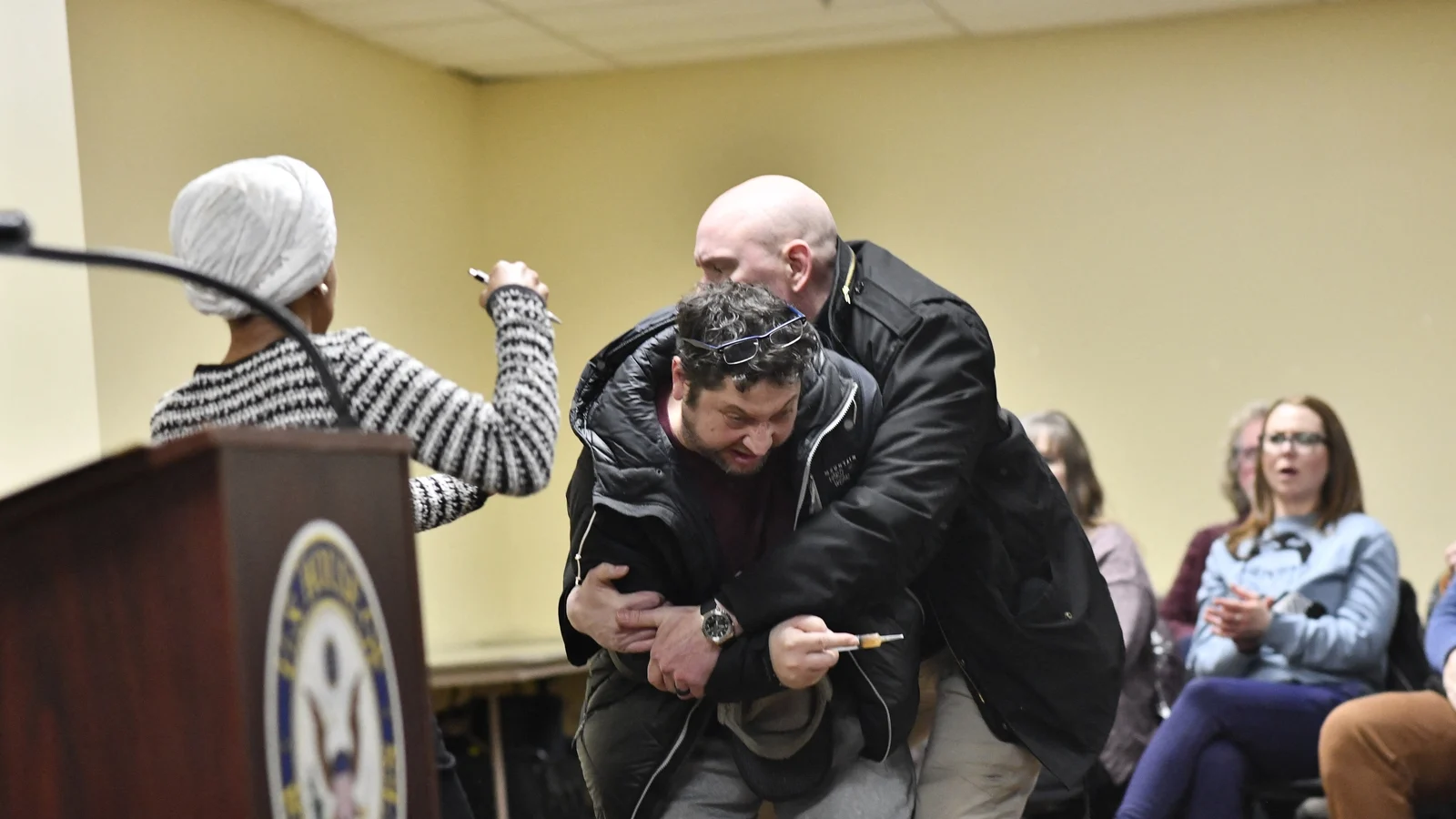
Last night a packed community hall in Minneapolis tilted for a few heart-stopping seconds toward chaos. The air — warm from bodies pressed shoulder to shoulder — smelled faintly of coffee and winter coats. Ilhan Omar, Congresswoman, Somali‑American daughter of refugees, and a lightning rod in American politics, was in mid-sentence when a man in the front row leapt up and sprayed an unknown liquid at her from what looked like a syringe.
Someone behind me shouted. Others froze. Security pushed forward like a delta of hands and jackets. The man was wrestled down and led away by officers from the Minneapolis Police Department; the audience exhaled in a collective, uneven sigh that was part relief, part rage, part disbelief. The congresswoman, shook but unbowed, stepped back to the microphone and finished her remarks. “We are Minnesota strong,” she told the room. “We will stay resilient in the face of whatever they might throw on us.”
What it felt like to be there
As a journalist who’s sat through dozens of town halls, I’ve learned that the most revealing moments are sensory ones: a cough at a tense pause, the sudden silence when a rumor sweeps a crowd. Last night, time snapped; a second stretched out into a small eternity of scrabbling shoes and shouted instructions. People pushed forward to help. One woman near the front, her hijab pinned in a careful knot, said to me afterwards, “I came to ask about healthcare for my mother, not to see someone try to hurt my Congresswoman.” Her eyes were wet but steady.
“I looked down and saw the tube,” said a security guard who helped tackle the man, his voice still shaking. “You don’t expect to be in a classroom and suddenly be in an emergency room. We did what we had to do.”
Context: Why this moment matters
The incident was not an isolated lapse in etiquette. In recent years, elected officials — particularly women of color and immigrants — have seen a spike in threats, harassment, and physical attacks. Across the United States, political rhetoric has become rawer and more personal, and it has bled into how people treat one another in public spaces. When attacks happen in places meant for civic conversation, it is a symptom and a signal: a symptom of polarisation, and a signal about how fragile our public sphere has become.
For Minnesota, the stakes feel particularly close. The state hosts one of the nation’s largest Somali‑American communities, centered in the Cedar‑Riverside neighborhood not far from where last night’s event occurred. For many residents, Omar is not simply a politician — she is a neighbor, a mosque‑goer, an emblem of possibility after decades of displacement. “She’s family,” said Ahmed, who runs a small cafe that doubles as a community bulletin board. “When they attack her, we take it personally.”
The politics behind the moment
Omar has been an outspoken critic of immigration enforcement policies and of statements from national leaders that single out immigrants and refugees. The exchange last night took place just after she called for comprehensive changes to how the Department of Homeland Security approaches enforcement. Her language — blunt, urgent — is the sort that draws applause from supporters and sharp rebuke from opponents. Presidential rhetoric has not helped soothe tensions; it has often amplified them.
Beyond the headlines and the applause lines, the issue touches millions: how nations handle borders and migrants; how communities balance security and compassion; and how rhetoric from the top filters down into everyday behavior. When public speech becomes dehumanizing, the downstream effects are tangible and sometimes dangerous.
Voices from the room: fear, defiance, resolve
After the man was removed, people lingered, reluctant to leave the circle of attention. A retired schoolteacher in the third row, who has lived through Minnesota’s civil rights battles, spoke in a voice that was equal parts exhaustion and determination. “We’ve raised our children here,” she said. “We will not let violence be normalized at a podium.”
A younger attendee, a community organizer who asked to be identified as Sofia, said, “This is what happens when leaders stoke fear — someone hears it louder than reason and decides to act. It could have been worse. It could happen elsewhere. We need to teach people to argue without trying to erase each other.”
Security staff later told me the suspect was taken into custody by Minneapolis police. Officials were still testing the sprayed substance; by the early morning hours there were no reports that the congresswoman had been seriously harmed. Yet the psychological ripple — the feeling that the public square is less safe — will linger for days, perhaps weeks.
What experts say
“Political violence rarely stems from one moment alone,” said Dr. Lena Ortiz, a political sociologist who studies political polarization and civic safety. “It is an outcome of a thousand small escalations — persistent dehumanizing rhetoric, echo chambers online, and a sense among some that extremes are the only way to be heard. Town halls used to be places of civic repair. We need to bring that back intentionally.”
Research supports Ortiz’s warning. Studies of political violence show that when public discourse degrades into demonization of opponents, incidents of harassment and threats rise. In addition, communities with high immigration enforcement activity often report elevated anxiety and distrust toward public institutions — a fact that local leaders in Minneapolis say colors everything from civic participation to school involvement.
Where do we go from here?
There are immediate, practical questions: How should security be managed at public events? What protocols keep both speakers and citizens safe while preserving the openness that democracy requires? But there are deeper questions, too. How do we speak across difference without reducing another person to a caricature? How do we honor the dignity of people whose histories and faces are different from our own?
“Resilience is not only standing back up after something scary happens,” said Omar in the minutes after she returned to the podium. “It is the decision to keep showing up, to keep listening, and to keep arguing for policies that make our community safer and healthier.” Her words landed like a benediction in a town hall meant to be about policy but that became a test of civic courage.
A community’s choice
As you read this from wherever you are — a café in Rome, a living room in Johannesburg, a university dorm in Seoul — ask yourself: what kind of public square do you want to inhabit? One where fear dictates who speaks and who is silenced? Or one where disagreement is heated but humanized? The answers matter. They are not abstract. They shape the air in community halls and the safety of people who step up to lead.
For now, Minneapolis will tend to its bruises and measure its next steps. The Somali cafes will open in the morning, the children will return to school, and the town hall’s chairs will be reset for the next time citizens want to be heard. The image that stays with me is simple: a woman returning to the microphone after being attacked, steadier than the moment deserved. That kind of steadiness is contagious, and in a season that desperately needs it, perhaps it is the most meaningful thing to witness.