Under the Northern Lights: Greenland Caught Between Ice, Identity and Great-Power Politics
On a clear evening in Nuuk, the capital’s harbor lights glint off black water and the air smells faintly of diesel and seaweed. Children on the boardwalk chase each other, bundled in bright parkas. The aurora paints the sky a slow, trembling green. And yet, beneath this tranquil surface, a restlessness has settled into everyday life — an unease born not of weather, but of geopolitics.
“We used to joke that the world comes to us only for pictures of icebergs,” said a shopkeeper who asked to be called Aqqalu. “Now they want to take part of who we are — and that is different. My sister can’t sleep.” The sister’s insomnia is not an isolated story; earlier this year Greenland’s government began a survey on the population’s mental health amid what officials call extraordinary external pressure.
A small island under big powers’ gaze
For decades, Greenland — an island roughly the size of Western Europe with about 56,000 people — has sat at the confluence of climate change, strategic military interests, and newly visible mineral wealth. Its ice is melting; new shipping lanes are whispering open; and beneath the tundra are deposits of rare earth elements that the world now prizes for high-tech manufacturing.
It was against that backdrop that the United States’ flirtation with buying Greenland exploded into headlines. Former U.S. President Donald Trump publicly discussed renewed attention toward Greenland, framing it as a security concern in the face of rising Chinese and Russian activity in the Arctic. After a flurry of statements and diplomatic alarm, Greenland’s prime minister addressed his people directly.
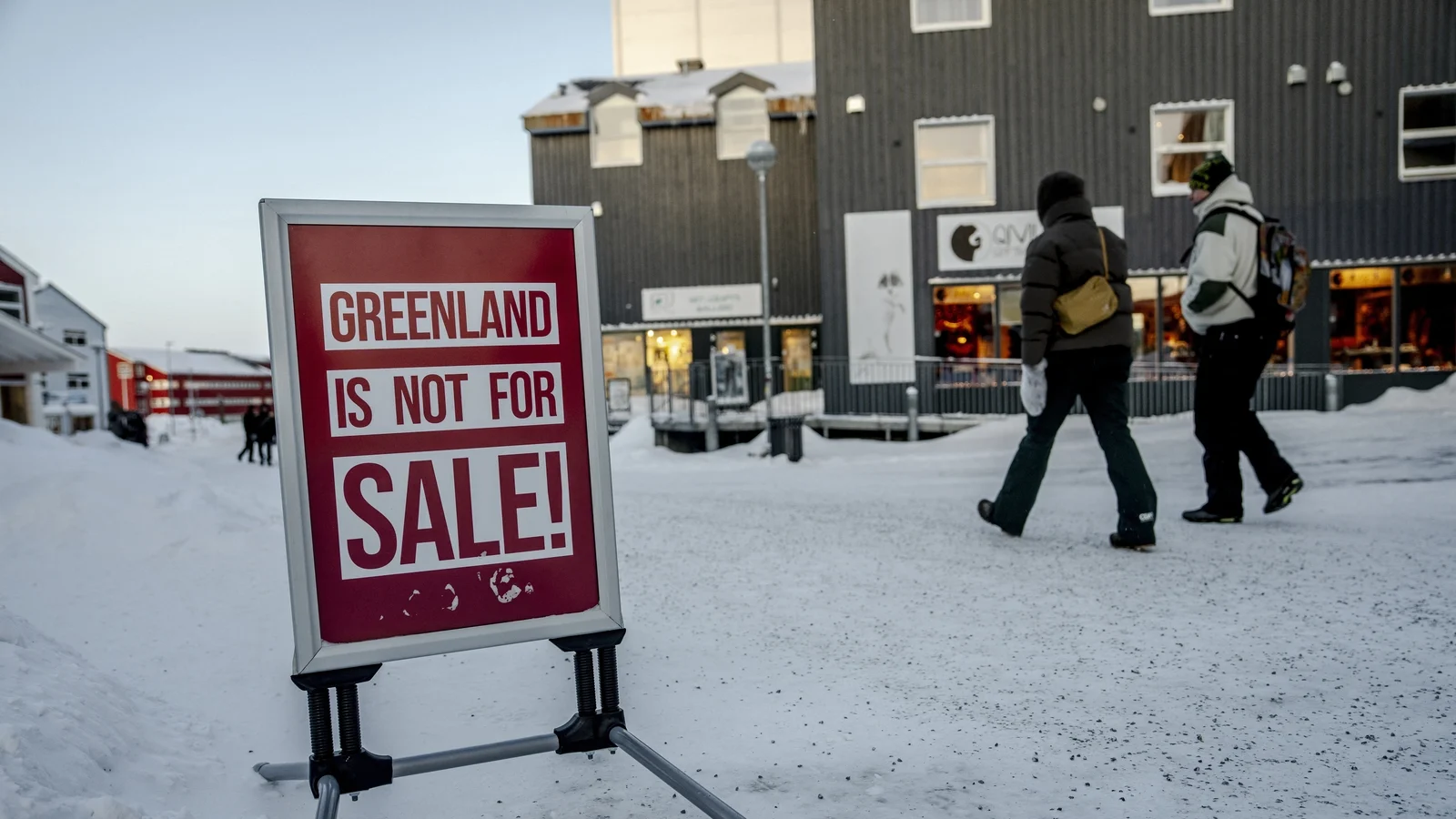
“The view upon Greenland and the population has not changed: Greenland is to be tied to the US and governed from there,” Prime Minister Jens-Frederik Nielsen told the island’s parliament in Nuuk, speaking through a translator. “The US continues seeking paths to ownership and control over Greenland.” He added, bluntly and to applause: “This is completely unacceptable.”
Not just politics — real lives
When capitals argue, it is easy to forget the human detail. The Greenlandic government’s mental health survey, launched amid the controversy, pulled back a curtain on daily anxiety: “Some of our compatriots have severe sleep problems,” the prime minister said. “Children feel the worry and anxiety of adults, and we all live with constant uncertainty about what may happen tomorrow.”
“My daughter whispers at night that the soldiers will come and take our house,” a mother named Malene told me, fingers tracing a coffee cup. “She is nine. She asks me, ‘Will I still grow up here?’ How do I answer that honestly?”
What is at stake: sovereignty, security, and culture
This is not merely a tussle over territory. It is a collision between two frameworks of meaning: Western concepts of land as property and Greenland’s Indigenous, largely Inuit, tradition of collective stewardship. Under Greenlandic law people can own houses but not the land beneath them; land is held in trust for communities.
“Land in our language is not something you sign away on a paper,” said elder Nivi Petersen, who has hunted seals and fished these waters for five decades. “It is a relation between people, bodies, animals, and weather. That cannot be parceled to someone in another country.” Her voice, at once weary and steady, carried something older than the diplomatic words being traded in Copenhagen and Washington.
Militarily, Greenland matter. The U.S. maintains Thule Air Base in the northwest, a Cold War relic now operating as a node in missile warning networks. Strategists point to Greenland as a platform for surveillance and a presence that counters Russian activity in the High North and China’s Arctic ambitions. Economically, the island sits atop minerals that are central to renewable technologies and defense supply chains — an unusual irony in a place defined by its ice.
Allies squabble, local people decide
When whispers about sale or control reached Europe’s capitals, several NATO allies publicly defended Denmark’s sovereignty over Greenland, warning that heavy-handed pressure risked fraying alliance ties. Diplomatic talks followed between the U.S., Denmark and Greenland to “discuss how we can address American concerns about security in the Arctic while respecting the Kingdom’s red lines,” Copenhagen’s foreign ministry said.
A NATO official, speaking on condition of anonymity, told me: “Allies can disagree on tactics, but sovereignty and self-determination are bedrock. If you ignore them, you corrode trust. That matters for alliance cohesion.” Another analyst in Copenhagen added, “Greenland’s status is not simply a bilateral U.S.-Denmark issue. It raises questions about how democracies treat their territories and peoples when strategic interest picks up. It’s messy, and there’s a moral dimension here.”
Voices from the waterfront
On the docks a young fisherman named Anders shrugged at the talk of geopolitics. “I care about my nets and the weather,” he said. “But if a country says we must be part of them, as a child I’m raised to think there are options. We chose to be part of the Kingdom of Denmark, and many here would prefer that. But choice must be real, not coerced.”
Others worry about future jobs. A 2018 estimate by Greenland’s statistics authority placed the annual block grant from Denmark — the subsidy that helps run the government — in the ballpark of several hundred million dollars (roughly 3.6–3.8 billion DKK). Any change in sovereignty or major foreign-led extraction projects would alter economic dynamics profoundly.
Global trends reflected in a tiny community
Greenland’s predicament is not isolated. Across the globe, smaller communities find themselves bargaining chips in great-power competition: Pacific islands negotiating infrastructure with competing donors; mineral-rich regions in Africa courted by multinational corporations and states. The Arctic, warming twice as fast as the global average, amplifies these pressures.
Ask yourself: what does sovereignty mean in a world of transnational threats and transboundary climate impacts? How do we balance the legitimate security concerns of states with the rights and mental well-being of local populations? These are not abstract questions. They shape whether a child in Nuuk sleeps through the night or wakes fearful of the future.
Where do we go from here?
For now, Greenland’s leadership and Denmark have been steady partners, saying they will defend the islanders’ choices. Prime Minister Nielsen has reiterated that Greenlanders would choose Denmark over being governed from abroad if forced to choose — a statement revealing both attachment and the fraught continuum between autonomy and dependency.
Practical steps exist: transparent consultations, legal guarantees of land and cultural rights, and regional security frameworks that include Arctic peoples at the table, not at the margins. Experts suggest multilateral mechanisms for Arctic governance could be strengthened to reduce the temptation of unilateral moves.
- Greenland area: approximately 2.166 million km².
- Population: roughly 56,000, majority Inuit.
- Key U.S. presence: Thule Air Base, in operation since 1951.
- Annual Danish block grant: around 3.6–3.8 billion DKK (estimates vary by year).
Closing thought
Walking back from the harbour, an older woman paused to look at the sky. “This place remembers,” she said. “The ice remembers the shape of our boats. The land remembers our names. We are not a map to be redrawn for convenience.” Her words lingered like the aurora’s afterglow.
It is tempting to see Greenland merely as a chess square on a map of global rivalry. But the island pushes back: it asks to be seen as a community with histories, attachments, and rights. If the world hopes to govern the Arctic wisely, it must begin there — with listening, with respect, and with policies that put people before geostrategic expedience. Will Western powers learn that lesson? The answer will shape more than Arctic policy: it will tell us whether the 21st century can reconcile strategic necessity with human dignity.