Smoke, Silence and a Fragile Promise: Another Day of Loss in Gaza
They buried four people in the lengthening dusk, and the air smelled of dust, incense and gasoline. A small procession wound through Khan Younis, men in keffiyehs carrying shrouds, children clinging to relatives, women crying out in a cadence that is both ancient and newly ruptured. A tank’s shelling, a second strike that found a medic rushing to help—these were the last things many of them remembered before the ground opened under their lives again.
“We were sleeping,” said a man at the funeral, voice raw. “The shells hit our house. My son—gone. My nephew—gone. We are not fighters. We are people.” He folded his hands as if to hold himself together. Around him, neighbors murmured agreement, not with politics but with the naked human fact of grief.
What happened today
Health authorities in Gaza reported that at least 24 Palestinians were killed in Israeli tank shelling and airstrikes across the enclave today, including seven children. The strikes hit southern Khan Younis and northern Gaza City; among those killed was a five-month-old boy and a paramedic who had run toward victims of the first strike only to be killed by a follow-up attack, the International Federation of Red Cross and Red Crescent Societies said.
The IFRC named the medics as Hussein Hassan Hussein Al-Samiri, describing him as “a dedicated paramedic” with the Palestine Red Crescent Society and noting that his death brings the tally of PRCS staff and volunteers killed in the line of duty to 30 since the conflict began in October 2023. “Humanitarian workers must be respected and protected at all times,” the federation said in a statement, adding an international sense of outrage to local sorrow.
Gaza’s health ministry—operating under the local governing authority—also reported at least 38 people wounded. Separately, Israeli military spokespeople said their strikes were targeted at a Hamas platoon commander they named as being responsible for a 7 October assault. Israel said it had taken measures “to mitigate harm to civilians as much as possible” and that the strikes were in response to militants opening fire near its armistice line—an action it described as a breach of the ceasefire.
Crossings, confusion and the fragile logistics of survival
Only three days earlier, the main Rafah border crossing between Gaza and Egypt had been reopened as part of a US-brokered truce deal intended to allow people and goods to move in and out of the shattered strip. The reopening offered a sliver of normalcy: ambulances lined up on the Egyptian side, the hope that medical evacuations and basic supplies would flow.
Then, almost as quickly as it opened, the process stalled. Palestinian patients who had been preparing to cross were told their passage was postponed. Israel’s COGAT agency said it had not received the coordination details from the World Health Organization necessary to facilitate the movement. An Egyptian security official told visiting journalists the cited reason was “security concerns in the Rafah area.”
Minutes became hours; hope became a taut thread. “They tell us to prepare, then they tell us to wait,” said a doctor who had escorted patients and spoke on condition of anonymity. “For the people here, delays can be life or death.”
Mawasi: Tents Ripped, Lives Tossed
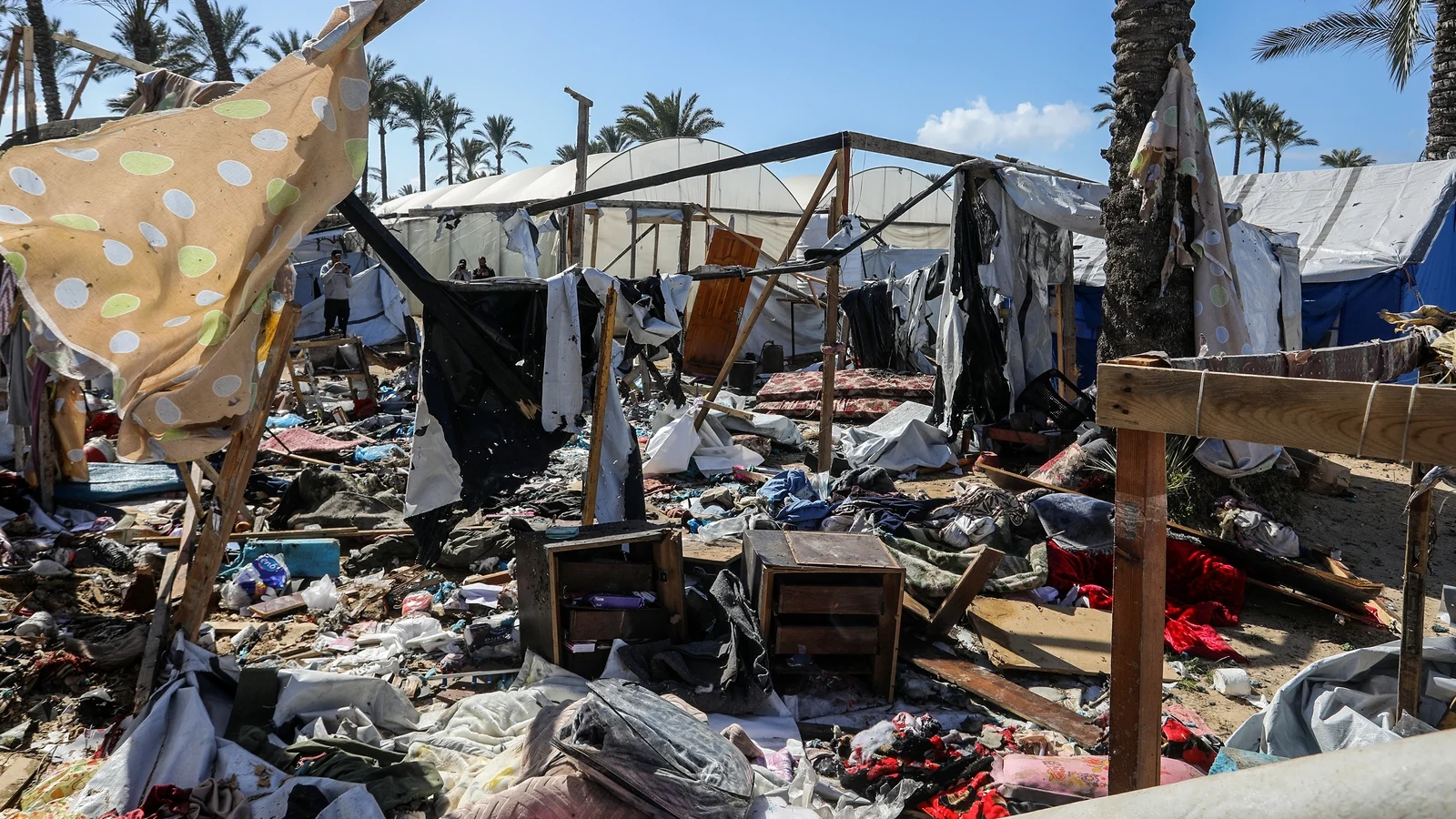
On the long, narrow coastal strip of Mawasi near Khan Younis, tents that had sheltered families displaced from other parts of Gaza were torn apart. The tents—patched and crowded, smelling of cooking fires and detergent—have become the only refuge for many among Gaza’s more than two million residents. Humanitarian agencies estimate that nearly the entire population has been uprooted at some stage during the fighting.
“We’ve been moving for months,” a woman in a faded headscarf told me, her hands steady despite everything. “Where do we go? The sea is to our left; the border is closed. You cannot live as if every night might be your last.”
Numbers that numb
Statistics accumulate like rubble. Since the ceasefire took hold nearly four months ago, local health officials say Israeli fire has killed at least 530 people in Gaza—most of them civilians—while Palestinian militants have killed four Israeli soldiers during the same period, according to Israeli authorities. The broader toll since October 2023 remains grim: Gaza’s health authorities report tens of thousands killed and injured, and whole neighborhoods reduced to the rubble that now passes for a map.
These are not simply numbers. Each is a story interrupted: a toddler who will never learn to speak, a medic who will never walk into an ambulance again, a farmer whose field is now a crater. Yet they also underscore a larger global truth about protracted conflicts in densely populated places: conventional distinctions between warriors and civilians dissolve under the pressure of modern warfare.
Voices from both sides
“Every violation threatens the whole architecture of the truce,” said an analyst who follows Gaza reconstruction efforts. “Trust is the currency of any ceasefire—and there’s very little of it left.”
Hamas decried the strikes as deliberate attempts to undermine stabilization efforts and called for immediate international pressure on Israel to cease such actions. Israeli military officials, meanwhile, framed the day’s strikes as necessary countermeasures against operatives they said were preparing attacks—measures, they say, justified even under a ceasefire when forces are active near armistice lines.
What this day tells us about the future
Beyond the immediate politics there are structural questions: how to protect medical workers and aid convoys; how to manage crossings to ensure patients get timely care; how to rebuild towns when the rules of engagement do not prevent repeated strikes on the same site. The second phase of the ceasefire—meant to negotiate governance and reconstruction in Gaza—has been stalled by unresolved core issues such as the presence of Israeli forces and the disarmament of armed groups inside Gaza.
What happens if the crossings open and close like a faucet—dripping hope and then drought—or if targeted strikes continue to claim medics and civilians? How can a battered population rebuild when fear frames every step into the street?
For readers far away
Ask yourself: how does one measure responsibility in a place where both sides point to violations? Where international agencies call for protection and yet the bodies keep arriving? Beyond taking sides, what practical steps can international actors insist upon to protect civilians, to enforce corridors for medical evacuations, to shield humanitarian staff?
In the dusk in Khan Younis, a small boy kept asking adults for bread. He was too young to understand ceasefires or declarations; he only knew hunger and the ache of loss. That image—simple, stubborn—stayed long after I left: a reminder that amidst the geopolitics and the headlines, the most urgent task remains not winning arguments but saving lives.
What to watch next
- Whether Rafah remains open for sustained medical evacuations and aid deliveries.
- Whether international organizations secure guarantees to protect healthcare workers and civilian zones.
- Whether negotiators can move from fragile pauses to durable arrangements for governance and reconstruction.
There are no easy answers. But there is a responsibility—political, moral and practical—to ensure that a day like today becomes less likely to be repeated. Otherwise, ash will be the only language left to describe a place that once hummed with family markets, weddings and almond trees.