Warm Coffee, Cold Wheels: A Day on the Road to Milano-Cortina 2026
There are moments when a steaming cup of espresso feels less like a drink and more like a passport—an entry back into civilization. I watched one athlete cradle his cup like that, content and almost oblivious, while the rest of us trembled on a slope of Italian ineptitude and weather. It is a small scene, but it tells you everything about these Olympics: pockets of comfort and theatre amid long, difficult journeys that connect them.
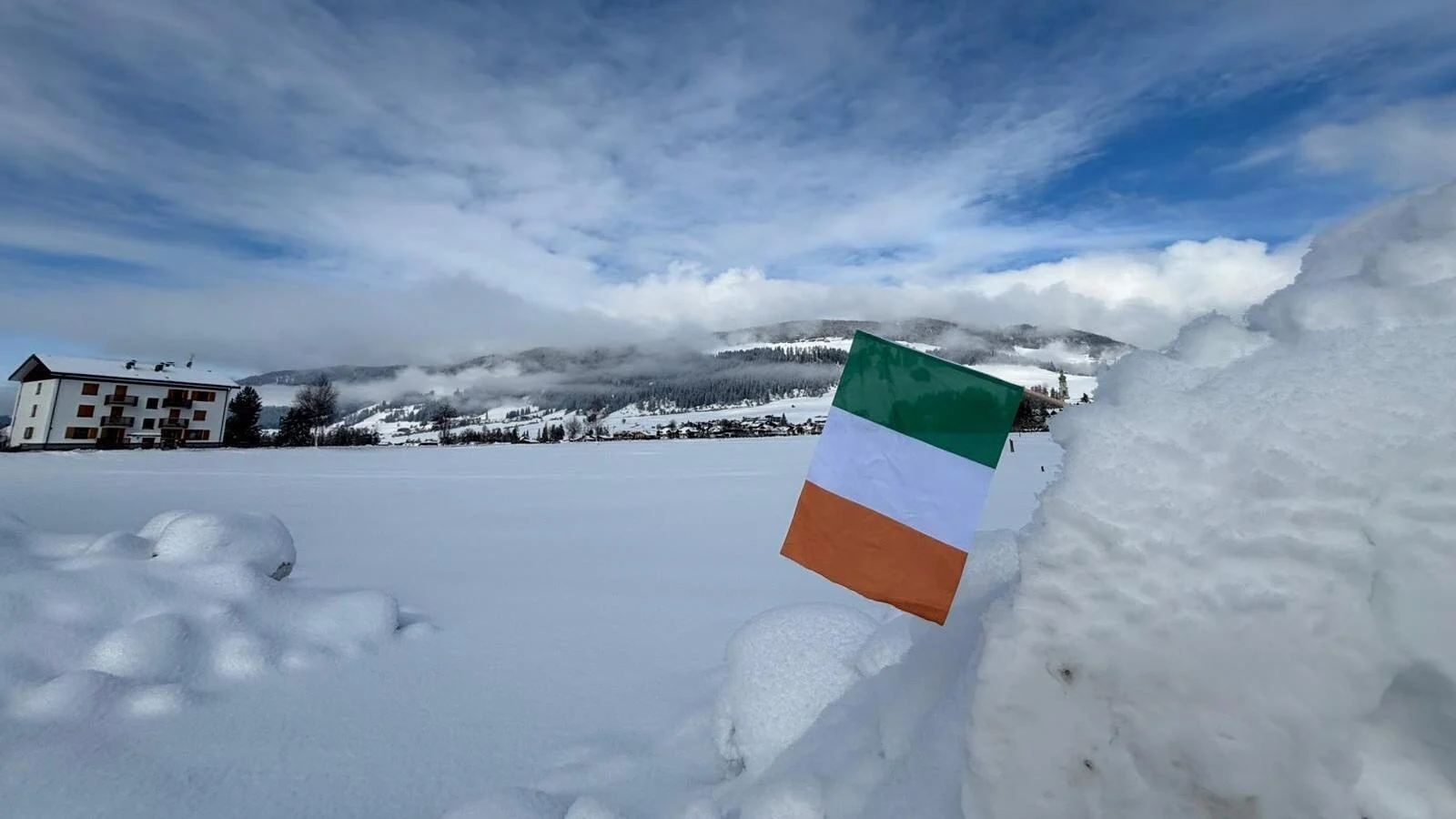
Thomas Maloney Westgard, a veteran of winter sport circuits and, fittingly, a man with both Norwegian grit and Galway roots, sat in a sunny residency in Predazzo. He sipped coffee, folded into his jumper, and prepared mentally for another run at an Olympic dream. Outside his window the Dolomites glittered like cut crystal. Inside his world, everything felt, for a moment, ordinary.
Not so for a trio of broadcasters who had set out earlier that day. That interview team—cameras, cables, a patient producer and the indomitable Heather Boyle, communications chief for the Olympic Council of Ireland—found themselves in mud and slush, wheels spinning and tempers fraying, a reminder that the 2026 Milano-Cortina Games are as logistically adventurous as they are glamorous.
The Geography of an Unconventional Games
If you’re imagining a compact festival of sport, think again. These Olympics are spread across the Alpine spine of northern Italy—clusters of venues strung out across valleys, passes and resorts. Organisers boast that the competitions will run on renewable energy and that many of the arenas are being reused rather than rebuilt. The trade-off is distance: venues whisper to one another across mountains, separated by more than 500 kilometres of roads, tunnels and, occasionally, bad luck.
“It’s beautiful and it’s maddening,” said Heather Boyle with a laugh, recalling the day she put the car into the sort of manoeuvre that looks much easier when practiced in a Michael Caine film than in a winter storm. “We were 32 minutes away on the sat-nav and 32 hours in our heads. You learn fast what matters: patience, good footwear, and a decidedly stoic mindset.”
Why the spread?
Part of the reason is the IOC’s “new norm” — a push in recent years to reduce costs, carbon and spectacle by reusing existing venues and dispersing events across regions that can host them without constructing entire new cities. The result is a mosaic rather than a monolith: Milan’s urban energy, Cortina’s alpine glamour, Val di Fiemme’s cross-country terrain, Bormio’s steep pistes and Livigno for the snow-hungry endurance events.
- More than 500 km of venues across northern Italy
- Over 100 medal events across roughly 15 sports
- Organizers promise 100% renewable energy for competition venues
- Estimated 2,500–3,000 athletes expected from roughly 80–90 countries
Those figures are estimates and plans evolve, but they are enough to make a traveller wonder: have we shifted the problem from infrastructure to logistics? You lose the compact heartbeat of a single Olympic village, but you gain the revival of places that would otherwise wait decades between major events.
Snow Chains, Espresso and the Face of Local Life
Cortina d’Ampezzo, once the high-society escape of Hollywood and European aristocrats—words like “Living Room of the Famous” still seem to echo off its Art Nouveau facades—has retuned its stage lights. The shops hum. Restaurants stretch to accommodate incoming crowds. On a cool afternoon in Predazzo, Valentina Galvan, originally from Argentina, wipes down the counter of a café and watches the first trickle of international visitors arrive.
“It’s like someone opened the shutters after a long winter,” she said, hands flouring the cloth like a ritual. “For us, for the town, it’s a party. Not just for money—though I won’t deny we hope for good tips—but because you feel part of something. Families from Siberia, teenagers from Spain, a group from Tokyo—all sharing table space and telling stories.”
Tourism that arrives with an event of this size can be a lifeline. But it can also be a pressure test. Roads that have not borne daily Olympic traffic must suddenly become arteries for media buses, equipment lorries, and the caravans of fans. Local authorities have spent months rehearsing, yet no rehearsal ever contains the improvisation of real weather.
Voices from the mountains
“We want the world to see us,” said Carlo Berti, the mayor of a small town en route to one of the ski venues. “We want the business, the winter season extended, our young people to have work. But we also want our streams and our slopes to remain. If the Olympics can balance that, it will be a good legacy.”
Environmentalists are watching the balance with equal parts hope and scepticism. Dr. Elena Rossi, a conservation scientist based in Trento, warns that the promise of renewable energy is meaningful, but not a cure-all: “Energy supply is important, yes, but so are transport emissions, construction impacts and the pressure on alpine ecosystems. Reuse of venues is encouraging, but the footprint of visitors must be managed.”
Small Heroics, Big Stories
Back on that slope, the day’s small heroics felt like a micro-epic. The cameraman, Stuart Halligan, barked directions through teeth chattering with cold. Heather, wrapped in an Olympic hoodie and bobble hat, drove with the kind of pragmatic courage that festivals often demand. When they finally arrived, muddy and triumphant, they didn’t just reach an athlete; they carried a story of ordinary people doing extraordinary things to make a global event work.
“You hear about medals and records,” Thomas told us later, stirring his coffee, “but these moments—meeting the people who fought the weather to bring you the picture—those stay with you. This is about more than sport. It’s about community.”
What do we want the Olympics to be?
That question hangs over Milano-Cortina like a low, persistent cloud. Do we prize compact efficiency, the sense of a single village pulsing 24/7, or do we accept the charm—and the headaches—of a dispersed Games that stitches new entertainment into old towns? Do we celebrate the sustainability talk and then look critically at the road traffic and hotel expansions that follow?
There are no easy answers. But as the first buses rattle along narrow switchbacks, as baristas call out orders in five languages, and as athletes step from warm cabins into the crystalline hush of snow, you begin to understand what these Games are trying to be: an experiment in scale and conscience, a chance to spread economic benefit while testing the limits of regional coordination.
So here’s a question for you, the reader: if you had to choose, would you prefer the theatrical bustle of a single, dense Olympic village, or the dispersed, culturally rich patchwork that Milano-Cortina offers? Both promise spectacle. Both demand compromise. And both—if nothing else—guarantee stories, small and large, about the modern world’s appetite for grand gatherings in fragile places.