The morning after Nils: wind-whipped streets and lives rearranged
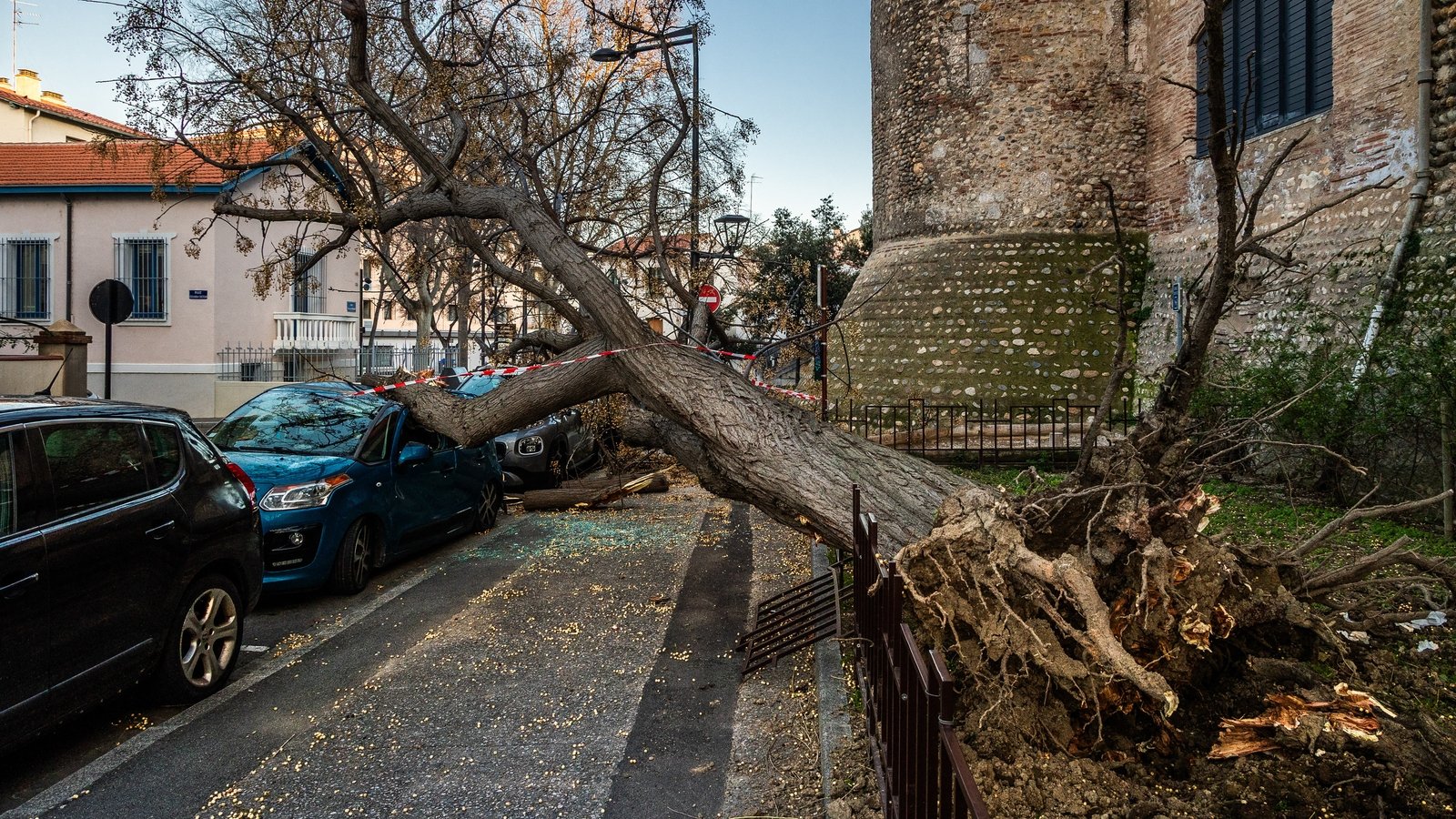
When dawn peeled back the night, the south of France looked like a place that had been rearranged by a careless hand. Branches the size of trunks lay strewn across boulevards. Shuttered cafes that the night before hummed with after-dinner conversation now sat under a sky the color of pewter. In Perpignan, a wheel of a street market lay half-buried in mud. In La Réole, emergency crews ferried a bewildered woman from her flooded home. Across the border in Spain, Barcelona’s glass and steel shoulders bore the scuffs of wind-driven debris. And in Portugal, a viaduct sagged, its foundations undermined by swollen waters.
The storm, given the name Nils by French forecasters, tore through the western Mediterranean corridor with an intensity officials described as “unusually strong.” By Tuesday morning authorities had confirmed three fatalities and dozens of injuries across France and Spain, while thousands of households remained in the dark. The scale of the disruption read like a weather map crossed with a ledger: uprooted trees, collapsed roofs, washed-out roads, cancelled flights and ferries, and trains that never began their runs.
On the ground: stories that make statistics real
France — toppled trees, a ladder, a fatal strike
In southwestern France, where plane trees line avenues and vineyards spill like patchwork across hills, the violence of the storm surprised many.
“I’ve never seen anything like it,” said one Perpignan resident, still shaking hours after a tree had nearly crushed his car. “Two seconds more and it would have.”
Local authorities reported that a truck driver was killed when a tree smashed through his windscreen. The following day, emergency services confirmed a second death: a person who fell from a ladder while working in their garden amid the chaos. Images from towns like La Réole showed streets ankle-deep in water and volunteers helping to haul flood-weary possessions onto higher ground.
Electric crews from Enedis — France’s main distributor — described a marathon effort to reconnect homes. “Enedis has restored service to 50% of the 900,000 customers who were without electricity,” the company reported. Some 3,000 workers had been mobilised to clear fallen lines and repair damaged substations, but high water and blocked roads slowed the fight to bring lights back on.
Spain — walls, roofs and lives shaken
Across the Pyrenees, in northern Spain and around Barcelona, the storm left a similar wake of destruction and dismay. A roof over an industrial warehouse collapsed under the onslaught of wind and rain; a woman working inside was killed. Dozens more were reported injured as masonry came down and drivers were trapped in flooded underpasses.
“The noise was like a train passing through the building,” said an employee at an industrial estate near Barcelona, speaking as she clutched a blanket around her shoulders. “We ran without thinking. The roof gave way in an instant.”
Public transport ground to a halt in many places. Flights were cancelled, ships were held in harbors, and long-distance trains were delayed or rerouted. For commuters and travelers, the storm meant sudden, intrusive disruption — a reminder of how tightly our modern lives depend on thin threads of infrastructure.
Portugal — a bridge that did not hold
In Portugal the violence of water was the dominant story. Flooding undermined a viaduct, causing partial collapse and prompting immediate investigations into structural safety. Though there were no widespread reports of fatalities there, the images of buckled concrete and mud-smothered fields made clear how quickly routine routes can become dangerous.
The ledger: numbers that matter
Here are the immediate figures that help frame the human stories in a wider context:
- Confirmed fatalities: 3 (across France and Spain)
- Households without power at peak: approximately 900,000 in France
- Enedis crews mobilised: around 3,000 workers
- Power restored by morning after storm: about 50% of affected customers
- Number of injuries reported in Spain: dozens (official counts ongoing)
Numbers are blunt instruments, but they point to a larger truth: this was more than a local squall. It reached into everyday life, into commerce, schools and hospital routines, and raised questions about readiness and resilience.
Why storms like Nils feel different
Ask meteorologists and they’ll tell you storms are not new. What has changed, they say, is the frequency and the footprint. “We’re seeing more intense downpours concentrated over shorter timeframes,” an atmospheric scientist who studies Mediterranean weather patterns explained. “That puts pressure on drainage, on river basins, and ultimately on communities that were built for a different climate reality.”
For locals, the problem is immediate and practical. Old drainage systems were never designed for torrents that fill streets within minutes. When rivers swell beyond their beds, the weakest points — low bridges, neglected culverts, and older bridges — are the first to fail.
And then there is the human factor: people who resist leaving their homes, businesses reluctant to close for fear of lost revenue, and infrastructure that is expensive and slow to upgrade. “We cannot simply move all essential services underground or build new power lines overnight,” said a municipal engineer in Bordeaux. “The challenge is prioritising where to invest so we reduce the next disaster’s toll.”
Voices from the aftermath
Emergency volunteers, firefighter crews, municipal workers and everyday neighbors have been the unglamorous backbone of the response. One volunteer in La Réole, a retired carpenter named Jean, put it this way: “When you see your neighbor’s furniture floating past your gate, you cannot stand by. We bring boats, sandbags, and coffee. It is what people do.”
Health services are stretched, and hospitals in affected areas have been operating under contingency plans. Schools in flooded towns closed their doors, leaving parents scrambling for childcare while they coordinate repairs and insurance claims.
Insurance companies will tally the cost in the weeks ahead; economists will watch for ripple effects on local economies. But for now, the human accounts are what linger: the smell of wet paper and wood in a salvaged home, the children who turned a puddle into a football pitch despite the gloom, the small businesses that opened a day later with a broom and a smile.
Looking ahead: questions for our warming world
What does a storm like Nils ask of us? How do we shore up our towns and cities, our power networks and our transport arteries against a future where the weather surprises us more often and harder?
These are not just engineering questions. They are questions about how we live together: where to place housing, how to support vulnerable neighborhoods, how quickly to modernise aging grids and drainage systems, and who pays when catastrophe arrives.
Will this week be remembered as an unfortunate anomaly, or as another data point in a trend that nudges public policy toward bolder investments and stricter planning? The answer will depend partly on political will, partly on budgets, and partly on whether communities themselves can build layers of local resilience.
What you can do now
For readers wondering how to help or prepare, here are a few practical steps that matter in any flood- or wind-prone region:
- Keep an emergency kit: flashlights, batteries, water, medications and important documents in a waterproof pouch.
- Know your local evacuation routes and the thresholds for alerts in your area.
- Secure outdoor furniture and clear gutters; small actions can reduce damage in a sudden storm.
- Check whether your home insurance covers flood or wind damage and what the claims process requires.
As recovery begins, we will hear many more stories: of resilience, of frustration with delayed repairs, and of quiet acts of kindness. In the end, storms like Nils test more than infrastructure — they test the bonds between neighbours, the responsiveness of institutions, and our collective capacity to learn and adapt. What will we choose to learn?