A New Kind of Peace Summit — and a War That Keeps Chewing at the Edges
On a sunwashed Thursday, a line of black SUVs will pull up to an unlikely venue for peacemaking: the Donald J. Trump Institute of Peace. Delegations from more than 20 countries — heads of state among them — are expected to walk through its doors. The announcement, posted with characteristic flourish on Truth Social, promises a pledge of more than $5 billion for Gaza’s reconstruction and humanitarian relief, and “thousands” of personnel for a UN-authorized stabilization force and local policing.
It reads on paper like progress: money, boots for order, a newly minted international board claiming ownership of the messy work of rebuilding lives. But beneath the language of pledges and press releases, the streets of Gaza still smell of smoke and the war’s arithmetic of death and displacement keeps changing by the hour.
Phone Calls, Press Releases and a Name on a Building
The “Board of Peace” is the brainchild of a controversial diplomatic blueprint that secured a United Nations Security Council resolution. Its first public meeting — at the institute that carries the name of the U.S. president who championed the plan — is being billed as the operational start of an endgame to a war that has rocked the region.
“Money is the easy part to announce,” said a European aid official who asked not to be named. “The hard part is whether the pledges will turn into cash that gets through checkpoints, into rubble-clearing equipment, into water, into schools that won’t be shelled again in a month.”
For some, the optics are jarring. To imagine the fate of an embattled enclave resting on a new institute with a political name is to confront the modern evolution of diplomacy: a mix of statecraft, branding and battalions of bureaucrats chasing both headlines and handshakes.
Gaza: Ceasefire, but Not Silence
The pause in fighting that entered a “second phase” last month has not been a serene lull. Ceasefires, as history and humanitarian workers know, can be fragile scaffolds. In Gaza, the walls of those scaffolds are riddled with holes. Palestinians and Israeli forces have continued to trade accusations of violations; the resulting strikes have killed civilians and combatants alike.
Medics in Nasser Hospital and field clinics in Khan Younis report fresh losses even as diplomats prepare talking points. Health officials in Gaza say that at least 12 people were killed in a recent round of airstrikes — including at least four in a tent encampment for displaced families, and five in Khan Younis — while the Gaza health ministry has counted roughly 600 Palestinians killed by Israeli fire since the ceasefire deal began. Israel, meanwhile, reports four soldiers killed by militants during the same period.
“We are living in a strange kind of pause,” said Dr. Leila Mansour, a surgeon at a southern Gaza hospital. “You operate at night for the wounded and during the day you listen to promises. The body arrives, and the promises don’t heal it.”
Tents and Rubble: The Human Geography of Displacement
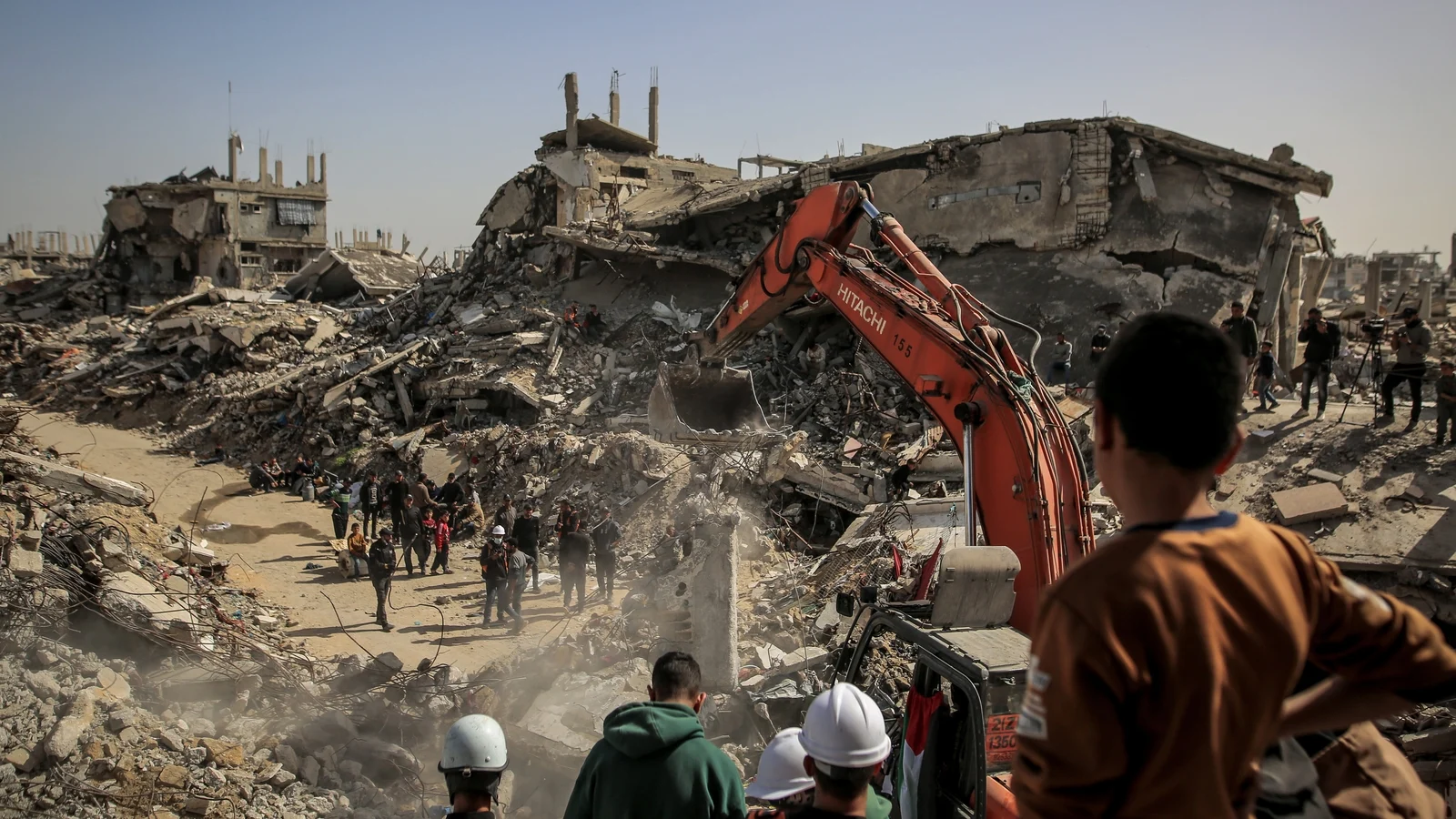
Walk through any of Gaza’s tent encampments and you’ll understand what reconstructing a place really means. The camps are not just rows of nylon and plastic. They hold the smell of lentils cooking in shared pots, children’s drawings pasted on tent walls, and the constant, queasy memory that today’s shelter may be tomorrow’s rubble.
“We lost our home in October,” said Amal, a mother of three, standing by the tent where she and dozens of others shelter. “The world talks about rebuilding, but I’m tired of rebuilding the same thing. I want my children to go to school near a home where they can hang their coats.”
The Yellow Line, Tunnels and Accusations
One of the most disputed features of the truce is the so-called “Yellow Line” — a demarcation meant to mark the boundary between Israeli and Hamas-controlled areas. Israeli officials say militants have repeatedly crossed that line and used tunnels to reappear beneath rubble and buildings, prompting what they call “precise” strikes in self-defense.
An IDF statement framed recent operations as narrowly targeted, insisting strikes were in response to militants who emerged armed from tunnels near the line. “When fighters move east of the line while armed, it’s an explicit ceasefire violation,” an Israeli military source told reporters. “Our duty is to protect our forces and civilians.”
For Gaza residents, that calculus feels abstract. “We have learned the geometry of fear,” said Mahmoud, a taxi driver in northern Gaza. “We know where the shelling comes from, but we also know that life has to continue between the lines.”
Lebanon: A Wider Shore of Violence
The conflict’s edges extend beyond Gaza. A recent strike on the Lebanese-Syrian border left four dead, Lebanon and Israel assigning blame differently: Beirut said civilians were killed in a drone strike near Majdal Anjar; Israel said it struck operatives from Palestinian Islamic Jihad. Since the November truce that paused large-scale fighting with Hezbollah, Lebanon has endured frequent strikes along its southern frontier. An AFP tally of health ministry reports places more than 370 Lebanese killed by Israeli fire since the ceasefire.
“We feel the tremors here as if the war is a drum that never stops,” said Rania, a shopkeeper in a border town. “Every siren is another reminder that peace is paper thin.”
Promises, Practicalities, and Politics
What could a $5 billion pledge actually buy? Reconstruction in Gaza faces logistical and legal complexities: demining, rubble removal, materials subject to blockade or inspection, and the establishment of credible local policing. Add to that the political problem — who decides which local actors receive authority and who guarantees they can operate without becoming targets.
“Reconstruction without a durable political settlement is like planting seeds on a moving plate,” said Dr. Omar Haddad, a scholar of conflict reconstruction. “One needs not just money, but guarantees: guarantees of access, of protection, of rebuilding that benefits families rather than feeds spoilers.”
- Key hurdles: safe corridors for materials, accountability for civilian protection, deconfliction with military objectives.
- Humanitarian urgency: tens of thousands displaced; basic services — water, electricity, health — remain fragile.
- Regional dynamics: Lebanon’s front and factions inside Gaza complicate any straightforward security architecture.
Questions for the Reader and the World
When a summit is held under the banner of one nation and a peace institute bears a single leader’s name, who holds the moral claim to the project? Who counts as a partner in rebuilding? And perhaps most urgently: can money and staff replace the fragile trust that communities need to live without fear?
These are not rhetorical flourishes. They are questions families in Gaza whisper to each other as children sleep among rubble. They are the same questions border communities in Lebanon ask when the sky darkens with drones.
Looking Ahead: Caution More Than Certainty
The forthcoming meeting may chart a course for funding and staffing operations that Gaza desperately needs. Or it may become another chapter in a long list of international responses that fail to align political will with on-the-ground reality. For now, the engines of diplomacy and aid rev up as bullets and accusations continue to find their marks.
As you read this, consider this: Are billions and battalions the right starting point — or a distraction from the more unglamorous work of building mutual security, accountability and everyday normalcy? Who, finally, will be allowed to live the ordinary life that seems for so many publics just out of reach?
The tents will remain until they are not. The names on buildings will remain until they are replaced by memories. The hope is that, this time, pledges turn into streets repaired, hospitals that stay open and children who can go to school without counting the minutes to the siren. The test of any peace plan will be measured not in press conferences, but in whether those children can sleep through the night.