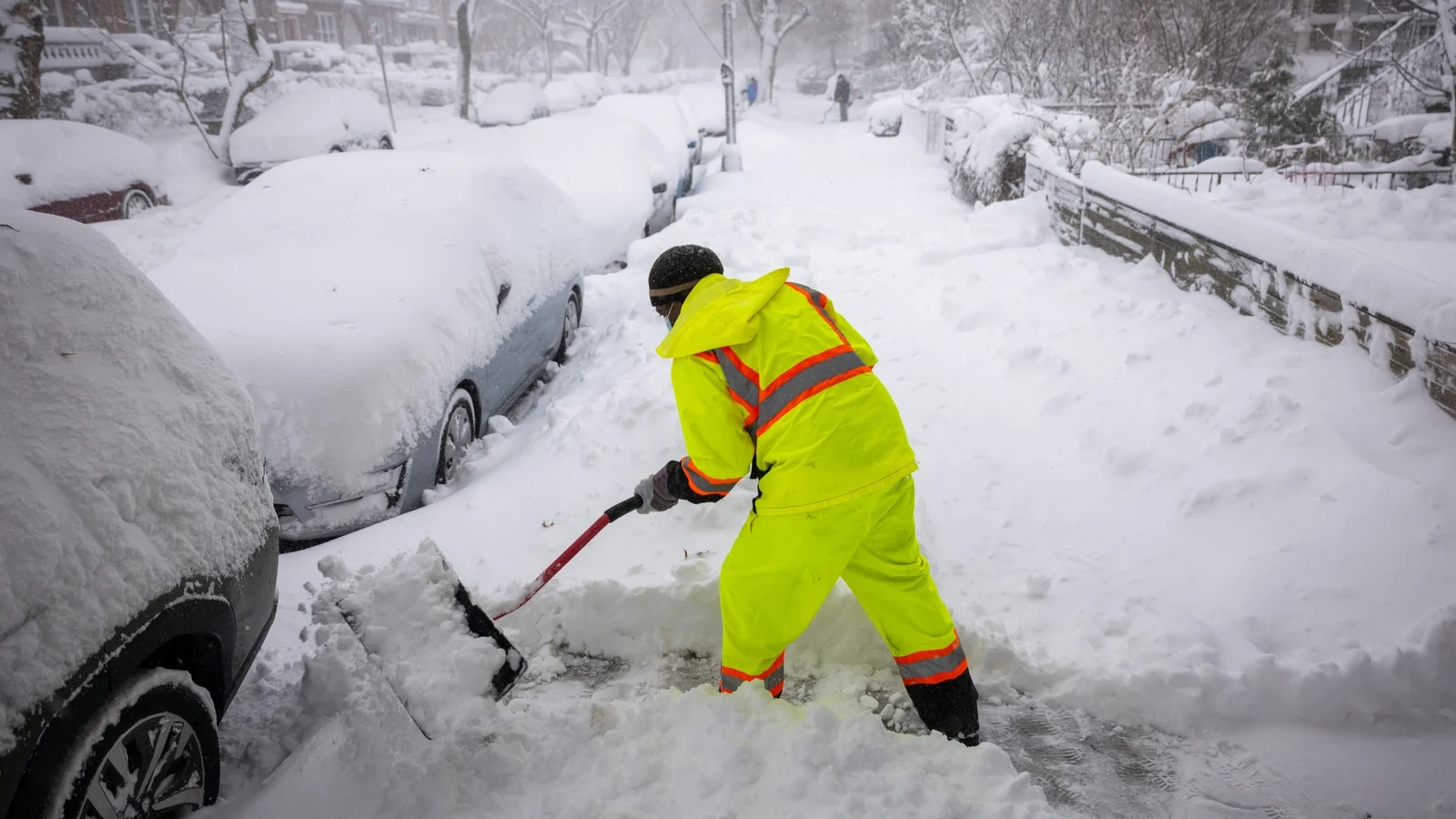
When the City Went Quiet: A Blizzard That Felt Like a Reset
There’s a particular hush that only a great snowfall can bring to a city that never sleeps — a heavy, muffled pause, like the world taking a deep, white breath. Today that hush descended over the US northeast with the authority of a closing bell: more than 30 centimetres of snow blanketed neighborhoods, parks and highways, bringing daily life to a near standstill and laying bare both the strengths and the vulnerabilities of places we take for granted.
By 8 a.m., Central Park’s lawns were hidden under about 38 centimetres of powder, and forecasters warned of another 13–15 centimetres before the blizzard eased later in the day. In pockets from southern New England down to Delaware, towns reported 30–45 centimetres. Boston had closer to 15 centimetres by mid-morning. Winds howled at sustained speeds that met — and in places exceeded — official blizzard criteria: gusts between 64 and 96 km/h, with isolated reports topping 112 km/h along exposed coasts and islands.
“We have, in many places, a textbook blizzard — heavy snow combined with intense winds,” said Bob Oravec, a meteorologist with the National Weather Service’s Weather Prediction Center. “You get the whiteout conditions, and snow drifts that can pile up several feet. It’ll take crews a long time to dig us out.” He spoke to the scale of the recovery: “Realistically, in the hardest-hit corridors, it could be a week before travel returns to anything like normal.”
The Human Geography of a Snow Day
Empty streets in Midtown looked almost cinematic: taxis, usually parked two-deep at curbs, were rare. The United Nations closed its Manhattan complex. Mayor Zohran Mamdani issued a blunt, practical plea: “I’m urging every New Yorker to please stay home.” The message came not as a mere advisory but as a call to collective care — stay inside so the plows and first responders can work and so ambulances can reach those who need help.
On Long Island, where winds slammed Coastal communities, Stony Brook Village recorded some of the highest gusts. Nantucket Island, exposed to the Atlantic, also logged punishing winds. In neighborhoods where trees still carry the weight of old growth, branches snapped under the combined weight of wind and wet snow; downed lines left thousands of homes and businesses without power at peak. “I’ve lived here 30 years and I don’t remember snow like this,” said Rosa Delgado, a Chelsea resident shoveling a narrow channel to her stoop. “The whole block looks like a movie set.”
Airports, Trains and a Sky That Closed
The storm did not respect timetables. Airlines grounded flights en masse: FlightAware reported more than 5,700 cancellations by mid-morning and another 900 delays. A further 1,600 flights scheduled for the following day were already scratched. Major hubs — JFK, LaGuardia, Newark, Logan — bore the brunt, leaving travelers stranded, shoulders hunched around carry-on bags and airport floor plateaus.
“We are coordinating with airlines and airports to get passengers rescheduled and safe,” said a spokesperson for one major carrier. “Safety is our number one priority — we cannot risk flying into whiteout conditions.” Dublin Airport reported 14 flights canceled today because of the disruption, a reminder that these weather events reverberate across oceans.
On the ground, trains and buses were often the first transit victims. New Jersey commuter lines halted services. Rhode Island’s transit authority suspended all service from last night into today. Connecticut barred commercial vehicles from certain highways, leaving only emergency and essential deliveries moving. A commuter in New Haven, Jake Thompson, described the eerie morning commute he didn’t take: “I woke up early out of habit, looked outside, and called my boss. No trains. No point getting out there.”
Front Lines: Workers, Volunteers, the Guard
Snowfighters — municipal plow drivers, utility crews, roadside operators — were deployed before dawn. New York Governor Kathy Hochul activated 100 National Guard personnel to assist on Long Island, in New York City and the Lower Hudson Valley. Their tasks ranged from rescuing motorists stuck in drifts to assisting in clearing hospital access roads. “It’s a team effort,” said Lieutenant Colonel Maria Jenkins, who led a morning convoy. “We’re boots on the ground, shovels and chains, working with community groups to keep people safe.”
Emergency management agencies also had to contend with bureaucratic friction. The Department of Homeland Security warned of the risks of strong wind gusts up to 112 km/h and the knock-on threat of falling trees and extended outages. Meanwhile, FEMA reaffirmed that life-safety operations continue despite ongoing federal funding disputes that have complicated long-term planning in recent weeks.
Small Stories Amid the Whiteout
Inside a corner bodega on the Lower East Side, the usual bustle was pared down to a few regulars buying coffee and newspaper bundles. “We had people come in wearing everything from ski masks to parkas, like they were going to climb Everest,” laughed owner Samir Patel. “We sold out of milk and batteries by nine.” At a shelter in Hartford, volunteers handed out hot meals to seniors who could not clear their walks. “These storms show you who your neighbors are,” said volunteer Linda Park. “Some folks I’ve never seen before were here with casseroles.”
What This Storm Asks of Us — and of Our Systems
Weather of this intensity forces a reckoning. Are our power grids prepared for sudden, concentrated strain? Can transit authorities weather a day-long shutdown without cascading impacts? Are emergency response structures adequately funded to move quickly when the call comes? The numbers are stark: tens of thousands without electricity, thousands of cancelled flights, hundreds of plows and crews working around the clock. Each statistic is a person trying to get home, a nurse trying to get to a shift, a child missing a school day.
“Extreme weather is exposing weak links,” said Dr. Anika Roy, a climate resilience researcher. “When you combine heavier, wetter snow with stronger coastal winds — as climate models suggest we will see more often — the infrastructure we built for a different era gets tested.” She urged long-term investments: smart grid upgrades, more resilient tree management, and redesigns of critical transit corridors.
Things to Know Right Now
- Snow totals: 30–45 cm reported in many areas; Central Park ~38 cm by early morning, with another 13–15 cm possible in some spots.
- Wind gusts: generally 64–96 km/h, with coastal gusts up to 112 km/h in select locations.
- Air travel: more than 5,700 flights canceled and 900 delayed; 1,600 additional cancellations already logged for the next day.
- Power: thousands of outages across the region; crews and the National Guard activated to assist.
After the Drift: Recovery and Reflection
When the snow finally slows and the plows make their long passes, the work of rebuilding begins. Streets will be cleared; airports will reopen; life will find its rhythm again. But the storm leaves an imprint — on budgets, on planning, on how communities care for one another.
So I ask you, the reader: when is the last time your city tested its emergency seams? When the white noise clears, will we only patch and move on, or will we learn something about the infrastructure and social bonds that hold us together?
For now, the soft hush of the snowfall offers one simple, immediate instruction: stay warm, check on your neighbors, and let the city’s crews do their work. The blizzard is a break in the ordinary, a reminder that for all our lights and schedules, nature still has the final say — and that how we answer reveals who we are.