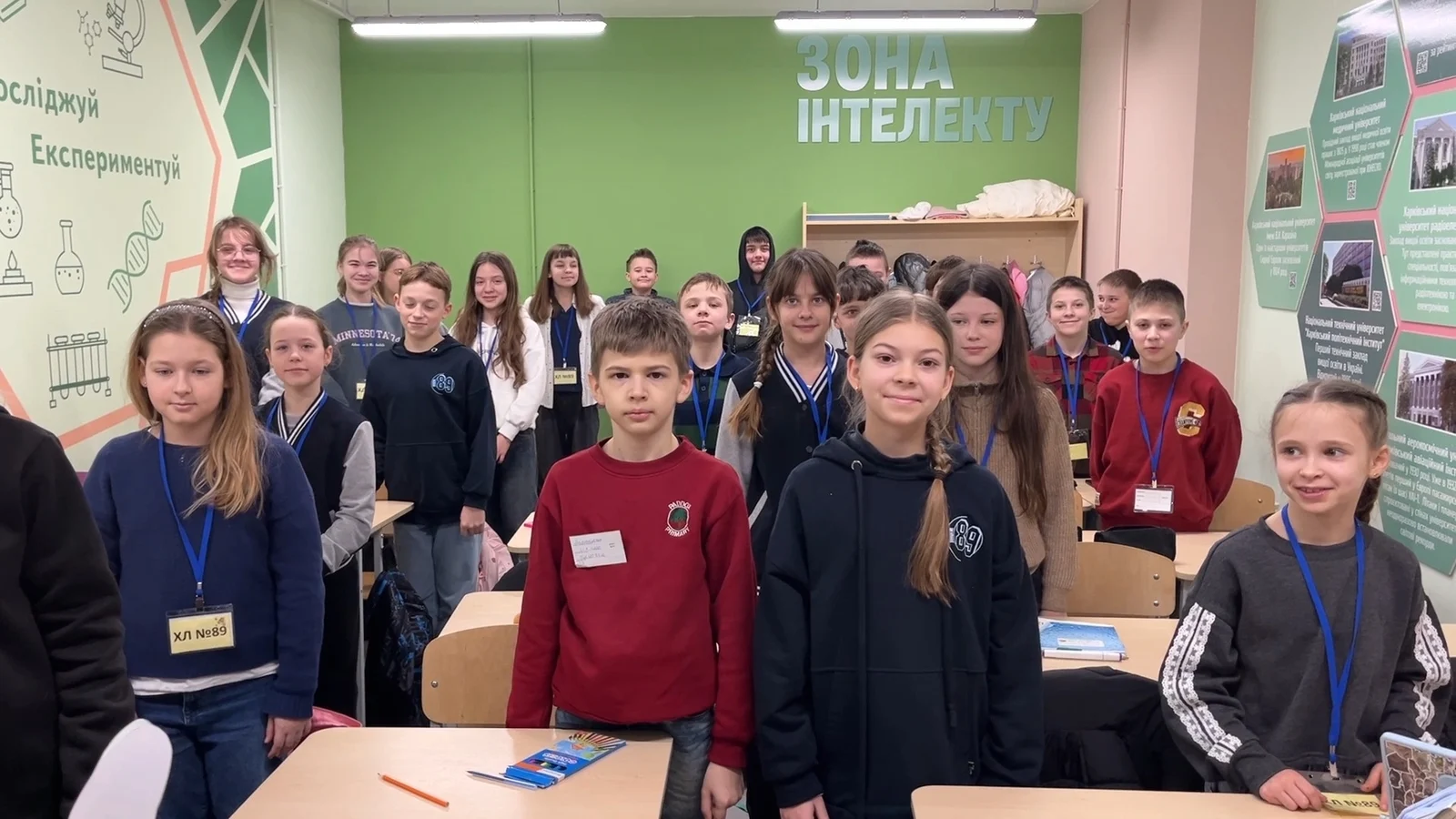
Downstairs Lessons: How Kharkiv’s Children Go to School Beneath the City
On a cold morning in Kharkiv, the city’s tram lines hummed aboveground while a different kind of life unfolded below. I stood at the mouth of a reinforced stairwell and listened as a distant siren faded — the ordinary, unnerving punctuation of daily life here. Then I descended into a world that feels both familiar and utterly alien: classrooms carved into the concrete ribs of the city’s subway and custom-built air‑raid shelters, where school desks and chalkboards sit shoulder-to-shoulder with pipes, tiles and the low, constant echo of a metropolis under strain.
Since 2024, tens of thousands of children in this eastern Ukrainian city have been attending classes underground. Kharkiv, barely 30 kilometres from the active frontline, was pummelled at the outset of Russia’s full-scale invasion in 2022 and remains within range of drones and missiles. Today, according to municipal figures, roughly 55,000 pupils are taught in about 21 underground sites — metro stations turned classrooms, repurposed bomb shelters and purpose-built subterranean schools.
What a school day looks like under the surface
Imagine the bell: not the thin metal clang of a school in peacetime but the steady, human cadence of teachers stepping out from behind a partition, smiling through masks and scarves. Students trickle in with backpacks, some clutching notebooks, others clutching small comfort objects — a toy, a fleece scarf, a photograph tucked into a pencil case. Teachers organize lessons on laminated timetables, but they also double as guardians of calm, breathing exercises and storytellers who carefully shield children from the mechanics of war with narrative and routine.
“We teach verbs and sums, but we also teach how to be still,” said a teacher who leads a primary class in a converted metro hall. “Not to freeze in fear, but to sit quietly during alerts, to help a friend, to trust that the adults here will keep them safe.” Her voice was steady; her eyes were tired but resolute. “The small wins matter — a handwriting improvement, a child returning after a week away, a nervous smile that didn’t need to be rehearsed.”
Lessons are adapted. Physical education looks different underground — games of coordination and breath control replace sprinting across a playground. Art classes use found materials and bright paper to build mosaics that hang like flags along concrete walls. Science experiments are planned with safety in mind; experiments that require heat or strong chemicals are postponed for online sessions or moved to safer days. Technology helps bridge gaps: when signal holds, teachers stream live lessons to children who cannot leave their homes.
Voices from the underground
“I missed the sun at first,” said 12‑year-old Yulia, turning a page in a math workbook, fingers ink‑stained from solving fractions. “But I like being with my friends. We laugh a lot. My teacher tells stories about Kyiv and our region and sometimes about when everything was different.” Yulia offered her answer shyly, then brightened: “I want to be a doctor. To help people. Under here, you learn to be brave.”
Parents speak in tones threaded with gratitude and sorrow. “We thought about leaving in 2022,” said Maksym, father of two. “But my wife’s elderly mother couldn’t move, and the children need routine. These underground schools give us that — and something else: dignity. They are places where kids are not just protected but taught to think about a future.” He paused. “It doesn’t replace the green parks, but it keeps childhood alive.”
Behind the numbers: facts and support
The scale of Ukraine’s educational disruption has been immense. International agencies such as UNICEF and UNESCO have repeatedly underscored that the war has affected millions of children’s schooling, both directly through destruction and indirectly through displacement and economic strain. In Kharkiv alone, municipal data indicate the 21 subterranean learning sites accommodate about 55,000 students, an extraordinary mobilization that illustrates the city’s pivot from conventional schooling to education as a protective service.
Local authorities coordinate with schools, volunteers and international partners to ensure the shelters are ventilated, heated and stocked with basic supplies. Many of these underground sites began as metro stations or civil-defence bunkers; some were expanded or refurbished after 2022 to meet the demands of continuous schooling under threat. Air raid alerts still sound multiple times a day — a fact parents and teachers measure their days by — but the routine has settled into a kind of rough normalcy that many here call “life with precautions.”
Inside, but not isolated
It would be easy to imagine an underground school as bleak and sterile. Instead, what you find is a surprising array of color and care. Teachers tape students’ artwork along the columns; a volunteer group hangs fairy lights to soften the glare of fluorescent bulbs; a local baker delivers loaves of bread to children in the mornings. Kharkiv’s cultural soul — its music cafes, its student theaters, its commitment to community — threads through even these concrete vaults.
“We try to keep our identity alive,” said Lyudmila, a school director coordinating schedules across several underground sites. “Singing lessons, poetry readings, even history class — all remind the children they belong to a place, not just to a time of crisis. That matters for resilience.”
Why these makeshift schools matter beyond safety
Protection is the obvious reason. But education in such circumstances also preserves social networks, nurtures mental health, and maintains a sense of possibility. Psychologists emphasize that routine — predictable transitions from home to school, from math to recess, from lesson to lunch — is stabilizing for children who experience trauma. Groups working in Ukraine report that structured learning can reduce anxiety, lower behavioral problems and sustain developmental progress that would be otherwise lost.
“Education in emergencies is not a luxury,” observed an international education expert I spoke with. “It’s a core part of humanitarian protection. It anchors lives and prevents the long-term erosion of a society’s human capital.” She added that investments in child-focused psychosocial support, teacher training and safe learning environments pay dividends for decades.
Looking up: reflection and the wider picture
Walking back upstairs, the light strikes differently after you’ve spent hours below — brighter, somehow brash. You notice the scaffolding around a damaged facade, the new mural on a school wall, the children who run with the reckless joy only young bodies can muster. Kharkiv’s underground classrooms are a testament to an extraordinary human impulse: to keep teaching, to keep learning, and to keep hope within reach.
Do we measure the cost of education interrupted only by tallying lost school hours? Or should we also count the courage of teachers transforming metro platforms into laboratories of resilience, the tenderness of parents delivering snacks and the small, stubborn acts of play that insist on joy? When conflict forces cities to reinvent where schooling happens, the world watches what a community chooses to preserve.
For readers far from eastern Ukraine: what does it mean when children’s lives are rerouted into tunnels and bomb shelters so they can learn? How does the global community respond — with aid, with policy, with long-term support for rebuilding schools and mental-health services? These are questions that stretch beyond Kharkiv’s station-turned-classroom, asking us how we protect the future of the world’s children when the present becomes uncertain.
Back in the underground hall, a teacher rings a small bell and the students straighten. The lesson resumes — a geography map unfolds, a child answers a question, a scribbled star is circled in pink felt-tip. Above them, the city goes on: trams, markets, the low thrum of a place holding its breath and pushing forward. Down there, beneath the weight of threat, learning does not stop. It adapts, insists, survives. And in that insistence you can see the outline of life continuing — stubborn, everyday, utterly human.