Morning sirens and steaming coffee: life on the edge in Kharkiv
I woke to the skittering trill of an air-raid alert the way some people wake to birdsong — a reflex rather than panic. Outside, Kharkiv was a picture of brittle normality: buses lumbering past, trams gliding over snow-rimmed tracks, a line of people at a bakery steam-wreathed and patient.
For a city that has been within earshot of active combat for four years, there is a curious choreography to daily life. The siren pierces the town; heads tilt toward the sky; then, almost as casually, the conversation resumes and the queue inches forward. How do you reconcile the cadence of small comforts with the drumbeat of war?
Where the frontline breathes
Traveling north from the center, the terrain shifts and the city’s scarred edge arrives: a motorway where construction crews unspool nets like fishermen casting for a strange, modern catch. “We’re just fishermen with rivets and steel,” one of them said with a half-grin as he looped wire through an anti-drone curtain.
The nets are practical poetry. Since the year began, crews said, they had strung roughly 18 kilometres of barrier along arterial roads moving outward from the border. The work is a blunt reply to a technological problem: in recent months Russian forces tried a fibre-optic guidance trick — a wafer-thin cable trailing a drone to avoid electronic jamming — and the city answered with more nets and new tactics.
Kharkiv’s proximity to the front is sobering. By road it’s only about 30 kilometres to the north; across flat farmland, maybe 20. At night, anti-aircraft tracers and the distant thump of Ukrainian air defenses are as much a part of the soundscape as shop shutters and distant laughter.
Damage counted in buildings and in stories
The toll is not abstract. Some 13,000 buildings in Kharkiv have been damaged or destroyed since the invasion escalated in 2022. In the chaotic months of the first wave, more than 600 residents were killed by shelling within the first three months alone, a stat that reads like a headline but feels like a ghost in the room when you stand beneath a shattered balcony.
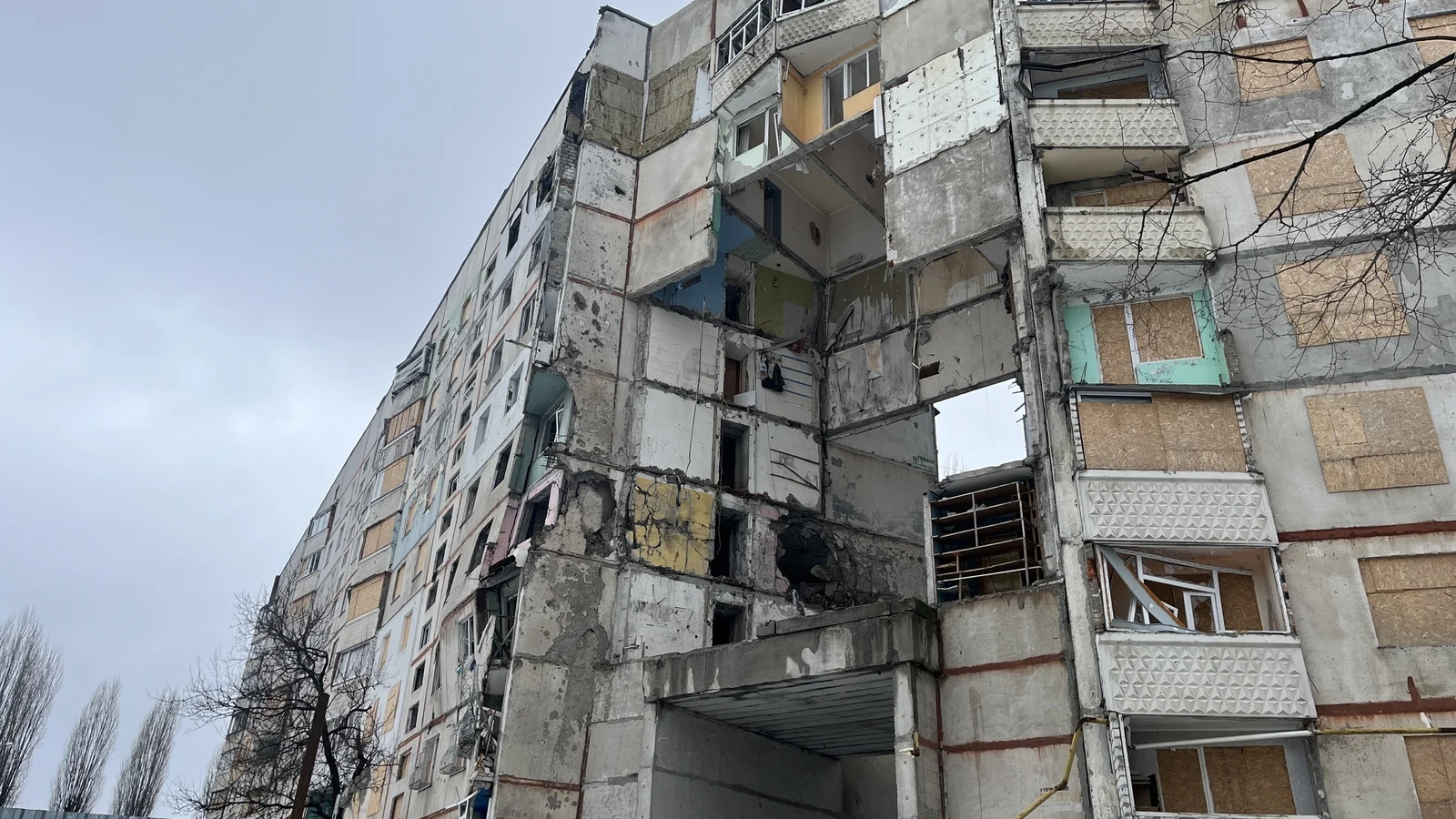
We went to Saltivskyi, a northern district that wears its wounds plainly. A 14-storey block stood with a jagged hole eaten out of one face; windows caved in like teeth. A woman’s coat still hung from an exposed wall — a mute testament to a life interrupted.
That morning, a Shahed-style drone had slammed into another residential block just before dawn, leaving a crater where a bedroom might have been. Cars outside were charred. By luck — no, by something more fragile — there were no deaths. “If it had tilted just a few degrees,” a neighbour murmured, “it would have been someone’s child.”
People, in all their resilient variety
In the back rooms of the damaged buildings, municipal workers were already boarding windows and clearing glass. The Ukrainian Red Cross moved through the site with thermoses and first-aid kits. A pensioner called Margarita Belkina invited us into the studio apartment she said she survives on for under €100 a month. Her floor was awash in glittering shards. She touched a pane of intact glass with something like affection and sorrow.
“The war made me a patriot,” she said in a voice that was both small and fierce. “I never thought I’d call myself that. But my home — my life — it’s here.” Margarita’s eyes were steady. She does not plan to leave.
In the city center, cafes and restaurants hum. Where two years ago tables stood empty, now a barista presses a steaming flat white, and young people scroll phones, exchange jokes, and smoke at doorways. Children shuffle off to school — not always in bright classrooms, but often underground, in converted metro stations and purpose-built shelters.
“We try to give them a childhood,” said Kateryna Chyryk, an English teacher who works with one of the city’s 21 underground schools. “Down there, there are no windows to watch the sky, no alarm bells in the distance. We teach grammar and resilience. They are children first.” Her hands stilled on a picture drawn by a pupil: a family, whole, under a yellow-blue sun.
Adaptations, small and large
- Air-raid apps and instant alerts: millions of Ukrainians rely on apps that ping with the location of incoming threats and the nearest shelter.
- Physical countermeasures: kilometres of anti-drone nets and new troop rotations through the city.
- Community solidarity: volunteers, the Red Cross, and municipal teams working hours after strikes to board up homes and deliver heating and supplies.
Voices of doubt and the stubborn hope for peace
Not everyone here expects an end soon. Natalia Zubar, a war-crimes investigator and activist I met at her flat, was blunt. “I can’t see a Russia that decides to stop,” she said. “They have shown no appetite for compromise that recognises our sovereignty. We brace, prepare, and gather the evidence.” Her apartment smelled of coffee and paper; folders lay open like wings, evidence catalogued and numbered.
Yet beneath the hard realism, the city pulses with a different impulse: a hunger for ordinary joys. Renovated shopping centres — some still with their brand names dimmed — welcome shoppers who treat a renovated mall as both victory and necessity. On a cold afternoon, a group of teenagers skateboarded along a boulevard that had been shelled months earlier; their laughter cut through the air like a small, fierce bell.
So what does “normal” look like now?
Here, normal is a compound word: half-bruise, half-resume. It is the sound of boots and lullabies; municipal buses and the whir of anti-aircraft systems. Normal is a country that has learned to translate risk into routines, to weave grief into the fabric of everyday life without letting grief define every gesture.
But at what cost? Mental health clinics report rising demand. Teachers and aid workers speak of fatigue. The economy, while resilient, has been remade around scarcity, logistics, and the constant need for repair. When you walk through Kharkiv, the human calculus is visible: repair, then live; defend, then dream; resist, then rebuild.
Questions to carry with you
How long can societies normalize danger before the normalization itself becomes part of the problem? What does recovery look like for a city whose children learn algebra in a subway tunnel? And finally: when peace comes, how do you mend not just walls and windows, but the small violences that take root in everyday life?
Kharkiv’s answer, for now, is a kind of stubborn grace. People queue for coffee after an air-raid alarm. Pensioners patch curtains. Teachers map syllables underground. Volunteers string nets along the roads. The city continues to breathe.
As you read this, imagine standing at a window with a cup in your hands, watching a city you may never visit continue its slow, fierce work of holding on.