A First Lady in the Security Council: When Symbolism Meets a Smoky Chamber
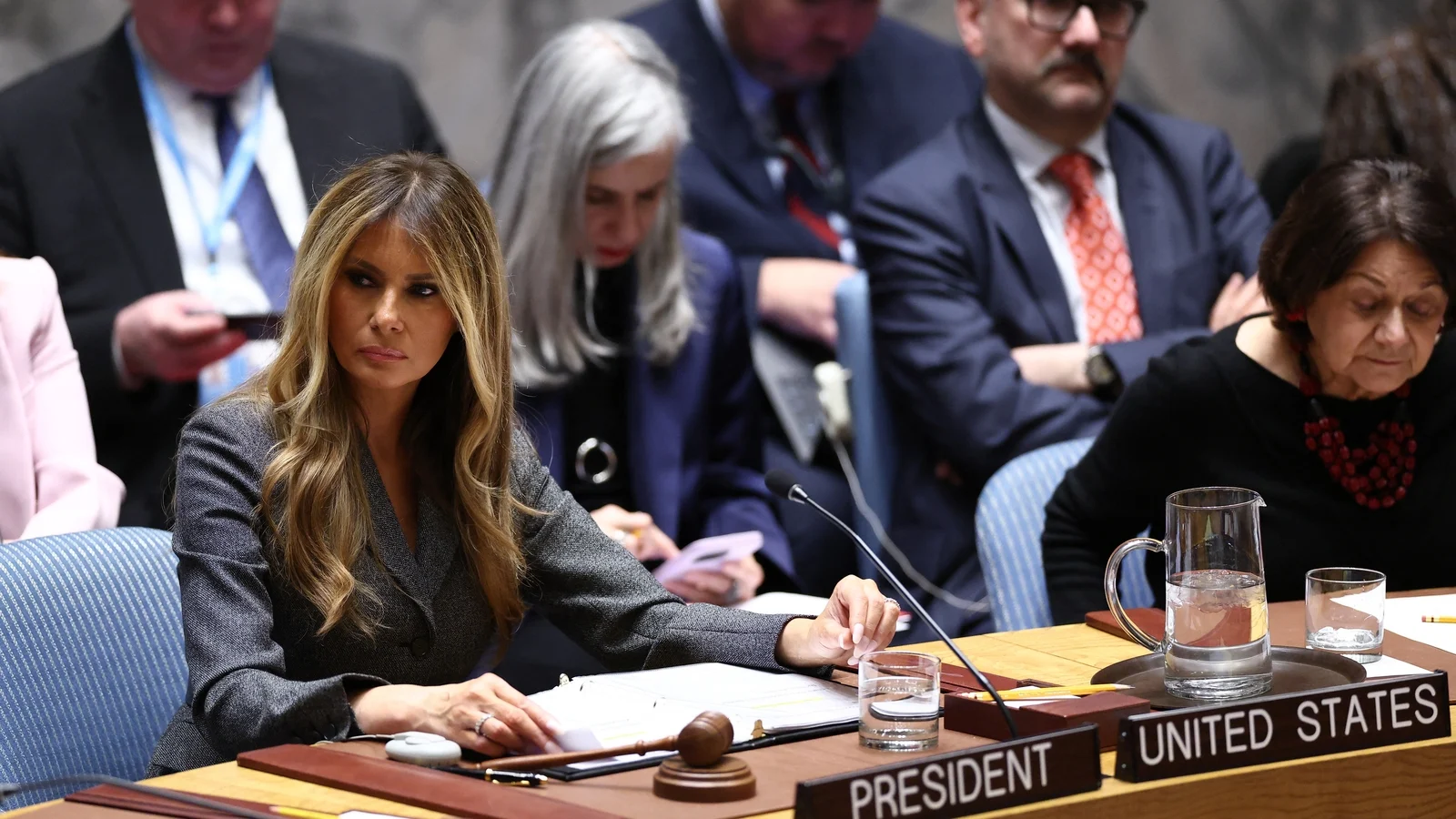
It is not every day that the heavy doors of the United Nations Security Council swing open to a first lady. On a chilly New York morning, Melania Trump stepped into a room built for stern diplomacy and wartime calculus—rows of nameplates, towering flags, the hush that comes when 15 nations listen—and took the chair for a meeting about children, technology and education in conflict.
There was a surreal edge to the scene. The meeting had been scheduled before a fresh wave of violence upended the region; it unfolded just days after the United States and Israel launched strikes on Iran that have focused the world’s attention—and its anxieties—on civilian safety. For many observers, the setting felt like a collision of worlds: the ceremonial and the catastrophic, the symbolic and the immediate.
Historic, for better or worse
This was historic: the first time the spouse of a serving head of state presided over a Security Council meeting. Protocol sheets quietly ruffled. Diplomats exchanged glances. Some saw a well-meaning outreach to an issue that cries out for more attention; others saw the personalization of policy, an image of governance refracted through family and allies.
“The US stands with all of the children throughout the world. I hope soon peace will be yours,” Melania Trump told the council in a short, measured statement that sought to place education as the hinge upon which tolerance and peace could swing.
“It shows the importance that the United States feels towards the Security Council and the subject at hand,” UN spokesperson Stephane Dujarric said this week, framing the appearance as Washington’s signal to the world about where it wants to put the spotlight.
Voices from the ground: grief, accusation, and the question of credibility
As the polished language of diplomacy filled that chamber in New York, the town of Minab in southern Iran became an urgent, raw counterpoint in the global conversation. Iran’s UN envoy, Amir Saeid Iravani, accused the United States and Israel of responsibility for a strike on a girls’ primary school in Minab that he said killed 165 schoolgirls. “It is deeply shameful and hypocritical,” he said, pointing to the jarring optics of a Security Council meeting on protecting children at the very moment parents were allegedly mourning their children.
Reuters could not independently verify the casualty figures, and that gap—between raw grief and corroborated fact—was one of the most painful features of the day. In moments like this, every headline is freighted with the risk of amplifying tragedy and the duty to seek verification.
On the streets of Minab, people spoke with a cadence that mixed fear and a fierce need to be believed. “We heard the blast at the edge of the schoolyard; then there was dust and smoke,” said a woman who identified herself as the parent of a student at the school and who asked not to be named. “My son is safe, but so many families are waiting to know. We need answers.”
What the child protection community says
UNICEF, alarmed by reports from the region, warned that the military escalation marks a dangerous moment for millions of children. The organization urged de-escalation and cited the lifesaving role of education in conflict zones. China’s UN ambassador, Fu Cong, echoed a familiar refrain from child-protection doctrine: attacks on schools are one of the grave violations against children, and the international community must respond with robust investigations and accountability.
Experts who work on the ground say those calls are more than rhetoric. “When classrooms become targets, you’re not just destroying a building—you’re fracturing a community’s future,” said an independent child protection specialist who has worked for years in the region and asked to speak anonymously for safety reasons. “It’s a tactical blow with generational consequences.”
- The United Nations identifies six grave violations against children in conflict: killing and maiming, recruitment and use, attacks on schools or hospitals, sexual violence, abduction, and denial of humanitarian access.
- The Security Council has 15 members; the UN General Assembly counts 193 member states.
- UN agencies have repeatedly warned that large numbers of children—millions across multiple regions—live under the shadow of conflict and face interruptions to education, displacement, malnutrition and psychological trauma.
Politics, perception, and the role of symbolism
There is a broader conversation embedded in this single act of chairing a council session: who gets to speak for peace, and how does the messenger shape the message? The United States is in the midst of a foreign policy era in which personal relationships and family members have been unusually visible. The presence of a president’s spouse at the helm of the Council underlines this personalized approach.
A seasoned diplomat in New York, who asked not to be identified, noted that diplomacy lives on precedent and practice. “You can vary the choreography—but the credibility of those installations depends on the consistency between words and actions,” they said. “When a state convenes a meeting to protect children and is simultaneously involved in strikes reported to hit civilian areas, the Council’s moral authority comes under strain.”
Behind the rhetoric is another, less glamorous reality: Washington is behind on billions of dollars in UN contributions, and those arrears affect programs and peace operations that are often first responders when schools and hospitals are put at risk.
Education as protection—and as a contested battleground
There is no shortage of research showing that education protects children, reduces vulnerability to recruitment and exploitation, and provides psychosocial support that resilience hinges on. But when conflict seeps into the schoolyard, those stabilizing effects vanish. Schools are increasingly used as shelters, supply depots, or worse—becoming targets themselves.
“You cannot have rebuilding without education,” said a teacher who now works with a regional NGO, traveling between makeshift classrooms and refugee centers. “Kids need routine, learning, and a place where they are not told every day that the world is collapsing.”
Questions for the reader
What does it mean when gestures of concern are staged in the same week as deadly allegations? How should the international community hold itself—and those it accuses—accountable without becoming yet another platform for propaganda? And how do we protect children whose voices are almost never heard in the corridors where decisions are made?
These are not questions with tidy answers. They invite us to look beyond soundbites and into the messy work of verification, humanitarian access, and political will. They also demand that we remember the human faces behind the statistics: parents waiting for confirmation, teachers marking attendance sheets now full of empty names, children who will carry the memory of a destroyed classroom for the rest of their lives.
Closing scene: a fragile hope
Back in the Security Council chamber, as flags fluttered and cameras clicked, the agenda moved on. Few people would claim that symbolism alone will change the calculus on the ground in Minab or elsewhere. But the meeting did place an urgent subject on the international docket—a reminder that in war, some institutions still attempt to stand between power and its most vulnerable victims.
“Peace is spoken of as a lofty ideal,” one relief worker said quietly, “but it is born again in the mundane—the bell that calls children to class, the teacher who shows up, the parent who trusts. Those small acts need protection as much as any ceasefire.”
How we protect those small acts—through diplomacy, investigation, accountability, and funding—may determine whether a generation of children grows up to lead or to inherit scars. The Security Council meeting was a start. Whether it becomes a turning point depends on what comes next: the facts we confirm, the voices we listen to, and the promises the international community keeps. Will we rise to that responsibility?