Smoke over the river: a Hercules falls in Colombia’s Amazon and a town holds its breath
They woke to the sound of a boom that did not belong to the river.
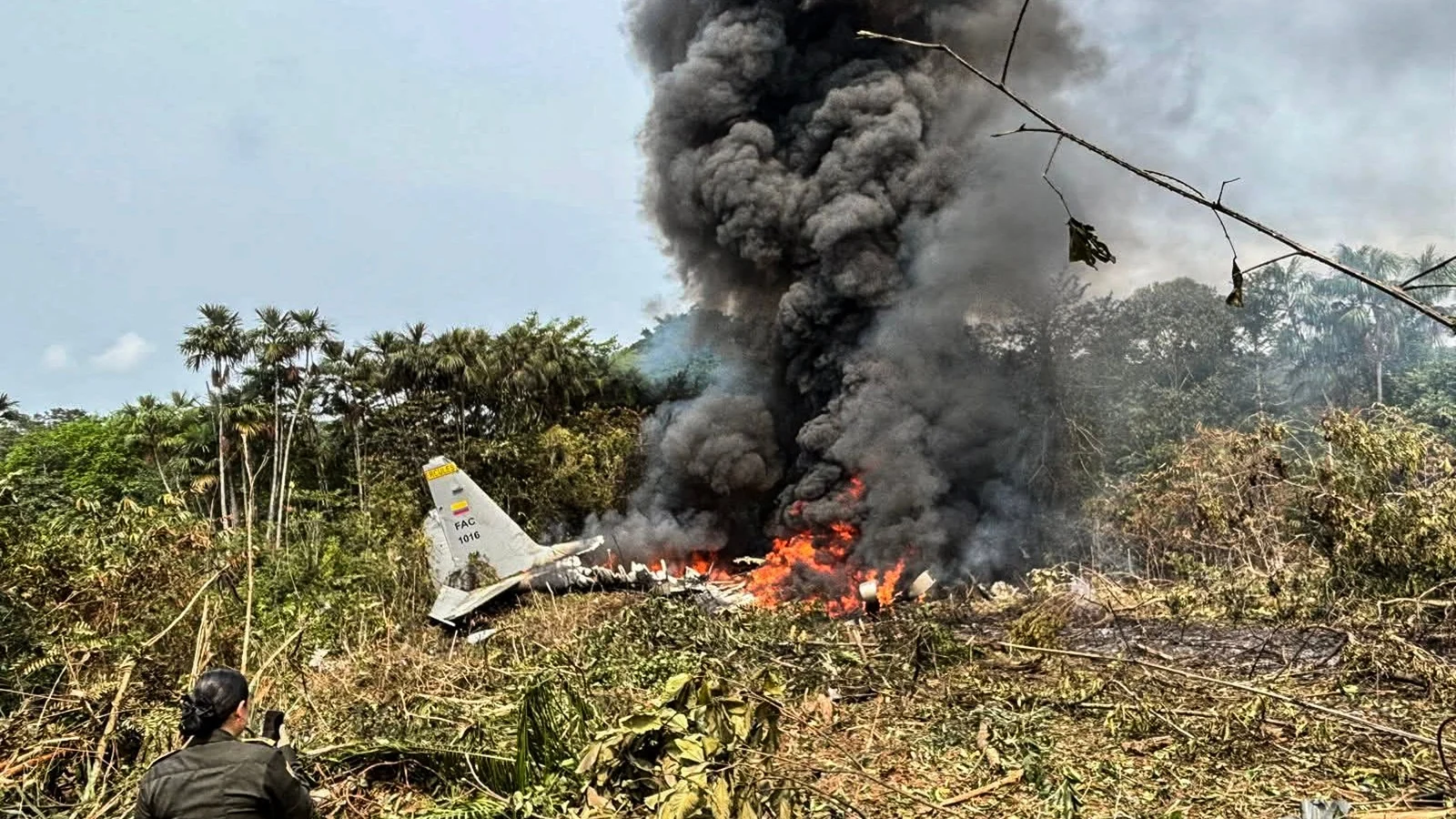
In the small riverside town of Puerto Leguízamo, where mornings usually begin with the slap of boat hulls on mud and the calls of market vendors, a different noise broke the dawn — the sickening thud of an aircraft crashing less than two kilometers from the airstrip. By midday the town square filled with people staring toward the smoke. By evening, the numbers were announced: at least 34 people dead, dozens more injured, and a community plunged into grief and questions.
What happened
Colombian authorities say a Lockheed Martin-built C-130 Hercules transport plane, operated by the Colombian Air Force, went down shortly after takeoff from Puerto Leguízamo, a remote outpost on the Putumayo River near the border with Peru.
Defense Minister Pedro Sánchez said the aircraft hit the ground roughly 1.5 kilometers from the runway. Flames followed the impact and detonations rocked the area as ammunition stored on board ignited. “There is no indication of an attack by illegal actors,” Sánchez wrote on the social platform X. He added that the aircraft had been declared airworthy and that a qualified crew had prepared the flight.
Local officials, including Mayor Luis Emilio Bustos, confirmed the grim toll. “Unfortunately, we currently have 34 confirmed deaths,” the mayor told reporters, his voice weary after hours of coordinating rescue and recovery efforts. Putumayo Governor Jhon Gabriel Molina said that some of the victims were still to be identified.
Faces and voices from the riverside
Across the town, grief and disbelief mixed with a pragmatic rush to help. “We ran down to the river when we heard it,” said one of the town’s boat captains, who asked to remain unnamed. “There was smoke, and then people were coming out from the bush. We took some to the clinic on our boats. The hospital is small — it is not ready for something like this.”
At the health center, nurses treated burns and fractures while relatives searched for missing loved ones. “My brother was a mechanic on the base,” said María, a local woman whose voice trembled. “He used to come to our house on Sundays. I am waiting to know.”
Rescue teams were hindered by the region’s geography. The Amazon’s thick forest, meandering rivers and limited road access mean that most large rescues depend on airlift capacity — the very thing that failed on this flight. “We are used to challenges here,” said a community elder, “but when a plane goes down close to your home, it feels like the whole world has fallen into the river.”
Why a Hercules matters — and why its loss echoes
The C-130 Hercules is not a glamorous jet; it is a workhorse. First flying in the 1950s and continuously developed since, C-130s haul troops, cargo, humanitarian aid and emergency supplies into places few airliners can reach. Militaries across the world still rely on them for their ruggedness and versatility.
For Colombia’s Amazon region, a C-130 is part of the lifeline — bringing medicines, food, and mobility in a vast and sparsely populated landscape where roads are few and rivers are the main highways. The crash therefore has immediate local consequences: delayed supplies, strained medical services and the loss of trusted personnel.
Questions that hang in the smoke
Accidents rarely have a single, neat cause. Aviation investigators will look at mechanical records, weather at the time of departure, crew training, weight and balance, and any potential foreign object damage or runway issues. The fact that ammunition on board detonated adds another layer of danger — it complicates recovery and investigation, and turns an already tragic accident into a chaotic scene.
An aviation safety expert who asked not to be named told me, “Takeoffs in hot, humid, and riverine environments are tricky. Short runways, dense air, and the need to carry heavy loads can reduce margins for error.” He cautioned that it was too early to speculate about any single cause.
Government officials insist there is no immediate sign of hostile action. But in a region that has seen long-running conflicts, illicit economies, and decades of armed groups, the very thought raises old fears. “We want answers,” said a local teacher. “Not speculation. We want the families to know what happened so they can bury their dead and heal.”
On the ground: response, rescue, and the human cost
Emergency crews from regional and national authorities mobilized, but the remoteness of Puerto Leguízamo — reachable by river or small aircraft — complicated immediate aid. Hospitals are small and can be overwhelmed quickly; critical patients require transfer to larger medical facilities, often far away.
Colombia’s geography helps explain why the military uses transport planes for both defense and civilian support in these areas. The region is also a frontline for environmental and social challenges: deforestation, biodiversity loss, and the displacement of indigenous communities. A crash of this scale magnifies those vulnerabilities.
- Passengers aboard: reported 125 people
- Confirmed dead (initial reports): 34
- Distance from departure point where crash occurred: ~1.5 kilometers
- Type of aircraft: Lockheed Martin C-130 Hercules (military transport)
Voices calling for transparency and care
Relatives and community leaders have asked for timely, transparent information and guarantees that the investigation will be thorough. “We need to know not only what happened, but who is responsible for the safety of our people when they fly,” said an aunt of one of the victims. “These are the people who help our towns survive.”
Humanitarian organizations and regional advocates emphasize that accidents in remote areas reveal deeper infrastructural imbalances. “When a place depends on a handful of planes for supplies and mobility, the stakes are national,” said an intellectual and human rights activist based in Bogotá. “We should ask what investments are needed so clinics and towns like Puerto Leguízamo are not so vulnerable.”
Beyond the wreckage: what this tells us about risk and resilience
As investigators comb the charred remains, as families gather names and photographs and the town moves through a ritual of mourning, there is a larger question: how does a nation protect its most distant citizens?
Modern societies pride themselves on connectivity and emergency response, but the Amazon reminds us that geography shapes vulnerability. When roads end and rivers begin, when weather can change in an hour and resources are thin, lives depend on fragile lifelines.
What kind of investment — in infrastructure, in aircraft, in local healthcare — would reduce the likelihood of such tragedies? How can we better balance the demands of national security with the everyday needs of citizens in remote areas? These aren’t easy policy debates, but they are urgent.
Remembering and reckoning
In the days to come, names will be read, funerals held, and investigations published. The people of Puerto Leguízamo will pick through the aftermath — some will return to their boats, others will spend months caring for the injured or confronting bureaucracy. For now, the town gathers around its losses the way it has gathered around countless riverfront rituals: with quiet hands, with songs swallowed on the wind.
As you read this, consider those far from the headlines who keep the gears of remote regions turning — the pilots who fly into small airstrips at dawn, the medics who stitch wounds under lantern light, the families who travel by boat because there’s no other way. What does it mean, in a globalized world, to truly leave no one behind?
When the smoke clears, the hard work of answering that question begins.