Beirut in the Shadow of Sudden Explosions: A City That Felt the Sky Collapse
There is a particular quiet that follows a sudden, huge blast — a stunned silence stitched together with the shriek of car horns and the wail of ambulances. On Wednesday afternoon the sky over Beirut filled with smoke, and that silence was broken over and over again by explosions that flattened buildings and shattered lives.
By early night the Lebanese health ministry had given an initial count: 182 people killed and 890 wounded. Those figures, officials warned, were provisional. On the streets, the arithmetic of loss felt immeasurable: apartments collapsed, families displaced, small businesses levelled, and children torn from classrooms and playgrounds. “I saw the blast, it was very strong, and there were children killed, some with their hands blown off,” said Yasser Abdallah, who runs an appliance shop in central Beirut, his voice raw with disbelief.
The day the capital looked more like a battlefield
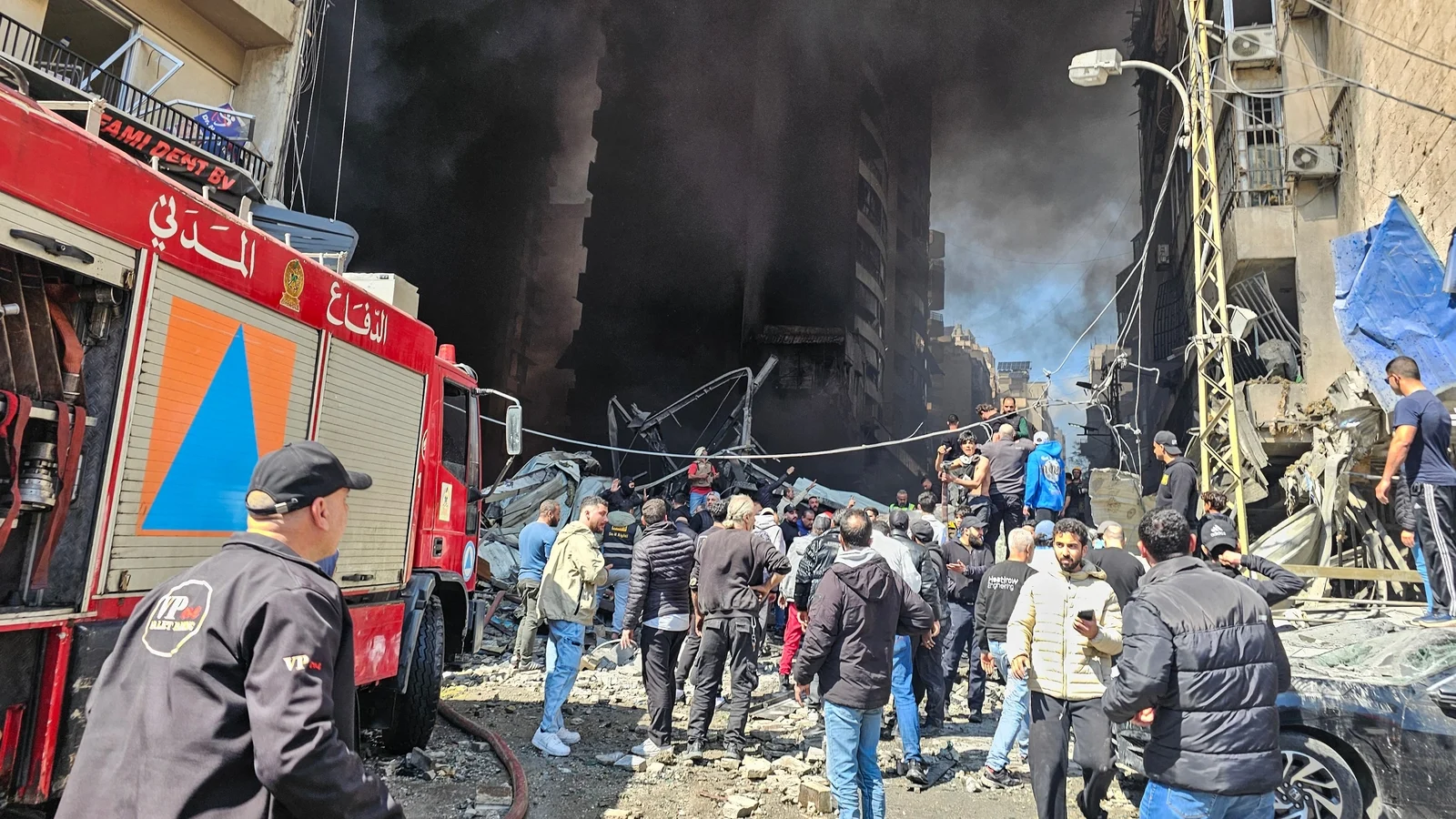
What was striking — and terrifying — was the simultaneity. Strikes hit neighborhoods across Beirut at once, and in one case a residential block in the Tallet El-Khayat area partially crumpled, trapping people on an upper floor while rescuers clawed through cracked concrete and dust to reach them. AFP journalists described scenes of panic: drivers hooting as they tried to clear paths for ambulances, neighbors dragging shattered window frames away, and the acrid smell of burning rubble and diesel filling the air.
One of the strikes toppled a building on Corniche al-Mazraa, a major artery of the capital that once bustled with joggers and families strolling by the sea. Black smoke rose into the sky as the rubble smouldered — a terrible postcard of a city that has already known too many of these mornings.
Names, Loss, and the Fragility of Truth
The dead included two journalists — Suzanne Khalil of Al-Manar TV and Ghada Dayekh of the local radio station Sawt Al-Farah — bringing home the grim reality that reporters, too, pay with their lives for the public’s right to know. “They were here to tell the story,” a colleague told me, voice low. “Now those stories end in a grave.”
Across southern Lebanon and into the Aley mountains, state media reported strikes that mirrored the devastation in Beirut. Hospitals filled, morgues overflowed, and rescue teams worked into the night with limited equipment. Emergency workers spoke of chaotic scenes and of being overwhelmed; one volunteer medic described transporting children with blast injuries “wrapped in blankets and silence.”
Humanitarian corridors battered and bridges broken
The raids did not only exact immediate casualties. They severed lifelines. Israel struck the last coastal bridge connecting Tyre to Beirut — the seventh bridge over the Litani River hit since the fighting intensified — hampering evacuation routes and aid efforts. In a region where a single river can be the line between safety and siege, the destruction of such infrastructure amplifies the human toll.
Despite evacuation orders that pushed tens of thousands north or inland, humanitarian efforts continued in small, stubborn ways. A Catholic NGO managed to deliver roughly 30 tonnes of aid to Christian-majority villages in the south — a statistical blip against the scale of suffering, but a human one nonetheless. “We could not stand watching children go hungry while waiting for political agreements,” said the NGO’s coordinator as volunteers unloaded boxes in a dusty courtyard.
Politics in the wake of smoke
Wednesday’s strikes came against the fraught backdrop of a US-Iran ceasefire announced overnight. Pakistani Prime Minister Shehbaz Sharif, who has been attempting to mediate among regional players, declared that the two-week pause should apply “everywhere including Lebanon.” But Israel’s government moved quickly to exclude Lebanon from its interpretation of the truce.
“Lebanon was not covered,” Israeli officials stated, and Israel’s defence minister said the strikes had targeted Hezbollah members across the country — calling it the largest operation since the pager-bomb campaign of 2024. Hezbollah, for its part, said it was on the verge of a “historic victory” and insisted it retained the right to resist. Yet since the Iran-US stitch of temporary calm came into force, the group had not announced any operations.
White House Press Secretary Karoline Leavitt later said Lebanon remained on the table for discussion among leaders, acknowledging the diplomatic tightrope the US and its allies are walking. Back in Beirut, President Joseph Aoun described the shelling as evidence that Israel was “pressing ahead with its aggression and dangerous escalation despite international efforts to contain tensions in the region.”
The wider ripple: displacement, statistics, and the human ledger
To grasp what these latest strikes mean, you must step back from the smoke. Since the conflict widened, Lebanese authorities say more than 1,500 people have been killed and over one million displaced. Whole neighborhoods have become mosaics of corrugated roofing and temporary tents. Markets where families once bought zaatar and fresh fish are now replaced by aid distribution points and queues for bottled water.
These numbers are not abstract. Each displaced family represents disrupted education, lost livelihoods, and long-term psychological trauma. Schools converted into shelters do double duty: protecting and depriving. Children who should be learning multiplication tables are counting checkpoints and worrying about missing meals.
- Reported deaths so far: 182 in Wednesday’s raids (initial toll) and more than 1,500 since the wider campaign began.
- Reported wounded on Wednesday: 890, with likely undercounting due to overwhelmed hospitals.
- Displaced persons since the escalation: over 1,000,000, according to Lebanese authorities.
Voices on the ground
Local voices are varied and aching. “My sister’s apartment is gone,” said Rania, a schoolteacher who has been sleeping at a neighbour’s house with three children. “We are not safe anywhere. The whole city feels like it could fall apart at any moment.”
An ambulance driver named Samir told me he had been out all day making impossible choices. “Which house do you go to first? The one closest? The one with smoke coming out? You can only carry so many people in a stretch of an hour,” he said, wiping soot and sweat from his brow. “Sometimes you feel like you are running on prayer more than fuel.”
A regional analyst based in Beirut, Dr. Leila Haddad, framed the moment differently: “This is not just a military operation; it is a continuation of a long, tragic cycle where civilians are the main casualties. If diplomacy excludes whole territories, the diplomacy is failing the people it is meant to protect.”
What does the world owe Beirut?
When cities burn and bridges fall, the instinctive international response is either to convene and contain or to point fingers across noisy diplomatic channels. But between statements and summits, people need water, medical care, shelter, and a map to safety. They need guaranteed humanitarian corridors and the protection of journalists and emergency crews.
So ask yourself: when a ceasefire is negotiated between powers far from the rubble, who gets to decide which towns are covered? When a bridge is destroyed, who is responsible for rebuilding the small economies that cross it daily? And when journalists are killed trying to tell us what’s happening, how much harder does it become to understand the truth?
Beyond the headlines
There is no easy answer. But there is a simple, urgent truth: the scenes in Beirut on that smoke-filled afternoon are not isolated. They are part of a larger pattern where regional rivalries and global diplomacy collide on the faces of ordinary people. If the world wishes to break that pattern, it must choose persistent humanitarian engagement, clear rules of engagement that protect civilians, and a willingness to hold actors accountable when they cross those lines.
For now, Beirut waits under a mantle of dust and resolve. Neighbours share what little they have. Rescue teams keep digging. And outside the city, diplomats weigh public statements and private calls. The question is whether words on paper — ceasefires and declarations — can keep pace with the fragile work of saving lives on the ground.
When the blast dust settles, who will be left to rebuild? And what will remain of the everyday rhythms of a city that thought it could absorb the past and still move forward?