A surprise breakthrough between Washington and Tehran could soon reshape the conflict that has battered the region and jolted global oil markets: US and Iranian officials say they have agreed on a peace framework to end their war, lift the US blockade of Iran and reopen the Strait of Hormuz — a shift that could ease energy prices once shipments move again through the strategic corridor.
“The Deal with the Islamic Republic of Iran is now complete,” US President Donald Trump wrote on his Truth Social platform.
His declaration followed a message from Pakistan Prime Minister Shehbaz Sharif, whose government has acted as a mediator, saying the parties had reached an agreement.
The pact will be formally signed on Friday in Switzerland, Mr Sharif wrote.
For now, the exact terms remain unclear.
In a post on X, Mr Sharif said the framework calls for “the immediate and permanent termination of military operations on all fronts, including in Lebanon.”
Lebanon has repeatedly complicated the talks, with Israel and Hezbollah brushing aside calls from Mr Trump and others in recent weeks to halt their exchanges.
Mr Trump said the Strait of Hormuz — a vital artery for global energy supplies that Iran has effectively kept closed for months — would reopen on Friday, and that he had directed an end to the US blockade of Iranian ports.
“Ships of the World, start your engines. Let the oil flow!,” Mr Trump wrote.
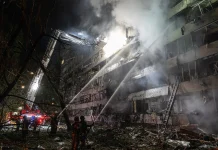
An Israeli airstrike on southern Beirut caused a late crisis in the talks
Markets reacted quickly. Brent crude futures dropped 4% in early trading this morning, while US West Texas Intermediate slid more than 4.6%.
Iran’s deputy foreign minister, Kazem Gharibabadi, said negotiators would pursue a broader agreement during a 60-day ceasefire window, including sanctions relief.
Sources previously told Reuters that those follow-on talks would also tackle the future of Iran’s nuclear program.
Since US and Israeli forces first attacked Iran on 28 February, thousands of people have been killed, mostly in Iran and Lebanon.
Iran has hit Israel as well as Gulf states that host US bases, and it has effectively blockaded the Strait of Hormuz, driving up global energy prices.
In response, US forces have blocked Iranian ports.
Israel offered no immediate comment, and it has said it was not a party to the planned US-Iran deal.
At home, the Iran war has weighed on Mr Trump and fellow Republicans in Congress, with public opinion polls showing Americans increasingly angry about higher gas prices ahead of November’s midterm elections.
Mr Trump has also confronted pressure from within his own party, where some insist Iran’s nuclear program must be fully shut down.
Israeli attack
Even as negotiators closed in on the agreement, an Israeli strike in Lebanon yesterday nearly derailed the effort and drew sharp criticism from Tehran and from Mr Trump.
Iranian negotiator Mohammad Baqer Qalibaf said Israel’s latest attack on Beirut’s southern suburbs — which Israel said targeted Iranian-backed Hezbollah militants — demonstrated the United States lacks “the will and ability to fulfil your commitments” in a post on X.
Iran’s foreign ministry said it held the US responsible for the attack.
Iran threatened a “strong response”, and its top joint military command said the “finger (is) on the trigger” ready to fire at the “enemy’s heart”.
Earlier yesterday, Mr Trump wrote: “This morning’s attack on Beirut should not have happened, particularly on a special day when we are so close to a Peace Deal with Iran.”
Prime Minister Benjamin Netanyahu has clashed with Mr Trump over US demands that Israel rein in its military action in Lebanon to clear the way for an agreement with Iran.
Israel has said it will keep freedom of operations in Lebanon, while Iran has made a full ceasefire there a central element of its demands.
Mr Trump briefed Mr Netanyahu on the progress toward a peace deal during a phone call yesterday, Israel’s N12 reported, citing a senior official.
Deal terms
Earlier, a senior Iranian official told Reuters that the draft deal would have the US release $25bn in frozen Iranian assets, while Iran would commit not to produce or obtain nuclear weapons.
The official said Iran agreed to preserve the nuclear status quo — including no uranium enrichment or expansion of nuclear facilities — until a final deal is reached.
A US official, speaking before the deal was announced, said the agreement would ultimately dismantle Iran’s nuclear program, with its stockpile of highly enriched uranium to be destroyed and removed.
Some hardliners have accused Iran’s Foreign Minister Abbas Araghchi of being a ‘compromiser’
A senior Iranian official said the draft deal would allow Iran — which denies seeking a nuclear bomb — to dilute its enriched uranium inside the country.
As negotiators worked to close the framework, Qatari officials flew to Tehran yesterday morning to help finalize the agreement, a source with knowledge of the situation told Reuters.
Inside Iran, the proposed framework has already faced public pushback from hardliners. At pro-government rallies across the country on Saturday night, residents and news agencies reported that opponents of the deal voiced their anger.
A resident in the northeastern city of Mashhad told Reuters that some protesters chanted “Death to the compromiser,” an apparent reference to Foreign Minister Abbas Araqchi.