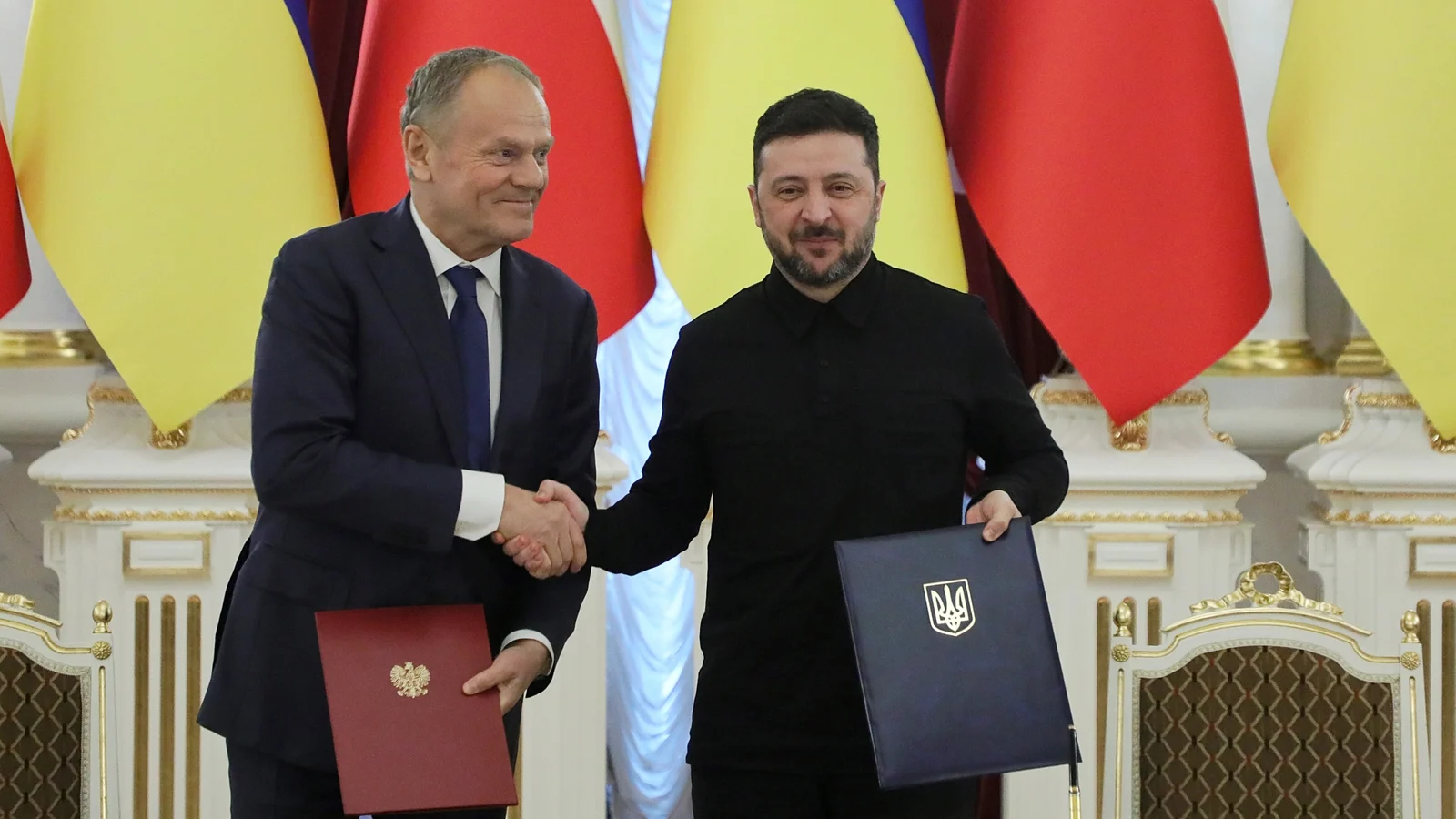
A row over World War Two history has suddenly pushed Poland and Ukraine toward a fresh diplomatic clash, after Poland’s president moved to revoke Volodymyr Zelensky’s highest Polish decoration in response to a Ukrainian military renaming that sparked fury in Warsaw.
President Karol Nawrocki’s decision threatens to sour relations between the neighbours just days before a conference on Ukraine’s reconstruction scheduled in the Polish city of Gdansk.
“In light of President Volodymyr Zelensky’s consent to nameone of the units of the Armed Forces of Ukraine “Heroes of theUPA,”… I have decided to revoke the Order of the White Eaglefrom the President of Ukraine,” Mr Nawrocki said in a statement.
“At this point, I would like to emphasise: this decision is not directed against the Ukrainian people. It does not signify a change in the strategic direction of Polish security policy.”
Mr Zelensky’s office offered no immediate response.
Read: Latest Ukraine stories
Although Warsaw has been among Kyiv’s strongest backers in its war effort, attitudes inside Poland have cooled in recent years amid fatigue over refugees, arguments about grain imports and the unresolved legacy of wartime atrocities.
Ukraine’s Foreign Minister Andrii Sybiha condemned the revocation as a “strategic error”.
“We regret that instead of looking for solutions, the Polish side decided to escalate this conflict to an unacceptable and inappropriate level,” he wrote on Facebook.
“No president of another country is going to dictate our history to us.”
Mr Sybiga said yesterday he intended to return an award he received from Poland in 2022, calling Mr Nawrocki’s decision “unjustified, impulsive and disrespectful”.
On Saturday, Mr Zelensky’s top aide and Ukraine’s ambassador to Warsaw echoed Mr Sybiha, saying they too would give up Polish honours in solidarity with the Ukrainian president.
They said the dispute would serve Russia’s interests.
“This is a gift to the Moscow aggressor, who will certainly use it against both of our countries,” Zelensky aide Kyrylo Budanov said on social media.
Mr Budanov said he was returning the Gold Officer’s Cross of the Polish Order of Merit.
Ukrainian Ambassador to Warsaw Vasyl Bodnar said on Saturday he was relinquishing his Knight’s Cross of the Polish Order of Merit, describing Mr Nawrocki’s move as a “gesture directed at the entire Ukrainian people”.
Polish Prime Minister Donald Tusk, Mr Nawrocki’s political rival who has tried to dampen the fallout, urged both presidents late yesterday to ease tensions.
“The conflict between Poland and Ukraine delights Putin and shocks our allies. The task of Presidents Zelensky and Nawrock iis to calm emotions, not to stoke tensions. The front line runs elsewhere,” he wrote in a post on X.
Former president Andrzej Duda presented Mr Zelensky with the Order of the White Eagle in 2023, citing his role in strengthening bilateral ties, democracy, peace and security in Europe, and praising his “steadfastness in defending inalienable human rights”.
Mr Nawrocki, however, said in May that an advisory council should examine whether Mr Zelensky should be stripped of the honour after the Ukrainian leader signed adecree that recognised a special forces unit for fighting Russian troops by naming it after the Ukrainian Insurgent Army (UPA).
That move triggered anger across Poland’s political landscape. Former Polish President and Nobel Peace Prize winner Lech Walesa said he would stop wearing a badge with the Ukrainian flag and, while continuing to back Ukraine in its fight against Russia, said he would not support Mr Zelensky.
In Ukraine, some view the UPA as heroes because of the resistance it mounted against the Soviet Union and Nazi Germany, and as an emblem of Kyiv’s long struggle for independence from Moscow.
Yet the group is also associated with the Volhynia massacres, killings carried out from 1943 to 1945 in which Poland says roughly 100,000 Poles died at the hands of Ukrainian nationalists.
Thousands of Ukrainians were also killed in retaliatory attacks.
Kyiv has previously said the name was selected by soldiers seeking to honour the UPA’s fight against Moscow, insisting there was no intention to offend Poland.