Iran is preparing to adopt what a senior official described as a “fully offensive” military posture after talks aimed at a permanent end to the war with the US stalled and Washington ruled out extending a temporary ceasefire.
Any momentum toward peace negotiations — and the return of oil tanker traffic through the strategic Strait of Hormuz — has dried up, raising the prospect of a longer conflict that began when the US and Israel launched attacks on Iran on 18 February.
“Iranian entities must be prepared to escalate tensions in the Strait of Hormuz and wider region, as Iran will be ready to make decisions and take action on difficult decisions,” the Iranian nofficial said. The official added that if diplomacy collapsed, Tehran would carry out a “timely and precise” military strike to break what was described as a US naval blockade.
A memorandum of understanding signed in June was intended to end the war and set a deadline of yesterday for Iran and the US to reach a final peace agreement.
Signed on 17 June, the memorandum set a 60-day time frame for a broader deal on Iran’s nuclear programme and US sanctions.
A car with replicas of missiles and an image of Iran’s new Supreme Leader Mojtaba Khamenei (R)
Although the agreement declared the “immediate and permanent termination of military operations on all fronts,” it quickly began to fall apart amid a disagreement over control of the Strait of Hormuz — a narrow corridor through which a fifth of global oil and liquefied natural gas moved before the war.
Asked by reporters whether the US would prolong June’s interim agreement, US President Donald Trump said no.
Back channel to IRGC
Still, one sign of diplomacy surfaced in media reports that Mr Trump had launched back-channel discussions with the Islamic Revolutionary Guard Corps, an organisation that has grown more powerful during the war and controls large parts of Iran’s armed forces and the economy.
Axios, citing two sources with direct knowledge, reported that former Director of National Intelligence Tulsi Gabbard spoke with an Iraqi Kurdish leader who has close ties to the IRGC, and that the US used the intermediary to send a message to IRGC commander General Ahmad Vahidi.
Fox News later reported that Mr Trump confirmed the account in a telephone interview.
The Trump administration was questioning whether Iranian negotiators at the table truly represented the IRGC, Axios reported, as Reuters described Gen Vahidi as a pivotal figure.
Gen Vahidi told Axios he was aligned with the Iranian negotiators.
“I can’t go into the details of it, but I will say that the conversations between the US government and different areas of the Iranian government at all areas is probably more robust than it’s maybe ever been,” Jared Kushner, Trump’s son-in-law and special envoy, said in a separate interview yesterday with Fox News Channel’s Chief Foreign Correspondent Trey Yingst.
Trump threatens to bomb Oman
Iran has argued that point five of the Memorandum of Understanding gives it the right to manage the strait, which it shares with US ally Oman, while the US has rejected that reading.
Fighting resumed after Iran began firing on vessels it said were attempting to pass through Hormuz via an unapproved route, and Mr Trump said on 7 July that the pact was “over”.
The Iranian official said Washington must fulfil the entirety of the MoU’s provisions within a few weeks as a precondition for any further negotiations.
Injured Pakistani and Indonesian crew members are discharged from a hospital in Yemen after their vessel was targeted by Houthi rebels in the Bab al-Mandab Strait last week
Even as Iran portrays itself as holding firm in the war, its leaders are concerned that the threat of additional economic punishment could deepen hardship, spark unrest again and further weaken the Islamic Republic’s legitimacy, according to three Iranian officials.
Iran went into the conflict facing high inflation, a weakening currency, energy shortages, sanctions and deep structural weaknesses. It must now also cope with damaged infrastructure, disrupted trade, lost production and the expense of rebuilding.
Separately, Iran has been negotiating with Oman on an agreement to manage the strait and says the sides are close to a deal. Mr Trump responded to those talks by threatening the Gulf state, a longstanding US security partner.
“If Oman gets in the way, we’ll bomb the sh*t out of them,” he told Fox News.
Thousands of people have been killed in the conflict, mainly in Iran and Lebanon.
Iran has bombed US military bases and infrastructure in countries including Oman, Jordan, Kuwait, Israel, the United Arab Emirates and Saudi Arabia.
Mr Trump warned Americans at a rally on Friday to brace for continued high fuel prices as a consequence of the war.
Americans have seen fuel prices rise above $4 a gallon
Benchmark Brent crude oil futures have jumped during the conflict, reaching a peak of $126 a barrel — about 75% higher than pre-war levels.
For Americans heading into November congressional elections, fuel costs have climbed above $4 per gallon from less than $3 before the war, according to the automotive group AAA.
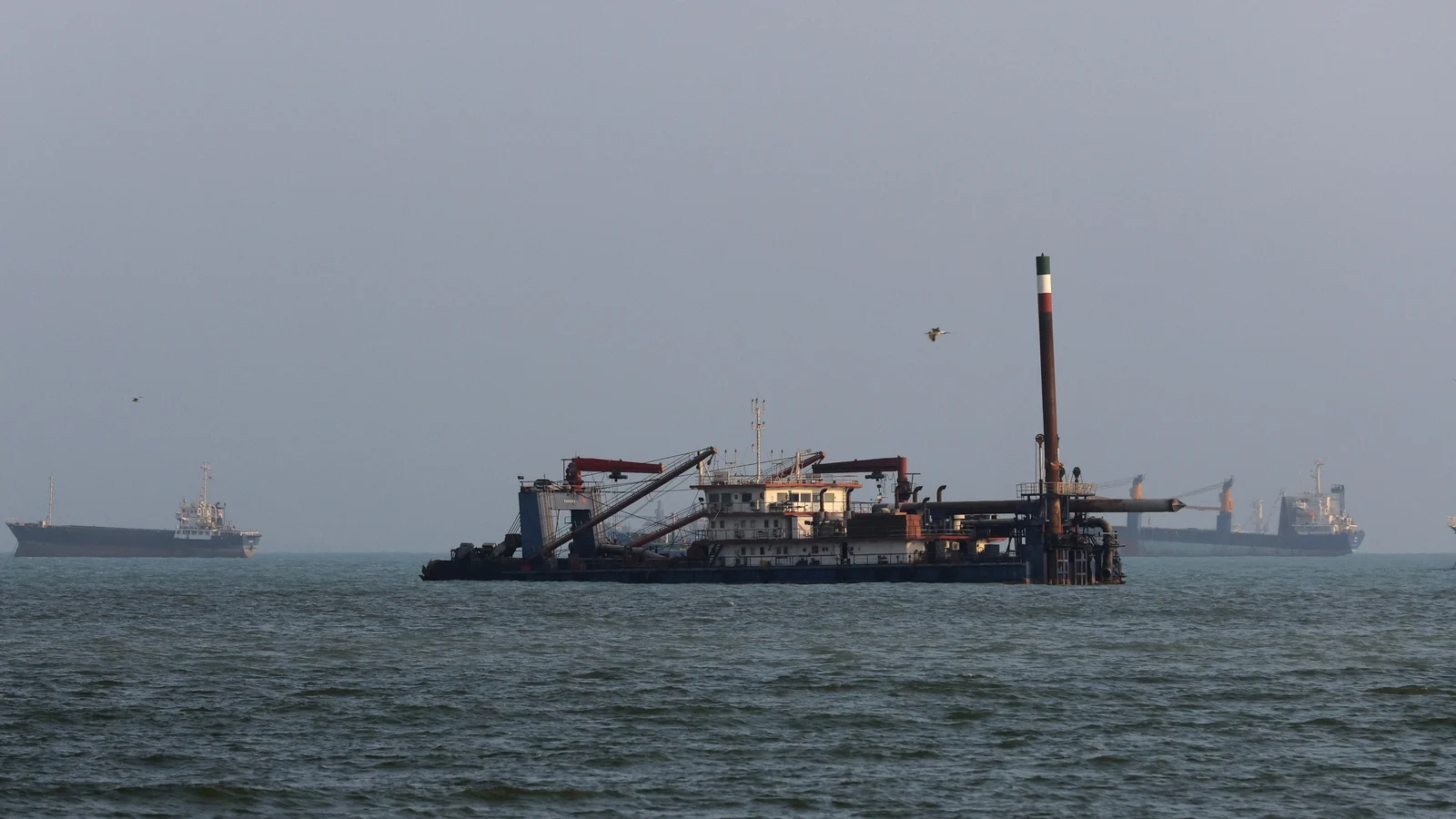
Ship crossings through the Strait of Hormuz remained in single digits yesterday, although they ticked up slightly from the weekend, according to preliminary shipping data.
Six commodity ships passed through the strait yesterday — three leaving the Gulf and three entering — Kpler ship tracking data showed. That compares with a 10-day average of 11 ships.
Three ships transited on Saturday while two moved through the waterway on Sunday.
No very large crude carriers or tankers carrying liquefied natural gas were recorded passing through.
Some vessels may be travelling through the strait with their transponders turned off and are not included in the tally.