As the world watches the Strait of Hormuz for signs of relief, Iran and Oman have reached agreements over their respective shares of the strategic waterway and its revenues, according to Iran’s Revolutionary Guards spokesperson in comments carried by the semi-official Tasnim news agency.
The spokesperson said the United States had been obstructing the talks between Tehran and Muscat, contributing to delays in the negotiations.
The remarks came after Iranian President Masoud Pezeshkian said Washington “will achieve nothing” with its latest round of economic sanctions, according to local media.
“With the measures that the government’s economic sectors have foreseen, America will not achieve anything with economic pressure at this stage, just as it was unable to achieve anything in the war,” Mr Pezeshkian said, according to ISNA news agency.
US Treasury Secretary Scott Bessent has outlined plans for what he called the “economic asphyxiation” of Iran, warning of severe consequences for countries that refuse to join the effort.
Iranian leaders, however, have downplayed the effect of the new steps, pointing to decades of punishing sanctions imposed shortly after the 1979 revolution.
“Our principle is understanding and resolving issues through interaction and negotiation, but at the same time, we will stand firm against economic pressures, as we have done so far and will continue to do,” Mr Pezeshkian added.
Talks between Iran and the United States have since stalled, as the long-time adversaries clash over control of the Strait of Hormuz, one of the world’s most important energy chokepoints.
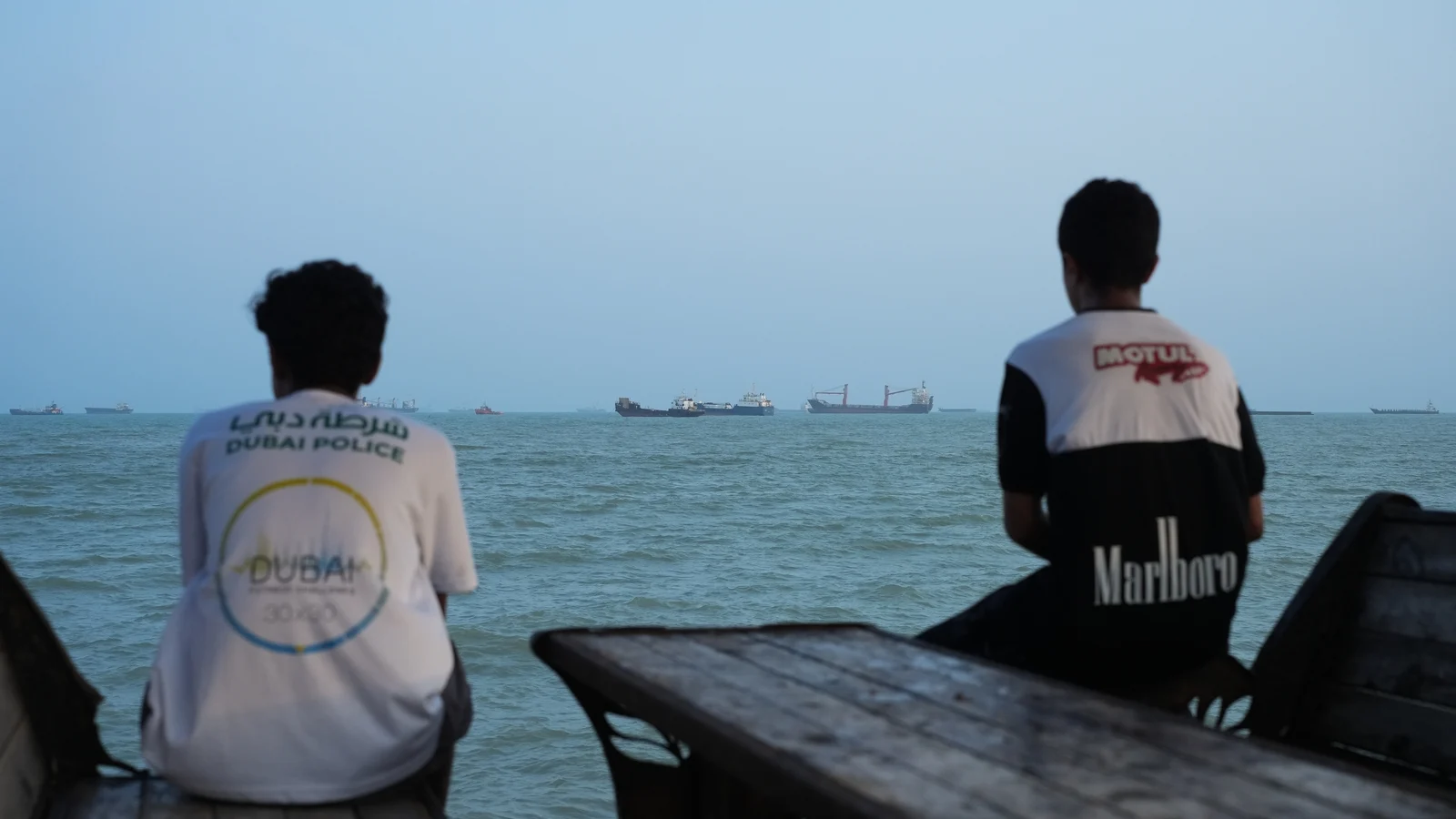
Traffic through the narrow passage — which in normal times carries about a fifth of global oil and liquefied natural gas exports — remains largely paralysed, sending ripples through energy markets far beyond the region.
Iran has asserted control over Hormuz since the war began on 28 February and has sought to levy fees on vessels transiting the strait.
Shipping through the Strait of Hormuz has been restricted since the war began on 28 February
The United States is pushing for a return to the pre-war system of free navigation, and US President Donald Trump has said Washington “has total control” over the waterway.
For weeks, Iran and Oman have held intermittent discussions on how to manage maritime movement through the strait, which handled one-fifth of the world’s oil and liquefied natural gas shipments before the war.
Most commercial shipping has been shut down since the conflict erupted on 28 February, after the US and Israel launched strikes on Iran.
Iran and Oman said they discussed “a joint temporary navigational corridor” through the strait and agreed to clear it of mines.
Although the most intense fighting between the US and Iran has largely eased, diplomatic efforts toward a peace deal have bogged down, and passage through the waterway is still considered hazardous.
Adding to the risks, an oil tanker was hit yesterday by an unidentified projectile and left disabled about 9 nautical miles (17 km) northeast of Oman’s Ash Shishah — located at the entrance to the strait — the United Kingdom Maritime Trade Operations said.
In a bid to squeeze Iran’s economy, the United States earlier this week threatened to penalise countries that continue doing business with Tehran, though it said it would not apply the punishments immediately.
Oil prices fell for a second straight day as traders appeared to discount the immediate impact of the US measures, while Iran condemned Washington’s push to isolate its economy as “gross lawlessness” and said it was confident many countries would resist joining the pressure campaign.
In the United States, public backing for the war has dropped to its lowest point since the early phase of the conflict, while Trump’s approval rating has hit a record low ahead of November’s congressional elections, according to Reuters/Ipsos polling.
Thousands have been killed in the conflict — most of them in Iran and Lebanon — while the US and Israel have degraded much of Iran’s conventional military capabilities.