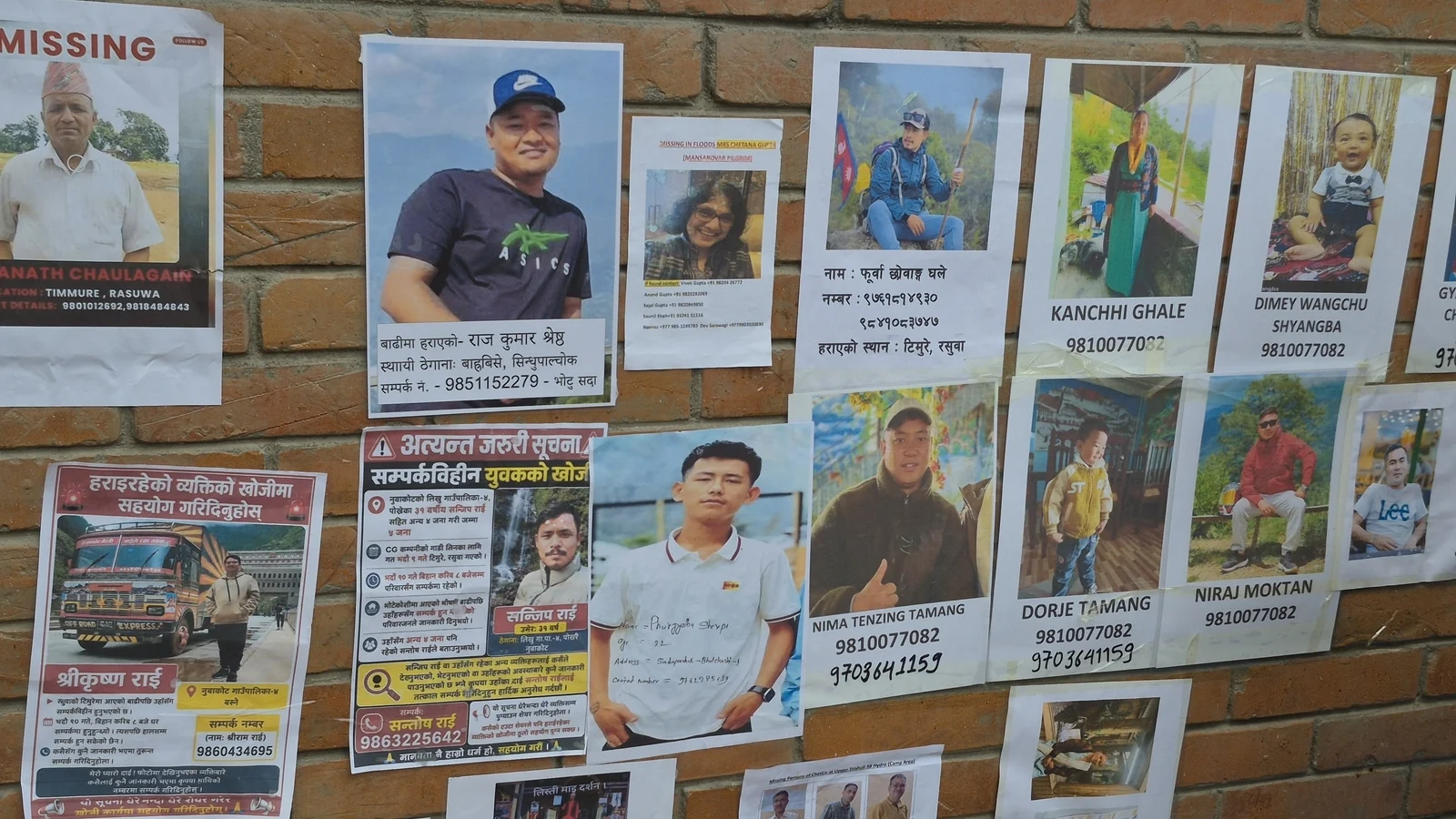
Kathmandu’s largest hospital has become a public bulletin board of anguish, its walls newly covered with brightly coloured posters pleading for answers.
In recent days, the notices have appeared almost everywhere inside and around the complex, showing smiling faces that jar against the simple words printed in English and Nepali.
“Help,” they read.
“Please. Missing.”
Those photographs put human lives back at the centre of a disaster that has ricocheted around the world this week, as videos of the destruction and devastation rack up millions of views.
Up close, each poster tells a different story: a baby in blue dungarees cradled in his mother’s arms, a newly-married couple, a grandfather on pilgrimage.
They are among more than 2,000 people still unaccounted for after Wednesday’s glacial collapse high in the Himalayas, which sent a wall of water, mud and debris tearing downstream.
For families waiting for word, the passing days have been excruciating.
Many have kept vigil outside Tribhuvan University Teaching Hospital, where some of the injured have been brought.
Whenever an ambulance pulls in, the crowd surges forward, scanning faces and stretchers, clinging to the hope their loved one has made it back alive.
Sitaram Khadka has been searching for his brother since the floods occurred
The pattern repeats again and again: a brief rush of optimism, followed by helplessness.
Among those searching is Sitaram Khadka, whose brother Bhupendra, 26, has not been seen since Wednesday.
Bhupendra worked with a tour agency that brings visitors to Mount Kailash, across the border in Tibet.
“We’ve been running around different hospitals and even airports in Kathmandu in the hope that my brother has been rescued and brought here,” he says.
“He has only been married for seven months. It’s very difficult.”
Many of the missing were tourists travelling along similar routes to Mount Kailash, a sacred destination for both Buddhists and Hindus.
Two Irish citizens, 46-year-old Santosh Sahu and 18-year-old Spandan Sahu, were taking part in one such tour.
They have yet to be located.
Sijan Tamang and her son Saahil are among those missing
‘My heart is broken’
A short distance from the hospital, another gathering point has formed outside a local morgue, where relatives arrive with dread and a shrinking hope.
What confronts them is almost impossible to imagine.
On the exterior walls, authorities have pinned up photographs of some of the recovered bodies – adults and children – some missing limbs, many swollen after long periods submerged in water.
Families move from image to image, studying each one with care, trying to match a face or a detail to someone who never came home.
It is a brutal task, made heavier by a week already defined by loss.
Sanu Tamang stands among those searching the pictures.
Woman ‘heartbroken’ as husband still missing in Nepal
Her husband, Bijay, is a logistics driver who had just crossed the border from Tibet when the floods struck.
“My heart is broken, it’s been very difficult. I have no information on him. It’s been so many days. My son is also refusing to eat anything.
“We keep going around hospitals but there is no name of him on the lists.
“My husband is a very fun-loving energetic person.
“He gets along with everyone very easily… if anybody sees him please get in touch with us.”
We need your consent to load this rte-player contentWe use rte-player to manage extra content that can set cookies on your device and collect data about your activity. Please review their details and accept them to load the content.Manage Preferences
Inside the morgue, facemasks and latex gloves are being handed out to families as they wait for their turn to view those inside.
Grief hangs heavily in the corridors and waiting areas.
Police say some bodies have been so badly disfigured that identification is only possible through DNA samples.
That painstaking process could take weeks, even months, extending the agony for families already living through an unimaginable ordeal.