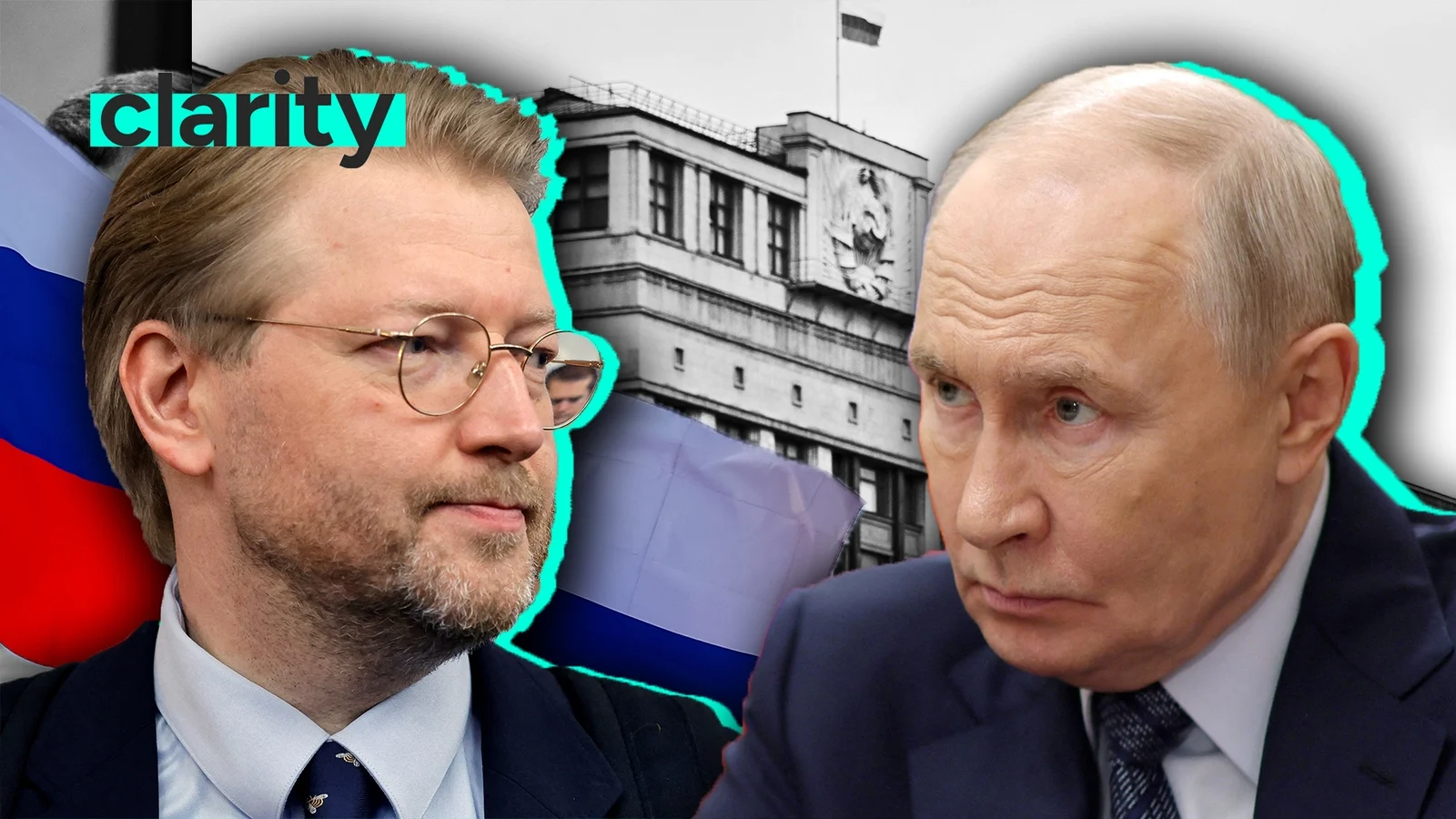
Russia’s tightly controlled political stage has shrunk again: earlier this month, the country’s supreme court blocked the small, anti-war Yabloko party from taking part in the federal parliamentary elections scheduled for mid-September.
The decision has raised a blunt question in a country where dissent has been steadily squeezed out of public life: why did the authorities put up with Yabloko for years, and why choose this moment to shut it out of the ballot?
In Vladimir Putin’s Russia, it can seem almost implausible that a party still exists that openly rejects the war in Ukraine.
Yet Yabloko, founded in the early 1990s, has maintained precisely that stance.
The party has publicly called for a ceasefire, directly contradicting the Kremlin’s position, while continuing to campaign for democratic reform at home.
Yabloko had registered to nominate candidates for September’s parliamentary vote — the first federal election since Russia launched its invasion.
That plan was derailed when the supreme court barred the party from running, following a complaint lodged by a pro-Kremlin nationalist party alleging copyright violations in Yabloko’s application paperwork.
On 17 August, Yabloko — now led by long-time member Nikolai Rybakov — failed to overturn the ruling on appeal.
Yabloko party leader Nikolai Rybakov outside Russia’s supreme court on 10 August
Also on 17 August, the party’s deputy chairman, Lev Shlosberg, was sentenced to 11 years in prison after being convicted of “discrediting” the armed forces and spreading “deliberately false information” about them.
Prosecutors tied the case to Mr Shlosberg’s participation in a YouTube debate in January 2025 with a Russian historian, during which he urged an end to the invasion of Ukraine.
According to the state’s case, he later reposted the debate on a Russian social media platform and also shared the front page of an edition of the Daily Mirror depicting the Russian president alongside a blood-soaked Ukrainian woman.
Russian authorities introduced sweeping legislation within the first week of Moscow’s full-scale invasion, sharply limiting criticism of the war and extinguishing what remained of press freedom.
Courts have since used those laws to jail hundreds of activists like Mr Shlosberg for even minor objections to what Mr Putin and his government continue to describe as the “special military operation”.
In June, another Yabloko deputy chairman, Maxim Kruglov, received a seven-year prison sentence on a similar accusation of publishing “false information” about the army. His offence, in practice, was expressing sadness about deaths in Ukraine in two Telegram posts from 2022.
Thousands of Russians have been detained and fined for anti-war views, particularly during the invasion’s first year.
Others have avoided the risk entirely by leaving Russia and building lives in exile.
“In Russia, there is almost no opposition. It is almost entirely destroyed,” Elena Filina, a former Yabloko politician now living in Germany, told RTÉ News.
“Mouths are shut, people either sit on their opinions or are labelled with a dangerous status, such as a foreign agent,” she said.
Ms Filina is on a Russian federal wanted list and faces the same charge used to convict her party colleague Mr Shlosberg.
On 24 February 2022 — the day Russian forces entered Ukraine — she was arrested in Moscow for protesting the invasion and sentenced to five days in prison.
Concluding that a future protest could bring a longer sentence, she decided to leave the country.
After she departed, she posted images in April 2022 of the Bucha massacre by Russian troops in Ukraine. Russian authorities then charged her with disseminating “deliberately false information” about the country’s armed forces.
Those who remain inside Russia and continue their political work, she said, are “completely heroic people”.
Yabloko deputy chairman Lev Shlosberg, next to his wife Zhanna Shlosberg-Kozlovich, after he
was sentenced to 11 years in prison over his criticism of Russia’s war in Ukraine
By most measures, Yabloko is a minor force: liberal by Russian standards, it has hovered around 1% in polling for several election cycles.
Its standing, however, has not always been so limited.
In 1995, Yabloko won 45 seats in the federal parliamentary elections, but it steadily slid toward the margins during Mr Putin’s early presidency and lost its last four seats in 2007.
Today it retains some representation in regional and city council bodies in St Petersburg and Moscow. Nationally, its weak support helps explain why the Kremlin tolerated it for so long.
Yabloko also served a political purpose: its legal existence allowed authorities to point to an “opposition” presence and claim the system offered room for dissent.
Even small backing for an anti-war party could be portrayed by the Kremlin as evidence of broad support for the war, by comparison.
As Ms Filina put it, officials could previously gesture to Yabloko and say: “Look, we have a party that is against us.”
But with the party campaigning for peace and a ceasefire, recent polling suggested it might climb to at least 3% of the vote.
That would still fall short of the 5% threshold required for parties to enter parliament via the national list.
Even so, 3% would publicly register a constituency for an anti-war platform — and, potentially, create momentum.
Earlier this month, Medusa, an independent Russian outlet now operating from Latvia, quoted a political strategist with Kremlin connections saying officials initially permitted Yabloko to register in order to observe the impact once campaigning began.
Once its numbers improved, the strategist said, the party was removed as a form of “risk mitigation”.
Another political consultant working with Russia’s presidential administration told Meduza that Yabloko had become a “mouthpiece amplifying the signal of the opposition in exile”.
Young supporters of Yabloko gather outside Russia’s Supreme Court on 10 August
“Yabloko is a symbol of the anti-war position, and it shows us how many people support these ideas,” Andrei Pivovarov, a Russian political activist living in exile in Germany, told RTÉ News.
He said the party had begun to function as a “point of consolidation” for different parts of society opposed to the war.
Even if Yabloko had been allowed to compete and somehow reached 7%, Mr Pivovarov said he did not believe it would have produced political change.
“Nothing changes because the Duma is absolutely controlled by Putin and his special forces,” he said, arguing that in today’s Russia elections no longer translate into shifts in power.
Those overseeing the electoral commission can “draw any numbers in the final election,” he added.
Mr Pivovarov was sentenced in July 2022 to four years in a penal colony for involvement with an “undesirable organisation”.
He had led Open Russia, a now-disbanded pro-democracy movement financed by exiled businessman and Kremlin critic Mikhail Khodorkovsky, who spent 10 years in Russian prisons after challenging Mr Putin’s leadership in the early 2000s.
Now 44, Mr Pivovarov was freed in August 2024 in the largest prisoner swap between Russia and Western intelligence agencies since the Cold War ended.
Despite that history, he said he still believes change is possible.
“We have a lot of groups and activists inside Russia, and it’s a new generation of people,” Mr Pivovarov said, noting that many activists of his own age cohort have since left the country.
Because Yabloko remains legal, he said, it has offered a rare shelter for younger anti-war activists in their late teens and twenties.
Vladimir Putin speaking at the United Russia party’s congress in Moscow on 22 August
Mr Putin’s United Russia party dominates the Duma with at least 312 seats, compared with 122 seats shared by four opposition parties.
But those four parties do not pose a genuine challenge and operate within boundaries set by the Kremlin.
They include A Just Russia, which mixes nationalism and socialism; the conservative New Russia; the Communists (KPRF); and the Liberal Democratic Party of Russia — an ultranationalist group that is neither liberal nor democratic and cooperates with United Russia.
None of them contests the Kremlin on core issues such as the war in Ukraine or political repression.
Some, in fact, back the invasion enthusiastically. At most, they occasionally push back on economic matters — and even that is limited.
Analysts often describe this arrangement as “managed opposition”.
Yabloko, even without Duma representation, stood out because it did not follow those rules.
“Yabloko was the only party within this constellation of managed opposition political parties, which openly promoted a message in favour of peace, although this message was very contradictory,” said Igor Gretskiy, a political analyst specialising in Russia and its foreign policy.
He cited what he described as a contradiction in Yabloko’s approach: supporting a referendum on Crimea’s constitutional status while also insisting Ukraine’s territorial integrity should be respected.
The Yabloko party did not respond to an interview request from RTÉ News for this article.
Mr Gretskiy said the earlier blocking of Boris Nadezhdin from running in the 2024 presidential election, together with this month’s decision against Yabloko, suggests the Kremlin may no longer see value in maintaining even a controlled version of pluralism.
“We’re at the point in which Russia is in the process of a totalitarian consolidation of its political system,” said Mr Gretskiy, a research fellow at the International Centre for Defence and Security in Tallinn.
He argued that the war and Western sanctions have increased economic risk, prompting the authorities to reduce any remaining domestic political uncertainty.
Signage on a Moscow metro highlights the dates of the upcoming Duma election from 18 to 20 September
Russia’s Duma election, scheduled for 18 to 20 September, is not expected to deliver surprises — much like the presidential vote two years ago, when Mr Putin took 88% against carefully managed rivals.
The broad outline appears set. United Russia is expected to cruise to another commanding majority, and its list this time includes army veterans from the war in Ukraine.
Russia’s mixed electoral model — combining single-seat constituencies with party-list mandates — is expected to leave the managed opposition with roughly the same overall seat total, though the split between parties may shift.
Still, some activists refuse to see Yabloko’s exclusion as pure defeat.
Mr Pivovarov called the case a “small victory” for the opposition, even without a “chance to vote for peace”.
“I think it’s a small step, and [in] my point of view, it’s not a win for [the] opposition, but it’s a loss for the Kremlin because they show his weakness,” he said, adding that banning a feeble opposition party would be noticed by the war elite and by figures in the FSB, Russia’s domestic security service.
For 26 years, Mr Putin has cultivated the image of a strongman who delivers economic stability.
But Russia’s war on Ukraine — which has reached Russian cities in recent months — has injected instability into daily life for many.
By striking Yabloko from the ballot, the Kremlin is signalling it will not gamble on even a trace of dissent appearing during an election.
Allowing any dent in the managed tally would amount to official acknowledgement that opposition to the war exists — the very outcome Mr Putin and his system appear determined to prevent.