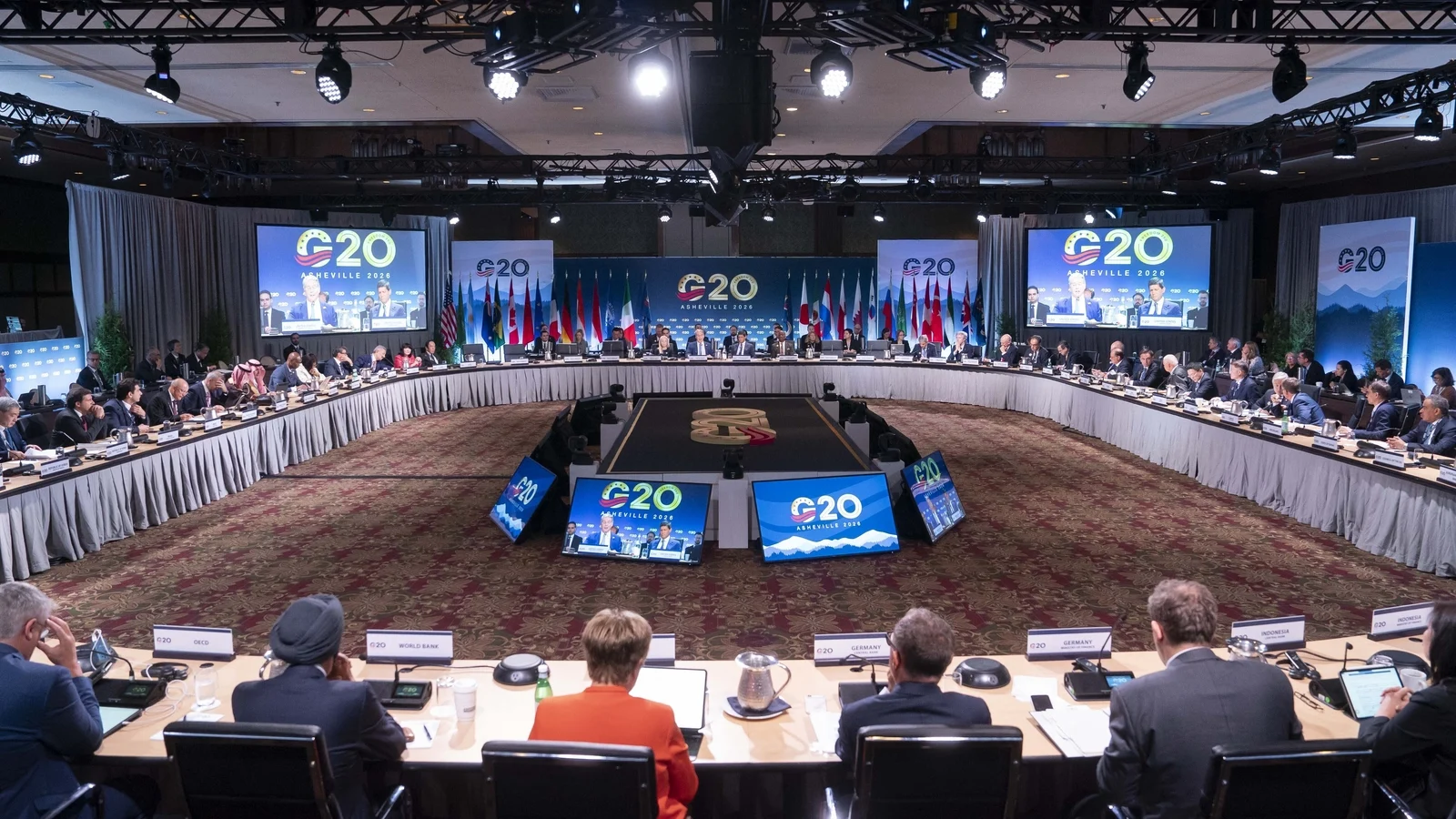
What was meant to be a G20 gathering centered on lifting global growth instead opened under a cloud of controversy, as the United States moved to bring Russia back to the table and simultaneously blocked some major news organizations from covering the meeting.
As part of Ireland’s EU presidency responsibilities, Tánaiste and Minister for Finance Simon Harris is attending the two-day session alongside European Central Bank President Christine Lagarde and EU Commissioner Valdis Dombrovskis.
The meeting comes at a moment when the world economy is being jolted by an energy shock linked to the Iran war, strained by escalating friction over China’s massive goods trade surplus, and watching closely for the long-term impact of a global surge in AI investment.
When US Treasury Secretary Scott Bessent formally opened proceedings, several finance leaders said they were caught off guard — and angered — to see Russian Finance Minister Anton Siluanov seated at the G20 table. It marked Russia’s first in-person appearance at the forum since its 2022 invasion of Ukraine.
Russian Finance Minister Anton Siluanov (3rd L) at the G20 Finance Ministers meeting
The United States currently holds the rotating presidency of the G20.
Polish Finance Minister Andrzej Domanski told Reuters he was unhappy that Russia was represented, even as he acknowledged that host nations have the authority to invite guests.
“We do not trust Russia. They lie constantly and you need to be really, really cautious while discussing with them,” he said, stressing that Russia was the aggressor in its conflict with Ukraine.
“So for me it would be very difficult to have any kind of conversation with Russia.”
Russia’s finance ministry said Mr Siluanov also met bilaterally with Mr Bessent, and that the talks covered financial cooperation within the G20 framework.
A US official said President Donald Trump’s peace plan for Ukraine was the focus of that meeting. A source familiar with the discussions said Mr Bessent told Mr Siluanov that no economic relief for Russia — and no agreements on other matters — could be reached until the war ends.
German Finance Minister Lars Klingbeil said Europe was preparing another round of sanctions against Russia, and warned that hosting Mr Siluanov at the Asheville meeting sent a “quite troubling” message about US willingness to work with Europe on the effort.
“I would have wanted greater clarity from the American side that he should not be received here as a normal guest,” Mr Klingbeil said.
European officials also said they opposed appearing in the traditional “family photo” of G20 finance ministers and central bank governors, adding that the picture ultimately was taken without Mr Siluanov.
The scene contrasted sharply with April 2022, when even Mr Siluanov’s virtual participation in a G20 meeting in Washington drew widespread condemnation of Russia’s invasion of Ukraine and triggered a walkout by officials from the US, Britain, Canada and the European Central Bank.
Scott Bessent told reporters that the world is ‘awash with debt’
Mr Bessent, for his part, argued that accelerating growth offered the clearest route out from under the mountain of debt accumulated since the 2008 financial crisis and the Covid-19 pandemic.
Global debt earlier this year climbed to a record of nearly $353 trillion, raising financial-stability worries and prompting some investors to reassess even long-standing safe havens such as US Treasuries.
“The world is awash in debt post-GFC, post-Covid, and the only way for us to get out of this is to grow our way out of this,” Mr Bessent said at the start of the meeting, referring to the 2007 to 2009 global financial crisis.
“I’m confident that a lot of the leaders are very receptive to this,” he added.
In another unusual move, the Treasury invited prominent private-sector figures to take part in some G20 discussions on boosting growth — a step reflecting the Trump administration’s view that deregulation, higher energy output and innovation are key to stronger economic performance.
Addressing one of the sessions, Mr Bessent said global growth had lagged its potential for too long and that leaders could no longer cite ”policy failures of our own making” as an excuse.
He said the US Treasury had identified several impediments to growth that G20 countries needed to work on, including “excessive regulatory and administrative burdens, poorly designed financial incentives and tax systems, insufficient public and private investment, internal market fragmentation, and gaps in workforce skills and mobility.”
Journalists denied credentials
Beyond the dispute over Russia’s attendance, the US Treasury also drew criticism for denying credentials to certain journalists seeking to cover the meeting, including teams from Bloomberg News and specific reporters from the New York Times and the Wall Street Journal.
“I believe the press has a completely legitimate interest in reporting openly and freely on this G20 summit,” Mr Klingbeil said.
“I consider it unacceptable for journalists or entire editorial teams to be excluded.”
A US Treasury spokesperson said more than 300 media outlets were covering the event, including another New York Times reporter, and said access carries a “responsibility to report factual information consistent with established journalistic standards.”
US Federal Reserve Chairman Kevin Warsh, attending his first international economic policy meeting since taking office in May, said he expected to gain a clearer read on growth prospects across member economies.
He said the long period of “secular stagnation” — defined by weak innovation — appeared to be ending as investment pours into AI.
“If I were to try to characterise this moment, it would be one of a global investment surge,” he said, adding that it had reversed the “global savings glut”, which previously left capital idle because of too few investment opportunities.
Mr Bessent also pointed to strong US growth, saying investment in AI infrastructure has helped lift US Treasury debt yields by absorbing savings that had earlier helped keep US borrowing costs lower by flowing into Treasuries.
Today, the US will shift the conversation to global trade imbalances. Mr Bessent said he would press G20 members to revisit their trade terms with China as part of an effort to push Beijing to rebalance its economy away from exports and toward domestic consumption.