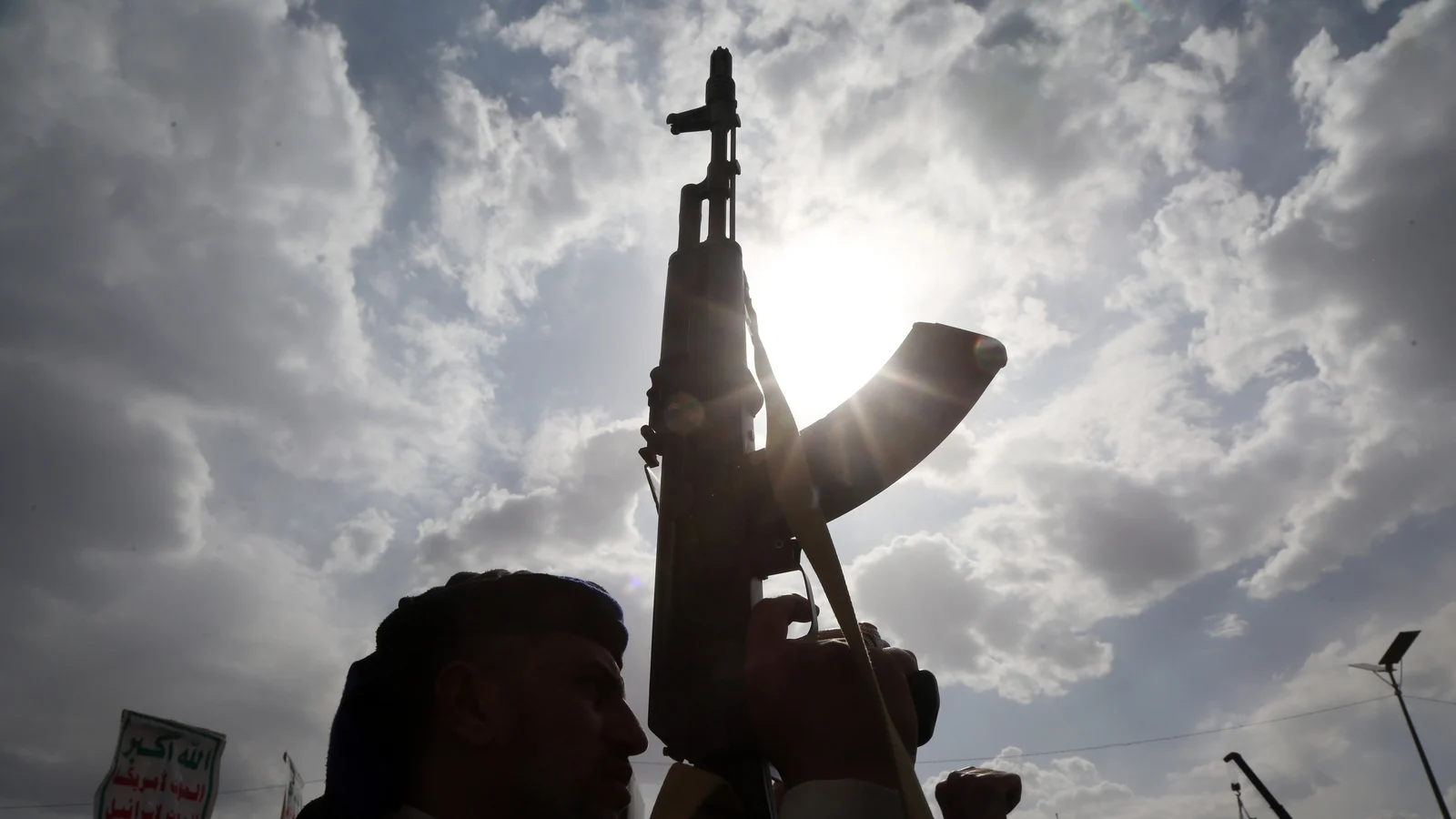
Yemen’s war has erupted into its bloodiest fighting in years after the Houthis launched a sweeping push toward the Red Sea gateway, with more than 120 people reported killed as the rebels sought to tighten their grip on one of the world’s most critical maritime chokepoints, sources said.
The Iran-backed Houthis triggered the latest violence with a ground assault backed by rocket fire and drone strikes near coastal areas, as both sides battled for influence around the narrow Bab al-Mandab strait at the southern mouth of the Red Sea.
Yemen, locked in more than a decade of civil conflict, was pulled in July into the wider Middle East war when the Houthis unraveled a 2022 truce with the Saudi-backed government.
A member of the Houthi authorities’ security forces stands guard at Sanaa International Airport
Since the truce collapsed, the Houthis have declared a maritime blockade of Saudi Arabia and have repeatedly attacked Saudi-linked ships in the Red Sea — a crucial alternative route for oil exports after Iran all but halted Gulf shipments by blockading the Strait of Hormuz.
Now, the rebels appear intent on consolidating control over the Red Sea corridor itself, a heavily trafficked global shipping lane they have increasingly disrupted by striking vessels transiting the area since the Gaza war began in 2023.
Military sources said the current offensive is designed to isolate the government-held port city of Mokha, which has been under fire for weeks, and to push forward toward territory bordering Bab al-Mandab.
A military source and an official in Taiz said the Houthis had captured high ground overlooking government positions along the Red Sea as well as near the inland city of Taiz, speaking on condition of anonymity.
From those elevated positions, the Houthis could potentially threaten ships, the sources said.
The death toll climbed to 129, according to a tally compiled from several sources, rising from an earlier count of 81.
A Yemeni military official, also speaking anonymously, said 66 of his forces had been killed. Medical and military sources close to the Houthis said at least 62 of their militants had died.
Another medical source reported that a civilian had also been killed.
Reinforcements sent
While the Houthis do not control territory directly bordering Bab al-Mandab, they hold Hodeida — the key Red Sea port city north of Mokha.
The port of the Red Sea city of Hodeida
“They are going for Bab al-Mandab,” said Mohammed al-Basha, of the US-based risk advisory Basha Report.
A Yemeni official in Aden — the seat of the internationally recognised government since it was forced out of the rebel-held capital, Sanaa, in 2014 — said the Houthis are seeking to seize the hills overlooking Bab al-Mandab and Mokha before moving against the coastline.
The same official said reinforcements had been dispatched to Taiz from Aden on orders from Saudi Arabia.
“The Houthis feel that if they capture Bab al-Mandab or Mokha port they will be in a better position of power to negotiate with the government and the Saudis,” Basha added.
With Iran’s closure of Hormuz, Bab al-Mandab has taken on heightened significance as a route for Saudi oil shipments, given Saudi Arabia’s status as the world’s largest crude exporter.
The narrow passage links the Red Sea — and, through the Suez Canal, the Mediterranean — with the Indian Ocean.
In July, the already-fragile truce between the Houthis and the government fractured after the rebels received an Iranian aircraft in Sanaa, triggering a new wave of attacks.
The Houthis later declared a maritime blockade of Saudi Arabia and began striking Saudi ships and territory.