In New York City this week, the signs of a diplomatic storm were hard to miss.It wasn’t only the heavy security footprint — the endless NYPD presence, hundreds of armed Secret Service officers with sniffer dogs, and the near-constant sirens as motorcades surged through Manhattan.
Across the city, another message campaign rolled into view: bold advertisements on trucks and billboards, some sharply aimed.
“Iranian delegates, thinking of a shopping spree?” one read.
“Back home, your people can’t even buy groceries.”
A billboard paid for by the State of Israel
The ads were part of a wide push by Israel to make its voice heard beyond the United Nations itself. Hundreds of billboards and digital trucks carried statements focusing on Iran and its nuclear programme, alongside messaging about the US-Israel relationship.
Inside UN corridors and meeting rooms, Israel’s role — from its involvement in US strikes on Iran to its actions in Gaza and the Occupied West Bank — was a recurring focal point in discussions during High-Level Week.
For Israel, the public campaign came at a moment of intensified scrutiny, as criticism mounted during one of the most closely watched weeks on the international calendar.
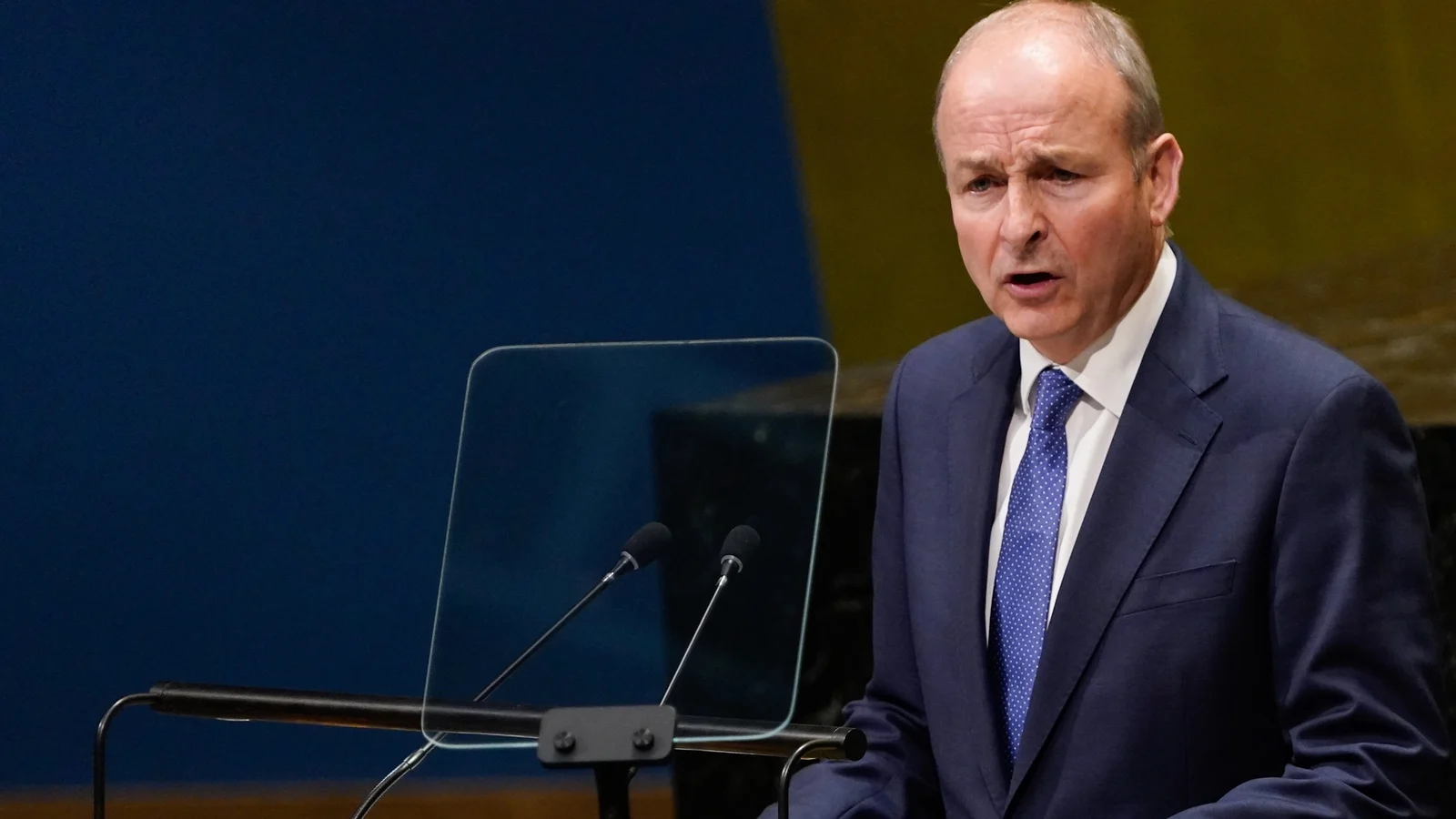
Those concerns echoed in the Taoiseach’s address to the United Nations General Assembly last night.
UN Secretary-General António Guterres opened High-Level Week on Tuesday with a stark warning: violence, displacement and settlement expansion were raising the spectre of ethnic cleansing in the Occupied West Bank.
The Taoiseach directly reinforced that message, citing settler violence, displacement and what he described as growing danger to the prospects of a two-state solution.
“Violent settlers continue to act with near-total impunity, while Palestinian communities face a sustained campaign of displacement and destruction – amounting to ethnic cleansing,” he said.
His criticism of the Gaza peace plan echoed the tone struck by French President Emmanuel Macron, who described the “so-called peace in Gaza” as “a spectacle that shames us all”.
‘The world has failed Palestine’ – Micheál Martin
In his UN farewell, the French President also rejected US President Donald Trump’s claims of having delivered peace in Gaza, arguing that despite the proclaimed peace not a single humanitarian corridor had been reopened in the enclave.
That critique on the General Assembly stage drew an immediate and forceful rebuttal from the Israeli Prime Minister in his own speech yesterday.
“Here’s the simple truth. Israel didn’t commit genocide. Israel prevented genocide,” Mr Netanyahu said, describing the Israel Defense Forces (IDF) as “the most moral army in the world”.
He used the moment to defend Israel’s conduct, push back against international condemnation and project a sense of resolve — a country under pressure, he insisted, but still able to protect itself.
“They’ve chosen weakness. They’ve chosen appeasement,” he said, accusing European democratic leaders — increasingly outspoken in their criticism — of taking the wrong course.
While the Irish delegation did not take part in a mass walkout during the Israeli Prime Minister’s address (Spain was the only EU country to do so), the Taoiseach aligned with a number of countries voicing serious concern about the circumstances facing Palestinians.
When he said that when the true horrors of Gaza “are finally and fully revealed, it will shame the world”, applause broke out.
Delegates from the state of Palestine applauded and appeared emotional. The Israeli delegation remained expressionless.
Micheál Martin said that the Gaza peace plan has not “changed the reality on the ground”
During his speech, the Taoiseach said the international community has “failed Palestine” and criticised last year’s Gaza peace plan, arguing it has not “changed the reality on the ground”.
A similar argument had been made earlier in the day by Palestinian President Mahmoud Abbas, who delivered remarks by video after the US refused to issue him a visa, saying promised steps had not materialised.
The issue is heightened by fresh financial commitments announced by the US President’s Board of Peace, which unveiled a $2.45 billion (€2.15bn) Gaza recovery plan spanning 66 programmes over the next six months.
Even that declaration, however, came paired with a warning about the scale of what lies ahead.
The board said $18bn has been pledged, but only $280 million has so far been handed over, while the estimated cost of full reconstruction is more than $70bn.
The Taoiseach’s address gathered many of the themes dominating the General Assembly this week: Gaza, the West Bank, the Two-State Solution, Ukraine, Sudan, human rights, and questions about the durability of the international system itself.
It also carried a distinct Irish note on the UN stage.
By coincidence, the two UN officials seated behind him were Vice President of the General Assembly Martin Fraser, a former Secretary General of the Department of the Taoiseach, and Emer Herity, Chief of the Economic and Social Council Affairs Branch in the General Assembly.
The outstanding question now is whether the declarations delivered within the UN this week will translate into meaningful change beyond its walls.