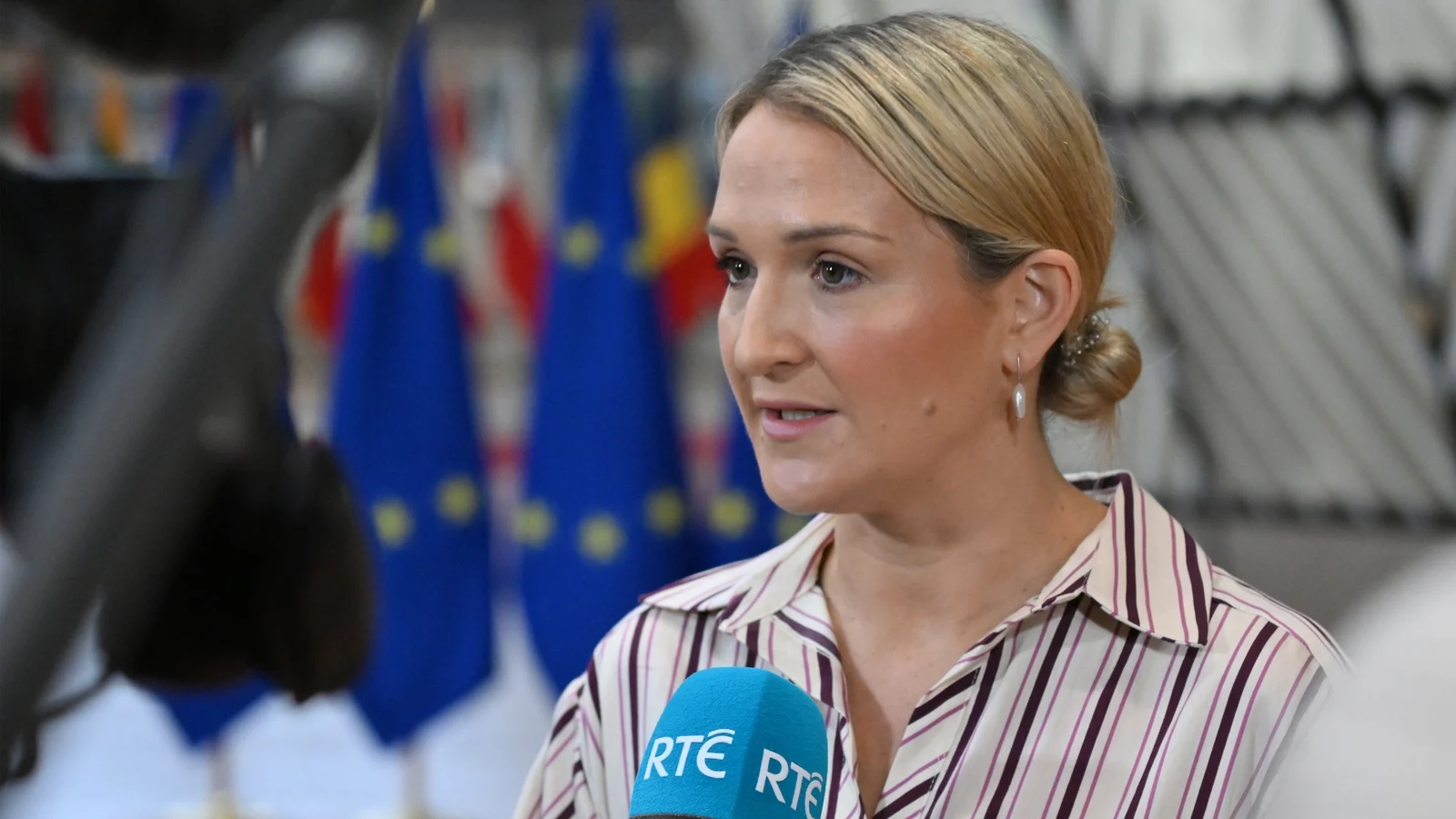
With winter closing in and Ukraine bracing for renewed strikes on its energy system, Minister for Foreign Affairs Helen McEntee has urged the European Union to keep one of its most contentious options in play: the several hundred billion euro in frozen Russian assets.
About €210bn in Russian central bank assets were immobilised within days of the invasion of Ukraine in February 2022, with roughly €185bn still held in Belgium at Euroclear, a securities depository.
EU leaders tried last December to persuade Belgium to sign off on using those assets to underwrite a long-term loan to support Ukraine’s military and budgetary needs, but they failed to secure agreement.
In the end, the bloc opted for a different route, agreeing to issue joint EU debt worth €90bn for Ukraine over three years. The decision relied on the enhanced cooperation mechanism to bypass objections from Hungary.
Now, with Russia stepping up attacks in recent weeks and fears growing of a broad assault on Ukraine’s energy infrastructure during the winter months, senior EU figures have indicated the frozen assets debate may need to be reopened.
Ukraine has warned of a €27bn gap in its defence budget as it tries to withstand a far more intensive aerial campaign by Moscow, including jet-powered drones and ballistic missiles.
Speaking as she arrived for a meeting of EU defence ministers in Brussels this morning, Ms McEntee said: “We need to keep everything on the table, including the frozen [Russian assets].
“It’s obviously very clear from some of our colleagues the challenges that are there. They haven’t been fully dealt with or haven’t been fully resolved, and so there was a very clear commitment from the Commission to further explore the challenges that have been raised by colleagues and to see is there a way forward. We need to keep that on the table.”
Ms McEntee also pointed to movement in recent weeks on freeing up about €6.6bn through the European Peace Facility (EPF), which partly reimburses member states for military equipment they supply to Ukraine. That mechanism has been stalled by Hungary’s outgoing prime minister Viktor Orban.
“We need to make sure that as much of this year’s money as possible is provided, all of it is provided, and that as early on as possible next year we are providing further assistance,” said Ms McEntee.
“Last year Russia attacked about 75% of the critical infrastructure in Ukraine. It’s very clear that that’s going to start happening again. It’s already happening. So ensuring that countries provide that bilateral support, as well as the other mechanisms I’ve mentioned, is really, really important.”
She said sanctions must continue to tighten pressure on Russia, and argued that the UN General Assembly in New York provided a platform to highlight how the war is rippling beyond Europe, with consequences “not just on Ukraine, not just on Europe, but now in global food security, in particular in the Global South”.
EU discusses new mutual defence mechanism in event of Russian attack
We need your consent to load this rte-player contentWe use rte-player to manage extra content that can set cookies on your device and collect data about your activity. Please review their details and accept them to load the content.Manage Preferences
Russia planning more acts of sabotage in Europe, says Kallas
EU foreign policy chief Kaja Kallas, also arriving at the Brussels talks, said intelligence assessments indicated Russia was preparing additional acts of sabotage across Europe.
“We need to be vigilant because we see in the intelligence that Russia is planning more sabotage acts and attacks against our democracy – to divide our society, to intimidate our societies [into] refraining [from helping] Ukraine,” she said.
Against the backdrop of what officials describe as escalating hybrid activity on European soil, Ms McEntee said the government would “look at” a proposed new mutual assistance mechanism floated by European Commission president Ursula von der Leyen in her State of the Union address on 16 September.
Ms von der Leyen argued for a “counter hybrid playbook” so member states could act in a more unified way when confronted by hostile actions that “fall below armed aggression but clearly threaten our national security”.
She outlined a mechanism designed “to flank NATO’s Article 4”, describing it as an Emergency Security Protocol under which “when triggered by one member state, all member states would convene to coordinate a European response, to deter further escalation, and to mitigate the impact”.
The EU already has a mutual assistance clause set out in Article 42.7 of the Lisbon Treaty.
Senior defence officials have said Ms von der Leyen’s proposal is focused on how to “operationalise” that clause at a time when EU countries say they face a growing number of attacks and pressure tactics.
Read more: Latest Ukraine stories
Minister McEntee said: “We need to look at all of these options. Obviously, we have Article 42.7, something that Ireland has contributed to in the past.
“It’s important that whatever we put in place would respect each individual member state’s constitutional position [and] at the same time, reflect the fact that we are seeing more and more hybrid attacks.
“We’re starting to see this on European soil, whether it was the airport in Leipzig [in Germany], whether it was consistent breaches of airspace into European member states.
“We need to be prepared. We need to be able to not just respond when incidents happen, but also [to] preempt possible escalations, work with member states, work with each other, to make sure that we have a strong response in place should something happen, or to try and prevent that from happening.”
She added: “There certainly is an appetite there. Something that would complement Article 42.7… is something that would be welcome and certainly would be helpful.”
The Brussels meeting takes place as Russia continues to intensify its offensive against Ukraine, expanding target lists to include more civilian and commercial sites.
Recent strikes have hit passenger trains, petrol stations and communications networks.
As Moscow increasingly deploys jet-powered drones that are more difficult to detect and shoot down, the death toll has continued to climb.
EU officials expect Russian President Vladimir Putin to mount sustained attacks on Ukraine’s energy infrastructure as winter approaches.