Delhi woke up to a sweeping security clampdown as Indian police detained more than 2,000 protesters — including the founder of the “Cockroach” youth movement — ahead of demonstrations demanding the resignation of the country’s election chief.
Authorities flooded the capital with thousands of police and paramilitary personnel as protesters prepared to rally against Chief Election Commissioner Gyanesh Kumar. Officials also suspended mobile internet in the central business district, shuttered dozens of metro stations and markets, and moved to prevent crowds from forming.
At the heart of the protests is a voter-list revision that critics say tilts the playing field toward Prime Minister Narendra Modi’s ruling Bharatiya Janata Party (BJP).
Thousands had planned to assemble at Jantar Mantar in central Delhi, a traditional protest site, but security forces sealed off the area before the gathering could begin.
A home ministry official, speaking on condition of anonymity, said more than 2,000 people were detained in Delhi.
Local media reported that roughly 400 protesters were held in Mumbai, the country’s financial hub.
Police did not immediately comment on the detentions.
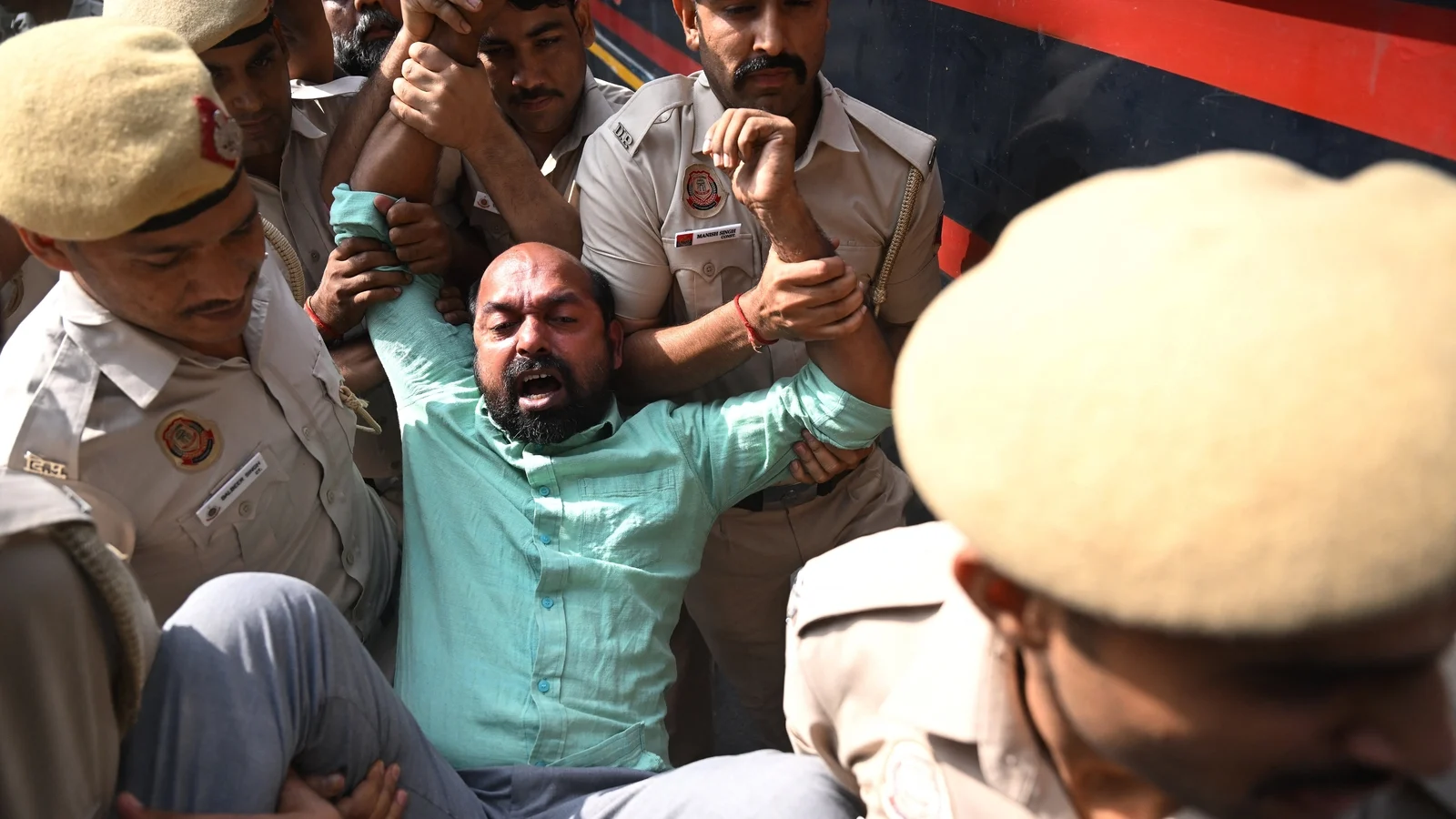
A protester is carried away by police officers in New Delhi, India
Even with central Delhi locked down, smaller demonstrations flared elsewhere in the city — including at a well-known crafts market and at the memorial to freedom movement leader Mahatma Gandhi — where protesters repeated calls for Mr Kumar to step down.
“Long live the revolution,” some young demonstrators shouted as police pursued them, detaining several and loading them onto buses to be taken away.
“This is violating the rights of the people and the country will not tolerate this anymore,” said protester Yogendra Solanki as officers escorted him away.
The UN office for the high commissioner for human rights urged India to immediately release people it said were “arbitrarily detained” during protests over alleged misconduct by electoral authorities.
“We are concerned by reports of mass detentions in India of demonstrators, protest leaders, members of civil society organisations, lawyers and journalists, before and during today’s large-scale demonstrations in Delhi,” the office said in a statement.
Movement leaders detained
Police detained Cockroach Janta Party (CJP) founder Abhijeet Dipke along with senior leaders Saurav Das and Ashutosh Ranka after their flight from Mumbai landed in Delhi, according to a statement from the group.
Television footage showed Mr Dipke confronting officers who approached him on the aircraft.
“I have come to be arrested, arrest me … I am not afraid of you guys,” he said.
Students climb on police barricades as they participate in protests in Bengaluru, India
The movement denounced what it described as the “authoritarian detention” of its leadership, called for their release and promised to press ahead with demonstrations.
“We will continue our protest tomorrow, day after … until Gyanesh Kumar resigns. We will be on the streets,” CJP leader Ajinkya Shinde told reporters.
CJP also said authorities refused to share information about the leaders’ whereabouts or health, even after the group received word that Mr Dipke’s grandmother had died.
Police said Mr Dipke was informed of her death and was offered assistance to return home for the funeral.
TV channels also showed opposition lawmakers and former chief ministers Mamata Banerjee of West Bengal, Arvind Kejriwal of Delhi, and Pinarayi Vijayan of Kerala being detained.
Representatives of two digital news outlets said police briefly detained four of their reporters while they were covering the demonstrations.
A Reuters journalist was also detained briefly before being released
Across the capital — home to about 20 million people — security forces erected checkpoints along major roads and at entry points, boarded buses to look for protesters and inspected vehicles.
Traffic was snarled by barricades and concrete blocks, while anti-riot vehicles fitted with tear-gas launchers stood guard along key routes.
New challenge to Modi
The demonstrations have emerged as one of the most serious challenges yet for Mr Modi, driven by allegations that election authorities improperly altered voter rolls ahead of recent state elections.
Protest anger sharpened after the Indian Express reported last week that two election commissioners had raised concerns about Mr Kumar’s revisions, which removed about 130 million names from voter lists.
Mr Kumar has not commented. The Election Commission and the BJP have rejected allegations of wrongdoing.
The BJP says its electoral success reflects Mr Modi’s popularity and India’s economic growth and accuses opposition parties of spreading misinformation (file pic)
The near-daily protests come only months after unrest over exam paper leaks culminated in the resignation of Mr Modi’s education minister.
Rahul Gandhi, leader of the main opposition Congress party, said opponents of Mr Modi would not retreat.
Senior BJP leader Ravi Shankar Prasad said the party did not oppose demonstrations, but argued street protests had been “weaponised” by rivals after election defeats.
The unrest comes ahead of a series of important state elections beginning in early 2027
Deletions affected state poll, opposition alleges
Opposition parties argue the deletions influenced the results of recent state elections won by the BJP, raising broader questions about voting in the world’s largest democracy.
Election Commission data show about 130 million voter entries were removed during the verification exercise, including 63 million people who had relocated, 30 million who could not be traced and 28 million who had died.
The commission says the removals stemmed from entries flagged during the draft revision process, and that any eligible voter wrongly deleted can re-enrol.