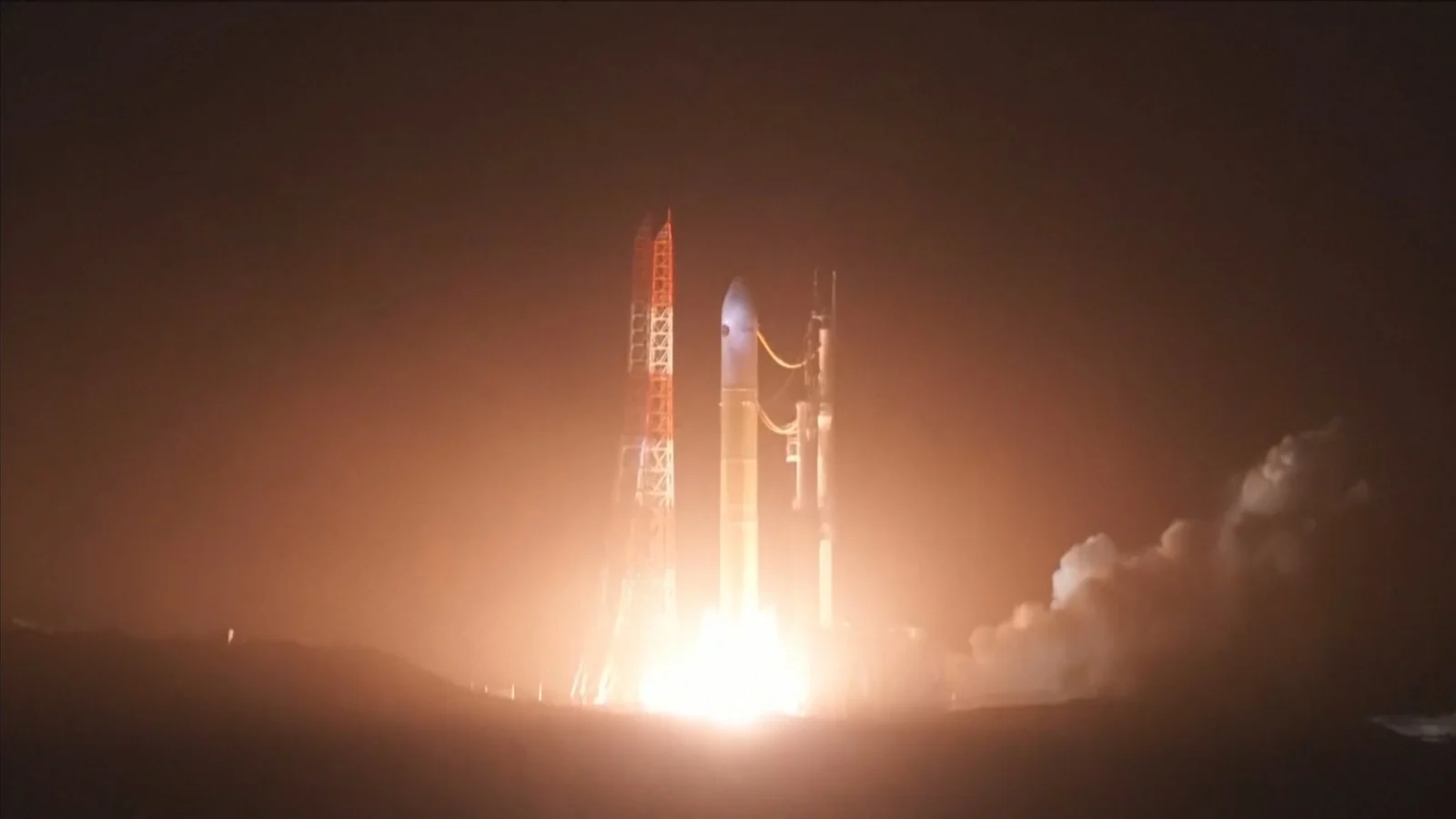
Before dawn broke over southern Japan, a powerful new rocket thundered into the sky carrying a bold scientific wager: that the key to understanding the Solar System’s beginnings — and possibly the roots of life on Earth — may be sitting on a moon of Mars.
Japan’s flagship H3 rocket, lifting off with the unmanned Martian Moons eXploration (MMX) probe, launched from the Tanegashima Space Center at 4.41am Tuesday (7.41pm GMT Monday), according to a live stream broadcast by the Japan Aerospace Exploration Agency.
If all goes to plan, the spacecraft will reach the Mars system around August next year and begin operating near Phobos, the larger of the planet’s two moons.
Watch: Japan launches world-first mission to retrieve samples from moon of Mars
Over the course of its planned three years in the Red Planet’s neighbourhood, MMX is expected to touch down on Phobos and gather at least 10 grams of surface material.
The project is designed as the first round-trip mission to the Martian region, and it is being carried out in partnership with US and European space agencies alongside a broad coalition of universities and technology firms.
Supporters of the effort say the work could also help set the stage for eventual human journeys deeper into space.
At its core, JAXA wants MMX to clarify how Mars and its two moons came into being — a missing chapter, the agency argues, in piecing together how the Solar System formed.
Scientists have long debated two main explanations for Phobos and Deimos. Under the “giant impact” hypothesis, the moons emerged from debris thrown up after a large object slammed into Mars.
The alternative “capture” hypothesis suggests the moons began as asteroids later snagged by Mars’s gravity.
Settling that question would help illuminate “how a habitable environment for life might have arisen on the terrestrial planets”, JAXA said, referring to the four rocky worlds closest to the Sun – Mercury, Venus, Earth and Mars.
Japan’s Martian Moons eXploration (MMX) unmanned mission and its objectives
‘Natural space station’
Beyond sample return, JAXA said MMX will examine whether Phobos could serve as a “natural space station” by defining what is needed for a round trip — a capability the agency called “essential for crewed Mars exploration”.
The mission will also study Deimos from a distance, but it will not attempt a landing there.
Japan’s push comes as other major space powers compete to become first to deliver Martian rocks to Earth.
NASA’s Perseverance rover, exploring Mars since 2021, has already collected samples on the planet’s surface.
But the planned return mission was effectively cancelled by the administration of US President Donald Trump after Congress voted in January.
China, meanwhile, has set its Tianwen-3 spacecraft for launch around 2028, with an aim of bringing back Mars samples as early as 2031 — potentially ahead of the Japanese mission’s own return.