France is preparing to widen curfews to new hotspots, Prime Minister Sebastien Lecornu said, after restrictions imposed in several cities were credited with helping authorities keep the peace overnight.
The country was shaken on Saturday by some of the most serious rioting in recent years, unfolding just six months before voters choose a successor to President Emmanuel Macron.
Facing criticism for not anticipating or containing the street violence, the government has promised to restore order and announced partial curfews in Paris and several other cities yesterday.
“Targeted curfews have contributed to calm overnight,” Mr Lecornu wrote on X.
“Tonight new curfews will be decided where the situation requires it. These decisions will be made on the ground, by the prefects, in coordination with the mayors,” he said.
Police said the night passed without major incidents across France.
Paris, the southwestern city of Bordeaux and Nice on the French Riviera were among the places that introduced partial curfews yesterday, responding to unrest that followed weeks of student demonstrations about poor learning conditions in secondary schools and later broadened into protests over the cost of living.
An almost deserted street in Ille, which was under a partial curfew last night
Some measures — including in Paris — were initially limited to the night from yesterday to today, while others, notably in Bordeaux and Nice, were due to remain in place for several days.
Overnight in the French capital, a helicopter circled above Place de la Republique, one of the centres of the unrest, scanning the square with a powerful searchlight as authorities monitored adherence to the curfew.
In Lyon, where demonstrations were banned, organisers said around 500 people gathered yesterday evening outside the tourism office that was set on fire, in a show of support for shopkeepers hit by looting.
Candles on the ground spelled out “LYON”.
Nearby, a banner hung from a fence read “Anti-Rioters Lyon” and “Doucet Resign”, referring to Green mayor Gregory Doucet, an AFP journalist reported.
With pressure mounting, the government set another round of emergency meetings for Tuesday, including discussions involving representatives of major social media platforms.
People gathered outside the burnt out tourist office in Lyon yesterday evening
Finance Minister Roland Lescure said support measures would be introduced for shopkeepers and craftspeople.
Patrick Martin, head of the Medef business lobby group, accused the state of having “failed” during unrest that struck at least 3,000 businesses, according to preliminary estimates.
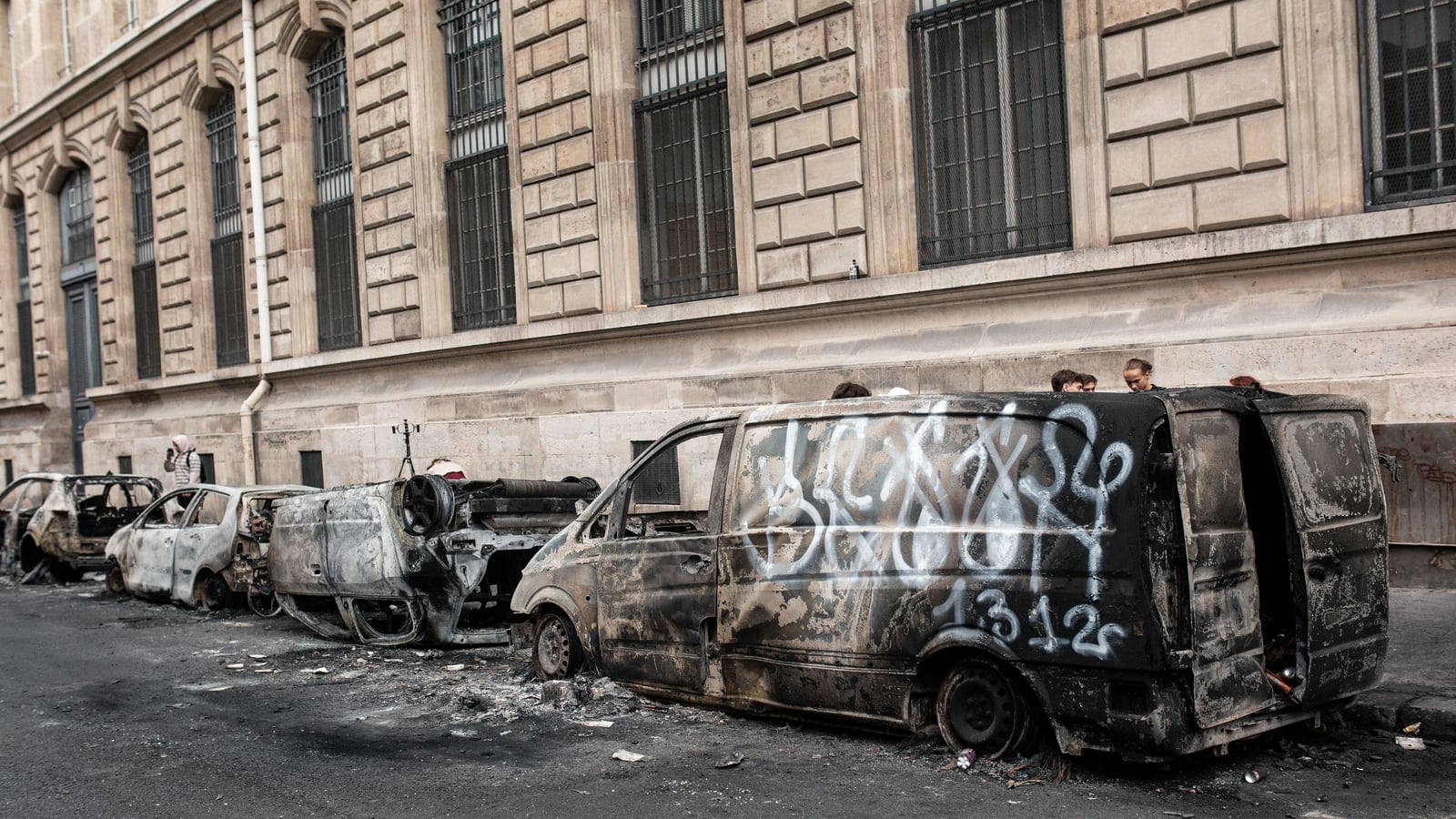
Bonfires of electric bikes burn in Paris riots
Amid the protests, one recurring image has stood out: electric bikes set alight in the streets.
In Paris over the weekend, black smoke and flames rose from piles of thee-bikes. In another part of the city, a protester threw an e-bike onto a burning car.
Shared-mobility operator Dott said in a statement that around 300 of its electric bikes were destroyed and 120 severely damaged in Paris during the nationwide protests on Saturday. It has 6,000 bikes in the city.
Dott also said 80 vehicles, including bikes and scooters, were destroyed in Bordeaux and 30 to 40 scooters in Lyon, putting total damage at about €400,000.
Lime said some of its shared bicycles and scooters in Paris were destroyed or damaged during the protests, with the company losing about 6% of its Paris fleet.
Before demonstrations began, Lime said it coordinated with police to remove vehicles from designated protest routes and limited parking and riding in several high-risk zones, revising those steps over the weekend as conditions shifted.
Smovengo, which operates the Vélib’ Métropole bike-sharing service in Paris, said about 300 bikes from its fleet of roughly 20,000 were damaged or stolen during the weekend unrest. Unlike dockless services, its bikes are kept at docking stations rather than left on pavements.
E-bikes often rely on lithium-ion batteries, which can ignite and produce intense fires that spread quickly and generate toxic smoke.
There was no sign that operators were being specifically singled out, but with thousands of bicycles available on Paris streets and at docking points, they were easily reached by protesters and were frequently used to form barricades or set on fire.
Portuguese police clash with housing protesters in Lisbon
Protesters had camped in Rossio square in central Lisbon
Unrest has also flared elsewhere in Europe.
In Portugal, police clashed with housing protesters today during a dawn operation to dismantle tent camps in Lisbon, detaining several dozen people.
Protesters in Portugal have rallied against surging housing costs and have sought to align themselves with similar actions in neighbouring Spain, where tents have been pitched for weeks in central Madrid.
In Spain, the eviction of 87-year-old María del Carmen Abascal — who later died — from her Madrid home set off nationwide protests over housing shortages and spiralling rents, and helped prompt a snap election next month.
After a demonstration on Saturday in Lisbon, dozens of tents were erected in Rossio square, in the city centre.
Footage aired by local television showed protesters forming a human chain as police moved in this morning, before scuffles broke out.
Demonstrators accuse the government of failing to address Portugal’s housing crisis and of trying to push through rental market reforms that they say would make evictions easier.
Protesters said about 30 demonstrators were injured and arrested.
In Milan, Italy’s affluent northern city, police on Sunday clashed with protesters who threw stones and looted stores during demonstrations over poor public services and rising living costs.
Belgium has also experienced demonstrations, while Albania has seen large rallies driven by anger over perceived government corruption, a lack of jobs and poor education standards.