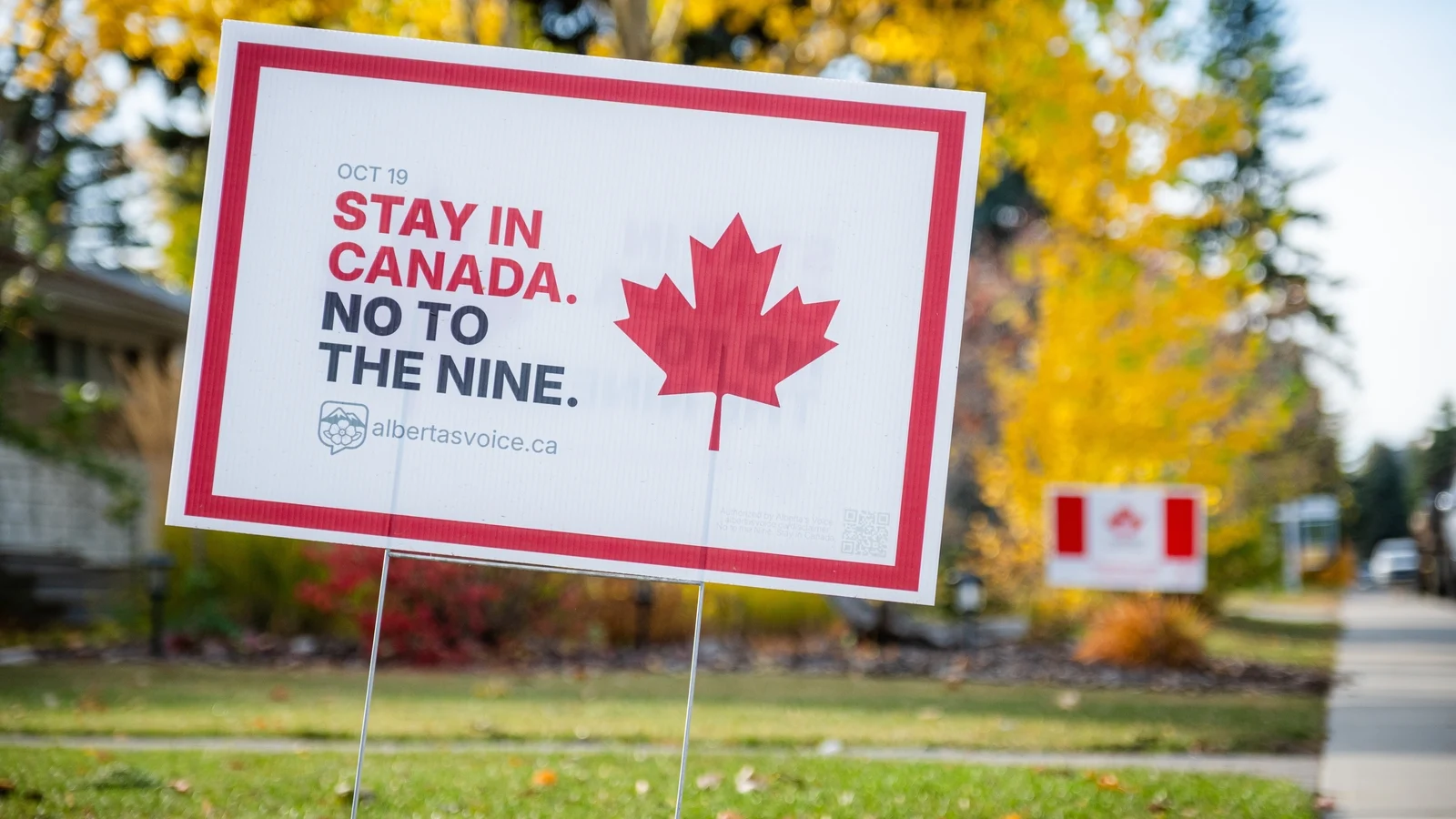
Alberta voters have rejected separation and opted to stay in Canada, delivering a timely boost to Prime Minister Mark Carney as he tries to hold the country together while Canada is locked in a trade war with the US.
CBC News, Canada’s government-funded national broadcaster, projected the outcome once 33% of ballots had been counted.
When CBC made its call, 76% of the votes tallied backed the “remain” side, compared with 23% supporting the province moving toward a binding vote on separation. The referendum itself was nonbinding.
“Albertans made a clear choice,” Mr Carney said in a statement. “They chose unity, to build together, and to take care of each other.”
“Canada is greater than the sum of its parts,” he said.
In the run-up to the vote, pollsters and analysts had consistently downplayed the chances of a separatist win, pointing to polling suggesting roughly one-third of people in the western province supported holding a future referendum on leaving.
Alberta Premier Danielle Smith announced the referendum in May, saying it was “time to have a vote, understand the will of Albertans on this subject, and move on”.
Late yesterday, Ms Smith posted a statement on social media saying she was “very pleased” that early returns indicated broad support for remaining in Canada.
She said she would speak to Albertans today about the outcome and “where our province goes from here”,
For months, a small but loud separatist campaign has pushed for an independent Alberta, arguing that the province’s energy wealth subsidises poorer regions of Canada and that Alberta would be substantially richer without what it calls Ottawa bureaucracy blocking its ambitions.
Last week, addressing a rally in Calgary, Mr Carney warned that a vote to leave would amount to “a dangerous bluff that will lead to years of deep division,” and urged residents to “vote like Canada depends on it”.
Canadian Prime Minister Mark Carney said that the referendum vote was held ‘at the worst possible time’
Mr Carney, who spent much of his childhood in Alberta, said he understands the long-running sense among some Albertans that Ottawa has dismissed their concerns. He also said his government had approved a proposed new pipeline, adding that Alberta would play a central role in helping Canada cut its reliance on the US.
The Alberta referendum came after two earlier separation referendums in Quebec, the majority French-speaking province. In both votes, Quebecers chose to remain part of Canada.
First Nations groups have also raised objections to the idea of an independent Alberta, noting that their treaties with Ottawa were signed before Alberta was created as a province within Canada.
CBC News reported strong turnout among First Nations voters. At one polling station in southern Alberta, in an area home to the Siksika Nation, officials temporarily ran out of ballots and later kept the station open until after 10pm so everyone still in line could cast a vote.
Even so, the result is not expected to extinguish Alberta’s separatist push. Ahead of the referendum, some separatist leaders said they would keep pressing for another vote even if the province chose to stay.
Alberta holds the world’s fourth-largest proven oil reserves, and frustration over management of the oil industry has fuelled much of the separatist energy.
Ms Smith has argued that Mr Carney’s predecessor, Justin Trudeau, helped spark the movement, accusing him of trying to squeeze oil production in pursuit of a pro-climate agenda.
Polling data released on 16 October by Angus Reid found that 62% of Albertans believe “there will never be an end to the separatist movement” in the province.
Alongside the separation question, Alberta’s ballot included nine other nonbinding questions touching on issues such as immigration, access to provincial services – including education, social care and healthcare – and voter identification rules.
Results for those questions were still coming in.