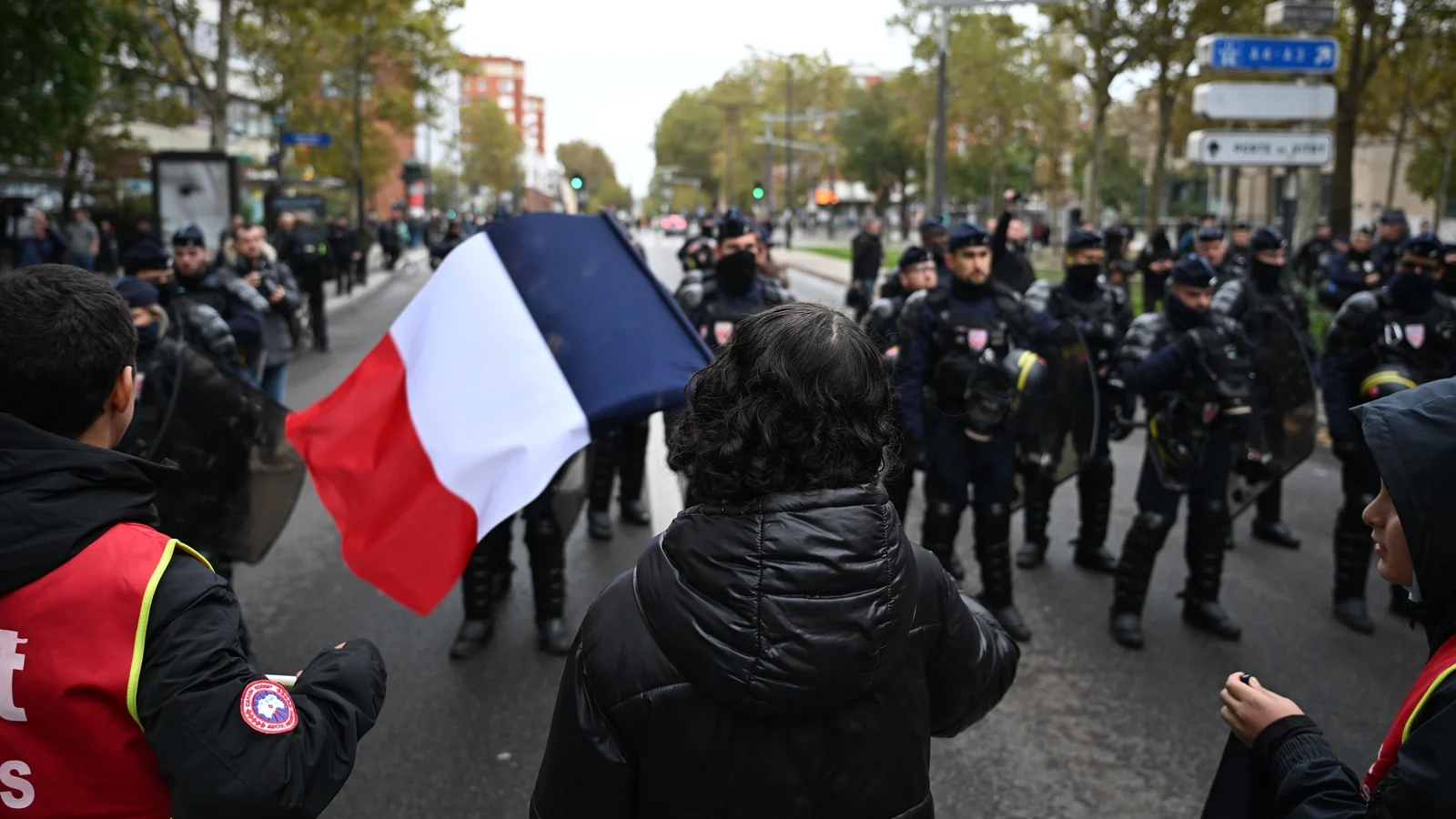
France braced for another day of street protests as police moved quickly to choke off any repeat of last weekend’s violence, detaining 135 people and confiscating an array of weapons, Interior Minister Laurent Nunez said.
Among the items seized were metal balls, lead pellets, fireworks, slingshots, steel balls, improvised weapons, a katana and airsoft weapons, Mr Nunez said, adding that up to now “there has been no major incident”.
Even so, officers used tear gas as they tightened security in major cities, aiming to prevent a return to the rioting seen a week earlier.
In Lyon, in the southeast, police fired tear gas to scatter about 150 protesters near the city centre — an area where demonstrations had been banned — after some of them briefly tried to block a road, an AFP journalist reported.
“The police are really mobile… They come and disperse marches before they even form,” said a student who came to protest and asked not to be identified.
Around the country, officials and shopkeepers spent the day preparing for the possibility of fresh clashes and damage.
French gendarmes stand amidst tear gas during a demonstration in Nantes
In Paris, businesses around the Bastille district took visible precautions: one clothing shop cleared its shelves entirely ahead of the marches, while a nearby restaurant was covered with boards but displayed signs insisting it was “still open”.
Across the capital, many other storefronts were similarly shielded with wooden panels.
The Louvre and the Musee d’Orsay museums were closed.
By midday, Paris police said they had seized “various forbidden items” and described the atmosphere as “calm”.
In Marseille, riot vehicles, armoured trucks and a water cannon stood ready in the city centre, as police elsewhere also positioned themselves for possible confrontations.
The deployments formed part of a major mobilisation: the interior ministry said 70,000 security personnel were on duty because the threat of violence was considered “high”.
Protest against Le Pen’s party
Political tensions were heightened further by Marine Le Pen’s National Rally congress in Orleans, where she launched her campaign for elections in six months to select President Emmanuel Macron’s successor.
Thousands of protesters, chanting anti-fascist slogans, marched against Ms Le Pen and also against Mr Macron, the country’s pro-business centrist leader.
“Macron resign. Le Pen in prison,” the crowd shouted. Police estimated turnout at 11,000, while organisers put the figure at 26,000.
The flare-up underscored an anxious mood in France ahead of the vote, which surveys suggest Ms Le Pen is best placed to win.
Last weekend, violence on the fringes of nationwide demonstrations saw rioters clash with police, vandalise public buildings and loot hundreds of stores. About 2,700 people were arrested, and the retail sector said shopowners suffered damage and stolen goods totalling hundreds of millions of euros.
Thousands of people are seen marching in Orleans
Mr Macron blamed the worst of the violence on “ultra-left” groups that he said “want to bring down the republic”.
Organisers of today’s renewed protests, however, accuse Mr Macron and his government of disregarding widespread anger over rising costs and over classroom conditions for students.
Inflation in France, as in other countries, has surged following the Middle East war, started in February against Iran by US President Donald Trump and Israel.
Demonstrations have also taken place in Italy, Belgium, Spain and Portugal on a range of issues, with some shared concerns around inflation and education. Italy has mobilised 500 troops to Milan after street violence there.
Boarded-up shops
Paris streets were unusually quiet today, with many shop fronts boarded up and some large retailers sending messages to customers saying they were closed for the day.
In a late change, Paris police ordered that a union-organised march be moved from Bastille in the centre-east to the more distant eastern Porte d’Italie on the southern edge of the capital.
Unions said they would reluctantly comply.
But the Yellow Vests — who led disruptive protests against Mr Macron eight years ago — denounced what they called an “authoritarian drift” and urged further demonstrations on 31 October for “the freedom to protest”.
Pedestrians walk past boarded up shops in Paris
In Rennes, a shopworker told AFP: “Bans are sometimes worse. Protesting is a right, and when you ban it you make it even more tempting.”
Mr Macron and his government have sought to distinguish what they call legitimate protest demands from the looting, fires and ransacking that broke out on the sidelines of last Saturday’s demonstrations.
Officials said courts have already sentenced 217 people to prison over Saturday’s events, including half who were first-time offenders.
Mr Macron has said authorities would accept only union-led demonstrations and would crack down on any others deemed “illegitimate”.
Protests took place across France last weekend
Those restrictions — including outright bans on protests in some cities — have drawn criticism.
Amnesty International condemned what it described as “a slide toward authoritarian practice”, saying the measures were “jeopardising the right to demonstrate peacefully”.
“Police have a responsibility both to ensure that protests can take place peacefully and safely and to protect the public from violent disorder,” said Eva Cosse, senior Europe researcher at Human Rights Watch.
More: How the French riots will affect the 2027 Elysée battle