
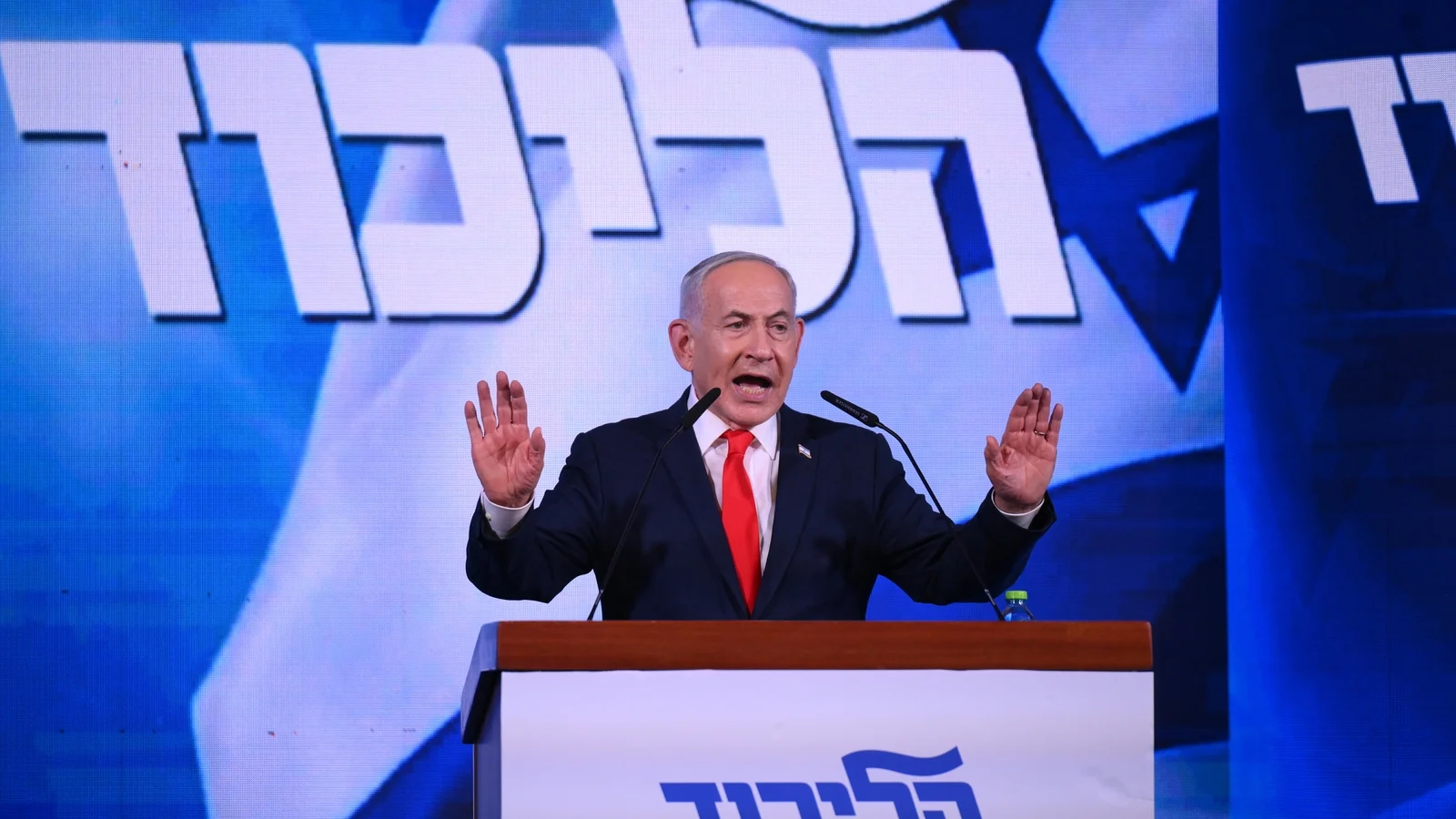
Israel woke to a knife-edge political picture, with fresh exit polls early this morning showing Prime Minister Benjamin Netanyahu’s bloc locked level with the opposition after earlier projections had put his rivals narrowly ahead.
Among the three mainstream broadcasters, Channels 11 and 13 each placed the two blocs at 51 seats apiece — short of a governing majority — while Channel 12 continued to show a slim advantage for the opposition led by Gadi Eisenkot following yesterday’s vote.
The shifting numbers came as Mr Eisenkot promised today to move fast on coalition-building, arguing that voters had turned against what he described as Mr Netanyahu’s divisive rule.
Exit polls indicated the biggest gains were made by Arab Israeli parties, buoyed by a surge in turnout among voters motivated to oppose Mr Netanyahu, who has repeatedly warned that Israel’s Arab minority would weaken the Jewish nationalist course he has pursued.
Addressing energized supporters at an arena in Tel Aviv, Mr Eisenkot also delivered a pointed caution to Mr Netanyahu over his threats to launch a new war on Iran — a step he suggested could upend already delicate coalition talks.
Gadi Eisenkot issued a warning to Prime Minister Benjamin Netanyahu over his threats to launch a new war on Iran
“Netanyahu, don’t you dare use Israel’s security for your political needs,” Mr Eisenkot said.
With turnout nearing 78% — the highest since 1999 — Mr Eisenkot said forcing a second election would be a mistake, and pledged to work “swiftly” to form a government.
“The public has voted for change,” Mr Eisenkot said.
“A worthy leader would accept the people’s vote of no confidence and announce his retirement from political life today,” he added.
Mr Netanyahu, for his part, also vowed to assemble a new coalition, insisting that no leader should govern with the backing of Israeli Arabs as their parties posted strong gains.
“We must put in place a strong government of the right,” Mr Netanyahu told cheering supporters.
“The Jewish and Zionist majority must unite,” he said. “It is out of the question to have a government that is backed by Arab parties.”
The remarks, delivered after 3am local time (1am Irish time), were notably brief by Mr Netanyahu’s standards, and he stopped short of declaring victory outright.
Gideon Saar, Israel’s foreign minister and Mr Netanyahu ally, dismissed the opposition’s victory claims as “premature”.
Eye on Arab kingmakers
Initial exit polls from Israel’s major television networks had given the opposition a slight edge.
By early this morning, two networks reported a 51-51 split between the blocs, with the third still showing a narrow opposition lead.
Broadcasters said Likud was expected to emerge as the largest single party in parliament, on 24 to 27 seats.
Israeli Arab lists were projected to take 17 to 18 seats — a significant jump.
No single party has ever won 61 seats outright in the 120-seat Knesset, making coalitions the norm.
Key Israeli Arab leader Mansour Abbas said he believed the right had “suffered a major loss” and signaled openness to working with Mr Eisenkot.
Mr Eisenkot has said he would not govern with Israeli Arab politicians — a prospect Mr Netanyahu had warned his supporters could follow from an opposition win.
Even so, Arab politicians could bolster Mr Eisenkot in Knesset votes to sustain a minority government without formally joining a coalition. Failing that, the stalemate could send Israel back to the polls.
Posters of Yashar Party leader Gadi Eisenkot and Prime Minister Benjamin Netanyahu
Itamar Ben Gvir, a far-right firebrand who exit polls suggested fell short of some expectations, cautioned Mr Netanyahu against another route: a unity government with Mr Eisenkot.
“It would be a terrible mistake,” said Mr Ben Gvir.
Hebrew University of Jerusalem political scientist Gideon Rahat said Mr Ben Gvir had managed to mobilise votes — of Israeli Arabs.
But he added: “Even if Netanyahu lost, that doesn’t mean Eisenkot won.”
Divisive
In a late push to maximise support, Mr Netanyahu had accused Israeli Arabs of seeking to “steal the election,” and his Likud party unsuccessfully pressed election authorities to keep polls open beyond 10pm local time (8pm Irish time).
Those moves prompted the opposition to argue he was laying groundwork to dispute the outcome.
Israelis voted under the long shadow of Hamas’s 7 October attack and the multi-front regional wars it ignited, with the trauma still acute and accountability and security dominating the campaign.
The election unfolded as Israel faces growing isolation internationally, amid the war in Iran and the military campaign in Gaza, rising settlement construction and violence in the occupied West Bank.
Mr Netanyahu is also the subject of an arrest warrant from the International Criminal Court over Gaza and faces domestic corruption charges that could result in prison if he loses power.
Read more: Netanyahu loses his majority, but no one has won it yet
Mr Eisenkot, a political newcomer, has presented a mild-mannered style that contrasts with the smooth-talking incumbent.
The son of working-class Moroccan Jewish immigrants, Mr Eisenkot would become the first prime minister of Middle Eastern or North African descent.
Before voting, the 66-year-old Mr Eisenkot quietly visited the grave of his son Gal, whose death fighting in Gaza has drawn sympathy from many Israelis.
Mass turnout
Tens of thousands of Israelis were estimated to have flown in from abroad for an election widely seen as pivotal for the country.
Eilana Zisblit, 55, told AFP she had returned from Canada — where she has lived for almost 30 years — to vote for a centre-right party aligned with Mr Eisenkot’s bloc.
“The country is going in a really, really bad direction. Both for Jews and Arabs living in the country, and for Jews living abroad,” she said.
The time to act is “now, or the country really won’t survive anymore”, she added.
Mr Netanyahu, 77, who has served as prime minister on and off for more than 19 years, has repeatedly been quick to raise allegations of electoral fraud.
He said yesterday that three senior officials of the United Arab List had been arrested with envelopes full of cash in the south — an episode election authorities described as an isolated, local case.
Mr Netanyahu last returned to power in December 2022.
In the final days of the campaign, he posted an image of a nuclear bomb destroying Tel Aviv and highlighted his endorsement by US President Donald Trump, who is also known for alleging election fraud.