Explosions and air-raid sirens swept across Ukraine overnight after Russia launched a new wave of attacks, Ukrainian authorities said, a sudden escalation that undercut hopes for fresh momentum toward peace in a war now nearing its fifth year.
The strikes hit multiple regions, killing dozens of people, forcing the evacuation of patients from a medical facility and setting off ballistic missile alerts in several parts of the country.
In Russia, Moscow mayor Sergei Sobyanin said air defences destroyed nearly 500 drones that were headed toward the capital region.
The renewed violence came immediately after a rare lull in fighting in the southern Ukrainian region of Kherson, a pause that ended Sunday.
That truce — described as the longest since the war erupted in February 2022 — allowed a humanitarian mission to reach the Russian-occupied city of Oleshky.
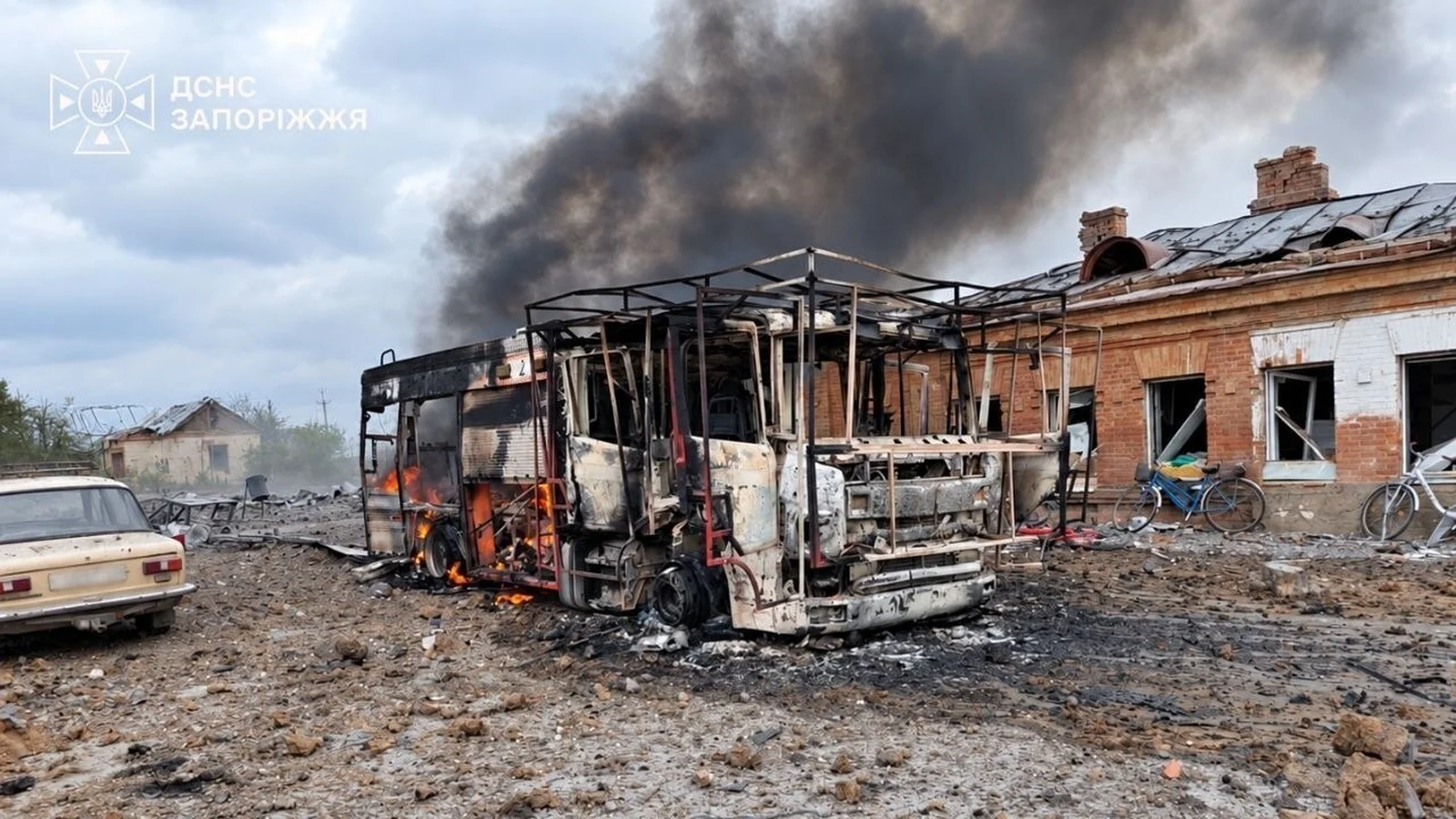
Not long after the local ceasefire expired, Russia struck a village in Ukraine’s southeastern Zaporizhzhia region, killing at least 26 people, according to the acting regional governor.
Authorities in Zaporizhzhia later said Russian bombing had killed 29 people.
Workers clear debris from a house destroyed in a Russian attack in Odesa, Ukraine
Ivan Fedorov, who heads the Zaporizhzhia regional military administration, accused Russia of “striking people who had come to receive humanitarian aid.”
In Kharkiv, the northeastern regional capital, Oleg Synegubov, head of the regional military administration, said a Russian strike hit a medical facility, wounding 25 people. He said about 200 patients were evacuated and that a building, windows and cars were damaged.
Ukraine’s army warned that ballistic missiles were heading toward Kharkiv and other areas, including the capital Kyiv as well as Dnipro and Sumy.
Oleksandr Ganzha, governor of the Dnipropetrovsk region, said a Russian strike damaged critical infrastructure in the Dnipro and also in Kryvy Rih, the hometown of President Volodymyr Zelensky.
Russia’s defence ministry said it carried out a “massive strike” targeting energy facilities across Ukraine and port infrastructure in the Odesa region.
Poland, which borders Ukraine, said it activated air defences to help protect its airspace, particularly along border areas.
The barrage unfolded as Britain and France announced that about 2,800 troops from ten European countries will hold military exercises this month in support of Ukraine.
Those soldiers are due to gather in Poland for the first drill of a new multinational force. The force has no offensive mission and would only be deployed after a ceasefire is agreed to end the war.
On the diplomatic track, US special envoy Steve Witkoff said Washington-led talks between Russia and Ukraine were expected to resume next week as the conflict grinds through its fifth year.
A Geranium-2, Russia-made drone, originally Iranian-designed Shahed 136, flying over Kyiv
President Donald Trump has pressed for a settlement, but no breakthrough has emerged.
Zelensky condemned the deadly strike on Zaporizhzhia yesterday, saying it hit a school that was distributing humanitarian aid.
“There was a moment when the next steps (after the Oleshky truce) could have shown that progress toward peace was possible,” he said.
“With these killings, Russia is sending an entirely opposite signal: Russia is counting on more killings. There must be a response to this.”
Mykhailo Semikin, the acting regional governor, said on Telegram that two rescue workers and four police officers were among those killed.
Last week’s ceasefire, brokered by US First Lady Melania Trump, made it possible to evacuate people from Russian-occupied Oleshky to both Ukraine-controlled territory and Moscow-annexed Crimea.
A senior Ukrainian figure told AFP on Sunday that Russia rejected a Ukrainian proposal to extend the truce.
Ukraine’s military also alleged that Moscow used the pause in fighting to “fortify its positions.”
The Kremlin did not dispute those claims, with spokesman Dmitry Peskov telling reporters Monday: “This is a completely normal practice in such situations.”
He argued that Ukrainian forces had also used previous pauses in combat to regroup.
Peskov said Russia viewed the Oleshky humanitarian mission as “successful,” pointing to “good cooperation between all sides” and highlighting the role of Russia’s human rights commissioner Yana Lantratova.
Lantratova oversaw the ceasefire alongside her Ukrainian counterpart Dmytro Lubinets, in what amounted to one of the most significant episodes of Russian-Ukrainian coordination since the war began.
The Kremlin said no additional missions of that kind were being prepared “at the moment.”