
Russell Brand will be back in court today, where a judge is due to sentence the comedian after a jury found him guilty of raping one fan and sexually assaulting three other women.
Brand, 51, was convicted at Southwark Crown Court of raping a woman in 2009 and of sexually assaulting female TV and radio workers in incidents spanning 2004 to 2009.
Mr Justice Bennathan ordered Brand to begin his prison sentence immediately following the guilty verdicts delivered last Thursday afternoon.
Russell Brand leaves Southward Crown Court in a police van
When the court reconvenes, the judge is expected to hear victim impact statements as well as legal submissions from both sides before handing down sentence.
During a four-week trial, jurors heard allegations that Brand targeted women he met as his profile rose on the stand-up circuit and across television, radio and film, becoming one of the country’s most recognisable entertainers.
Brand told the court he had only ever engaged in consensual sex, describing a “promiscuous” period of his life that he said involved “idiocy” but no criminality.
The women who testified painted a starkly different picture: they described a celebrity who, they said, kissed and groped women within moments of meeting them, pursued sex aggressively and then laughed at and gaslit women after the attacks.
Russell Brand, with his wife Laura Gallacher, arriving at Southwark Crown Court
The trial also heard evidence from friends and former colleagues who spoke about Brand’s stated ambition to sleep with 5,000 women, and how, as his fame grew, troubling conduct towards women became “normalised” around him.
Jurors convicted Brand of raping a 21-year-old fan in 2009 after he met her following one of his stand-up shows at the Hammersmith Apollo.
The woman said she idolised Brand and told the court she willingly took part in a threesome with him backstage.
She later agreed to go to Brand’s home in Hampstead for sex a few days afterwards, but told jurors the encounter escalated into rape when, she said, he abruptly forced her into anal sex.
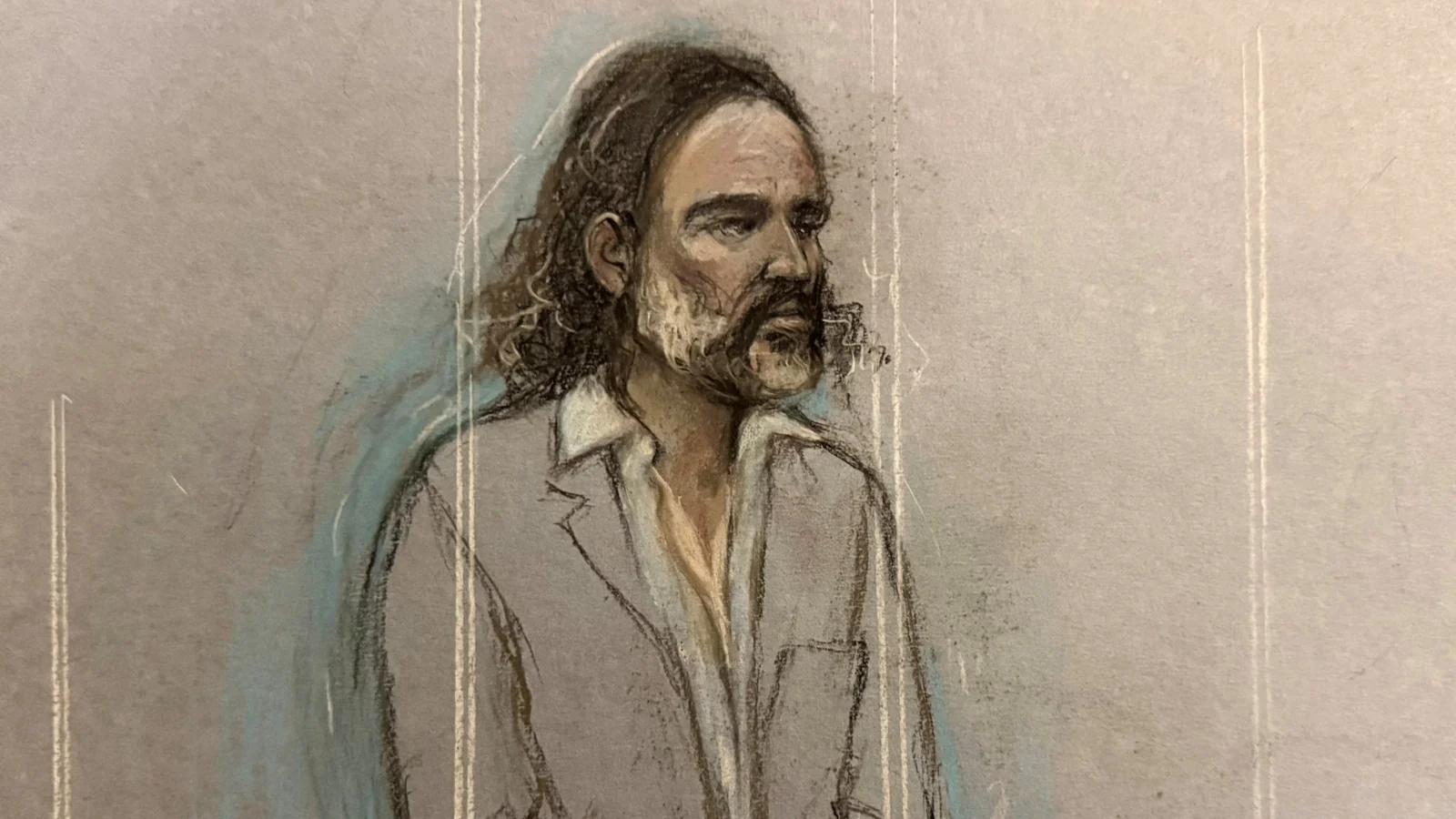
Court artist sketch of Russell Brand listening to Judge Mr Justice Bennathan at Southwark Crown Court
A second complainant described being sexually assaulted in 2004 in a London bar, telling the court that Brand groped her breasts only seconds after she was introduced to him at a party.
She said she remembered a “weird” grin on his face as he grabbed her, and that he did so openly in the middle of a crowded venue.
The court heard that in 2005 Brand kissed and groped another woman during a visit to Capital Radio’s studios in London, allegedly pouncing on her as she left a room.
The woman said she looked to members of Brand’s entourage for help but received none, and only managed to get him off her by pushing him away.
UK Police have revealed that Brand is currently under investigation over two further rape allegations
Brand was also found guilty of sexually assaulting a female Channel 4 worker in 2009 by putting his head into her groin after she was made to give him a massage.
She told the court that Brand refused to carry on with a recording session unless she massaged him, and said people around him encouraged the situation rather than intervening.
Prosecutors also challenged Brand with passages from his 2007 book, My Booky Wook, including an account in which he boasted he would not stop pursuing sex until he achieved what he called his “birthright orgasm”.
Brand, who told the court he was the target of a media conspiracy, was convicted of one count of rape and three counts of sexual assault. He was cleared of two additional rape charges and one allegation of attempted indecent assault.
Following the verdicts, the Metropolitan Police said Brand is now being investigated over two further rape allegations.
Met Commissioner Sir Mark Rowley said officers are preparing for “many, many more” potential victims of Brand to come forward, while Prime Minister Andy Burnham described the crimes as “horrifying”.
Russell Brand being questioned by police
Culture Secretary Lisa Nandy said media organisations have not changed enough to prevent celebrities like Brand from preying on women.
“We need far more robust processes in place to protect women like the women who bravely came forward in the Russell Brand case to make sure that they are protected and treated seriously,” she said.
“Hand on heart, I don’t think we can say that this couldn’t happen today,” she added.
One of Brand’s former producers, Jack Bayles, who was accused of encouraging the 2009 forced massage, has been told to “step back” from producing two BBC sitcoms by TV production company Various Artists Limited after the verdicts.
The Victims’ Commissioner, Claire Waxman, has urged the introduction of a new legal duty requiring judges to direct juries on rape myths and misconceptions if such issues arise during a trial.
Her call followed arguments made in court by Brand’s barrister, Ian Winter, who suggested Brand could not be a rapist because his accusers had not screamed, fought back or run away during the alleged attacks.
After the convictions, Mr Winter was seen verbally abusing Sunday Times journalist Rosamund Urwin in a courthouse corridor.
Ms Urwin was among the journalists who first reported on allegations that Brand was a sexual predator, and Brand’s defence had argued that media coverage had contaminated evidence in the criminal proceedings.
Mr Winter said on Friday that he has self-referred to the Bar Standards Board after reading media reports about the court incident.
Brand, who has millions of online followers and continued broadcasting Christian sermons during the trial, has now spent four nights in prison since proceedings concluded.
Mr Justice Bennathan has already warned him to anticipate a lengthy custodial sentence.