On the edge of a deal: how two sites stand between peace and more war
There are moments in diplomacy that feel less like negotiations and more like the final, breathless minutes of a marathon. Last week, in an auditorium beneath the California sun, a veteran of American interventionist wars — a man who once led troops across continents — told an audience that the effort to stop the fighting in Ukraine had reached “the last 10 metres.” His shorthand was ordinary; the consequences are anything but.
Keith Kellogg, the outgoing U.S. special envoy on Ukraine, told attendees at the Reagan National Defense Forum that only two issues remained truly thorny: the territorial fate of the Donbas and the status of the Zaporizhzhia nuclear power plant. Settle those, he argued, and “the rest of the things will work out fairly well.” It was the kind of line that excites negotiators and terrifies civilians.
A quiet but explosive geography
The Donbas — a patchwork of mined fields, shattered factories and stubborn towns — has been the epicentre of this long, grinding contest since 2014. Russia formally annexed Crimea that year, and the region of Donetsk and Luhansk has been contested even longer. When a full-scale invasion began in February 2022, the fighting metastasized: today, Russia holds roughly one-fifth of Ukrainian territory, including Crimea and large swathes of eastern and southern regions.
That reality is central to every conversation about surrender, compromise or a frozen line on a map. “If you cede Donetsk without proper consent, you don’t so much solve the war as invite a later, deeper one,” says a Ukrainian legal adviser in Kyiv who has followed negotiations closely. “A handover without a legitimate referendum is a legal abyss.”
Across the line in towns that have known only warfare for a decade, opinions are not monolithic. “My mother remembers Soviet times fondly,” says Olena, a teacher from a small Donbas village now under Ukrainian control, nursing a thermos of black tea in a Kyiv flat. “But she also remembers the shelling. People are tired. We want peace. But not at the cost of our freedom.”
The heart of the matter: Zaporizhzhia
More than any headline-grabbing clause about troop positions, however, it is the Zaporizhzhia nuclear plant that haunts negotiators. The plant — the largest in Europe by capacity — sits under Russian control and has been a recurrent flashpoint for months. A power plant is not merely an industrial asset; it is a potential disaster in a conflict zone.
“You can bargain territory, you can bargain ceasefires,” says Dr. Marie Koumbis, a nuclear safety expert and former IAEA inspector. “You cannot afford to gamble with a reactor’s safety culture. Any ambiguity about operational responsibility is dangerous.”
Kellogg’s assessment that resolving these two nodes could unlock broader progress is not naïve. But Russian officials have signalled they expect significant rewrites to the U.S. drafts. Yuri Ushakov, a longtime Kremlin aide, said Moscow wants “serious, radical changes” — though he did not specify them. That vagueness is, in itself, a negotiating tactic.
Intermediaries in the Kremlin corridors
Diplomacy took an unusual detour last week when two figures from the private sector — along with a high-profile presidential son-in-law — met with President Vladimir Putin. Long nights of Kremlin hospitality followed; public comment was thin but pointed. Moscow’s readout said “territorial problems” were discussed. Washington’s readouts were, until now, cautious and measured.
“Back-channel talks are necessary; they’re also risky,” notes Andriy Petrov, a retired European diplomat who has watched many rounds of peace talks in his career. “They can move the needle, but they can also create the illusion of progress without guarantees.”
Casualties, calculations and leaked drafts
Amid all the negotiating theatre, the human ledger is grim. Kellogg described the toll as “horrific,” citing — controversially — more than two million dead and wounded on both sides. Independent verification of such totals is elusive; both Moscow and Kyiv guard their figures closely. Yet even conservative tallies speak to a conflict that has left cities, families and livelihoods shattered.
Complicating the diplomatic picture was the emergence of a leaked document of U.S. draft proposals. The 28-point outline alarmed many in Kyiv and across Europe because, critics argued, it seemed to accommodate some of Moscow’s central demands — including limits on Kyiv’s military posture and the effective recognition of Russian control over substantial swathes of land. That leak illustrated an inescapable truth: once a draft enters the public realm, it shapes perceptions and politics as much as it shapes negotiations.
New U.S. framing, and Moscow’s cautious welcome
In parallel with the back-and-forth over a settlement, Washington shifted language in its latest national security strategy, removing a clause that had described Russia as a “direct threat.” The Kremlin, predictable in its relief, called the change “a positive step” and said Moscow would study the document closely. The move signals possible openings for limited cooperation on issues like strategic stability — arms control, nuclear risk reduction — even as fighting continues on the ground.
“Words matter in international diplomacy,” says Emily Rourke, an analyst at a strategic think-tank. “Labeling a state a ‘threat’ locks you into certain policies. A sliding scale of language gives diplomats more flexibility, at least on paper.”
Winter, power and the grind of strategy
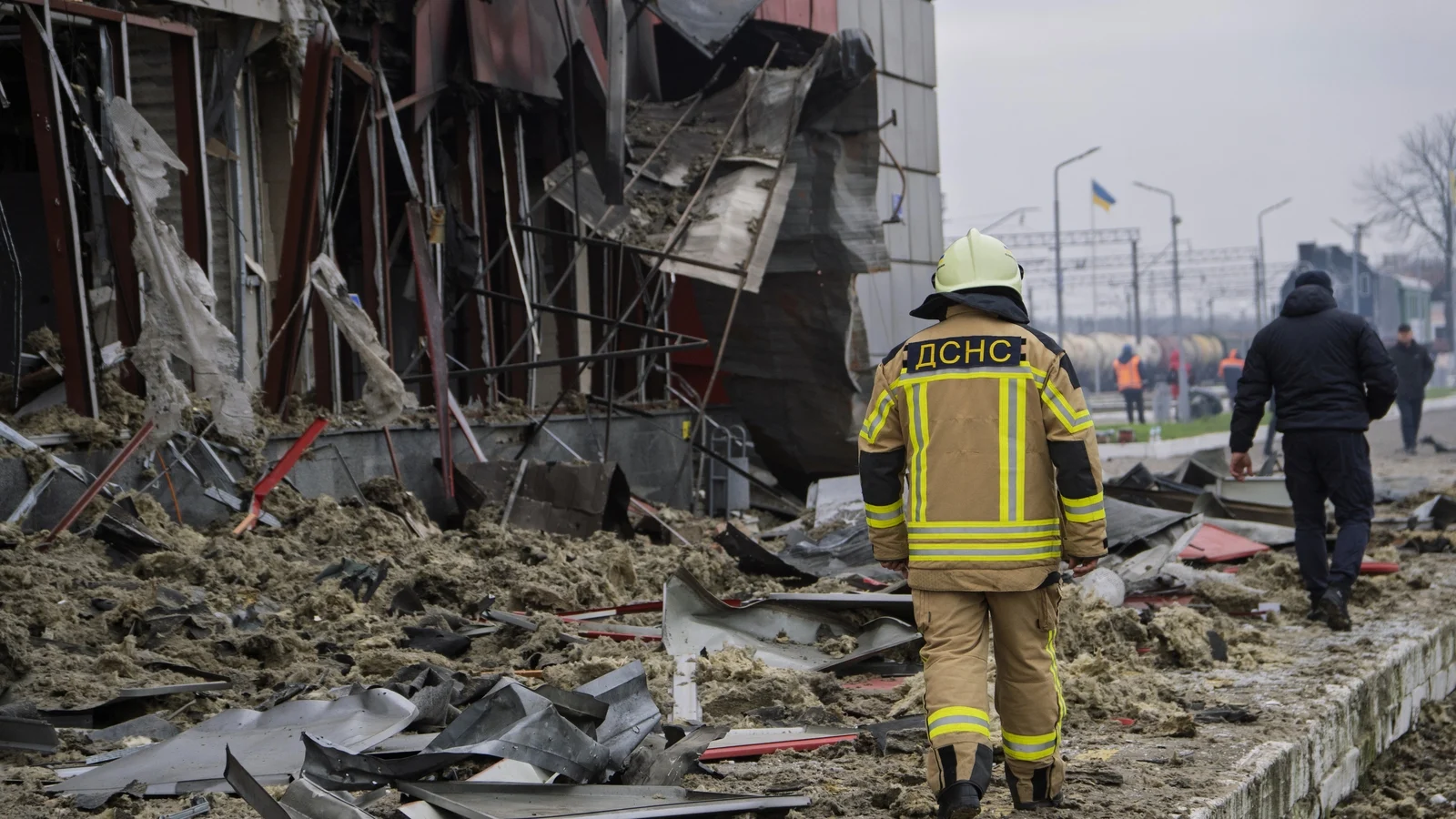
Winter is never just a season in this conflict; it is a weapon and a test. Russian forces have broadened long-range strikes on power, heating and water infrastructure in recent months, a campaign designed to sap morale and disrupt civilian life as temperatures fall. Overnight strikes hit central cities, including Kremenchuk, leaving neighborhoods without heat and water and local officials scrambling to assess damage.
“We will restore everything,” the mayor of Kremenchuk posted on social media after a strike that blacked out parts of the city. His pledge, sincere and defiant, echoes from municipal halls across Ukraine: repair, restart, survive.
On the ground, people improvise. A baker in Kharkiv swaps ovens on his route to serve communal bread. An electrician in a Black Sea port works 16-hour days to link backup generators as diplomats debate clauses in conference halls thousands of miles away. These are the small acts that stitch life back together while states haggle over maps.
Where do we go from here?
So what should we expect next? Negotiators, intermediaries and weary residents all hope for de-escalation. But hope will not hold a line on a map. Peace, if it is to be durable, will require more than signatures and press conferences: enforceable mechanisms, credible local buy-in, and safeguards for nuclear facilities.
Would you trade land for peace? Would you accept a frozen conflict if it spared another winter of blackout-strewn nights? These are not academic questions for the families whose windows show a streetlight blown out by the last strike.
For now, the deal — if deal there will be — rests on two stubborn fulcrums: the contested earth of Donbas and the reactors of Zaporizhzhia. Resolve those poorly, and the rest could unravel. Resolve them well, and a weary region might finally begin the slow work of rebuilding, remembering, and returning home.
Whatever comes next, the human stories will remain: teachers serving tea, mayors counting the cost, diplomats pacing corridors, and civilians asking the simplest of questions — when will it end?