Borderfire: A Day of Smoke and Sirens on the Cambodia–Thailand Line
The sun barely rose when the first reports came in: villages along the 817-kilometre stretch of border between Cambodia and Thailand were under fire again. Smoke threaded the paddy fields. Mothers wrapped children in sarongs and fled. Men who had tilled the same plots for decades grabbed what they could and ran toward roads choked with cars, motorbikes and livestock.
<p“This morning we woke to a sound like thunder,” said a woman who gave her name as Srey in a makeshift shelter near the border. “We thought it was a storm at first. Then people showed us the videos on their phones — drones, rockets. We left everything.”
How it all started (and why it won’t go quiet)
Both governments accuse the other of igniting the latest round of violence. Phnom Penh says it waited 24 hours to honour a ceasefire brokered earlier this year — a rare diplomatic intervention that, remarkably, was attributed to former US President Donald Trump. But, after evacuations and talks failed to end the strikes, Cambodia’s influential former leader Hun Sen announced that his country had been compelled to launch counterattacks.
“Cambodia needs peace, but Cambodia is compelled to counterattack to defend our territory,” Hun Sen wrote on Facebook, declaring that fortified bunkers and weapons gave Cambodian forces an advantage in defending against what he called an “invading enemy.”
In Bangkok, military spokespeople were equally blunt. “Thailand is determined to defend its sovereignty and territorial integrity and therefore military measures must be taken as necessary,” Rear Admiral Surasant Kongsiri told reporters, as officials described clashes across five border provinces and a navy operation in Trat province that they said would soon expel Cambodian soldiers.
Weapons, drones and the echo of history
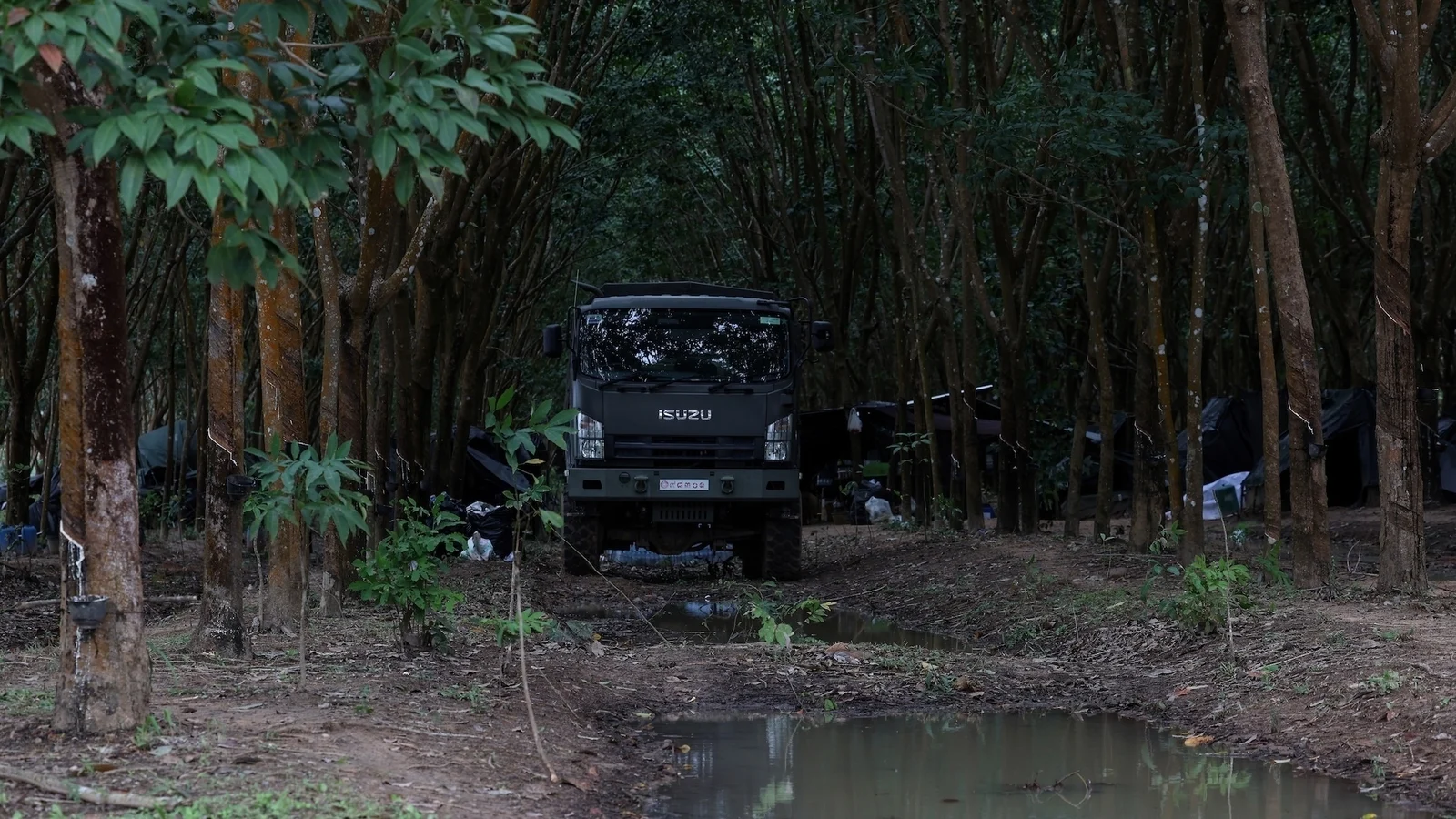
The fighting has not been a skirmish over a single village; it’s been an exchange of heavy weaponry and high-tech tools of war. Both sides accuse the other of using artillery and rocket launchers — and Thailand says Cambodian forces dropped bombs from drones. Thailand, which possesses a larger and better-equipped military, has also used fighter jets to support ground troops.
For people on the ground, the weapons are not abstractions. “I could see the streak of metal in the sky,” a rice farmer named Somchai said, describing an airstrike that passed low over his field. “Our cows hid behind the trees. Then the ground shook.”
These border tensions are far from new. For more than a century, the two neighbours have sparred over territory, with un-demarcated points and disputes over ancient temples fueling nationalist fervour on both sides. The last major flare-up in July saw a five-day exchange of rockets and heavy artillery that killed at least 48 people and displaced roughly 300,000. In 2011, another week-long battle over temple grounds left scars and animosities that endure to this day.
Evacuations, shelters and a quiet panic
Authorities on both sides say they have evacuated hundreds of thousands of people from border districts. Shelters are filling up in town halls, schools and temple grounds. The makeshift camps don’t smell of defeat so much as determination: boiling rice, plastic water bottles, children tracing circles in the dust.
“We’ve been through this before,” said Dara, a teacher now running a shelter in a community center. “We know what to do — but that doesn’t make it easier. The children ask when they can go home. What can I tell them?”
Cambodia’s Defence Ministry accused Thai forces of “brutal and unlawful actions,” claiming nine civilians were killed since the clashes resumed and 20 were seriously injured. Thailand’s military reported three soldiers dead and 29 people injured. Numbers are fluid; both sides release figures that reflect their own narrative and priorities, and in the chaos of displacement, verifying casualties and damage is difficult.
On the edge: daily life in limbo
At the shelters, people trade stories of close calls and lost possessions — a wedding dress, a family photograph, a small motorbike that was all a family could afford. Volunteers hand out rice sacks and blankets, while medics set up triage stations for those injured by shrapnel, stress or the cramped living conditions.
“We’ve had people fainting from dehydration, and others from shock,” a volunteer nurse said. “We are doing what we can, but supplies run out quickly. When the fighting comes so close it becomes a small, constant panic.”
The larger picture: more than a local skirmish
Ask yourself: why do border disputes that began over old maps and temples still combust in 2025? It’s not simply about cartography. It’s about identity, pride, strategic advantage and the politics of distraction. Nationalist sentiment can be stoked by politicians on both sides. Military capability disparities make small incidents spiral: Thailand’s armed forces are larger — in personnel, budget and hardware — and this imbalance feeds fears and calculations about escalation.
Experts caution that localized fighting rarely stays localized when national narratives are involved. “When leaders frame a conflict as defending national honour, it becomes existential,” said Dr. Maya Phan, a Southeast Asia analyst. “That makes compromise very hard, because leadership risks losing domestic legitimacy if they are seen as conceding.”
There are also geopolitical currents. A ceasefire brokered earlier this year by a high-profile outside player briefly cooled the flames, illustrating how third-party mediation can offer a pause. But when the underlying disputes over sovereignty and territorial control remain unresolved, any truce is brittle.
A human toll that outlasts headlines
Beyond the strategic calculus are the human stories that will remain long after the last shell is fired. Children who can no longer attend school will have lost months of learning. Farmers who miss planting seasons lose their income and their ability to feed their families. Psychological scars and trauma ripple out across generations.
“It’s not just the homes — it’s the rhythm of our lives,” a grandmother said as she handed a steaming bowl of rice to a child at a shelter. “We live with the land. When it is gone, we are not the same.”
Where do we go from here?
There are no easy answers. Diplomacy will need to pair with a genuine commitment to demarcation, equitable resource sharing and mechanisms that prevent local incidents from spiralling into full-scale war. Civil society — the volunteers, teachers and medics at the shelters — will need continued support from national governments and international agencies to care for the displaced.
For readers watching from afar: imagine what it is to have your life packed into a plastic tote and your future announced as uncertain. Could your country settle a century-old map dispute without the guns coming back out? How do communities rebuild trust after they have been told, repeatedly, that the other side will come for them?
Between spinning political narratives and the grit of ordinary people, the story along this border is, at its heart, about what we choose to protect: lines on a map or the lives rooted in the land those lines cut through. The answer will determine not only whether the ceasefire holds, but what kind of peace will follow — one stitched together by mutual respect, or one that simply waits for the next flare-up.
For now, the shelters multiply like a patchwork of resilience, and the border hums with an uneasy silence, punctuated by the distant rumble of artillery and the quiet, human sound of people trying to live.