When a King’s Visit Meets Kolkata’s Fever: Messi, Mayhem and a Stadium That Couldn’t Hold
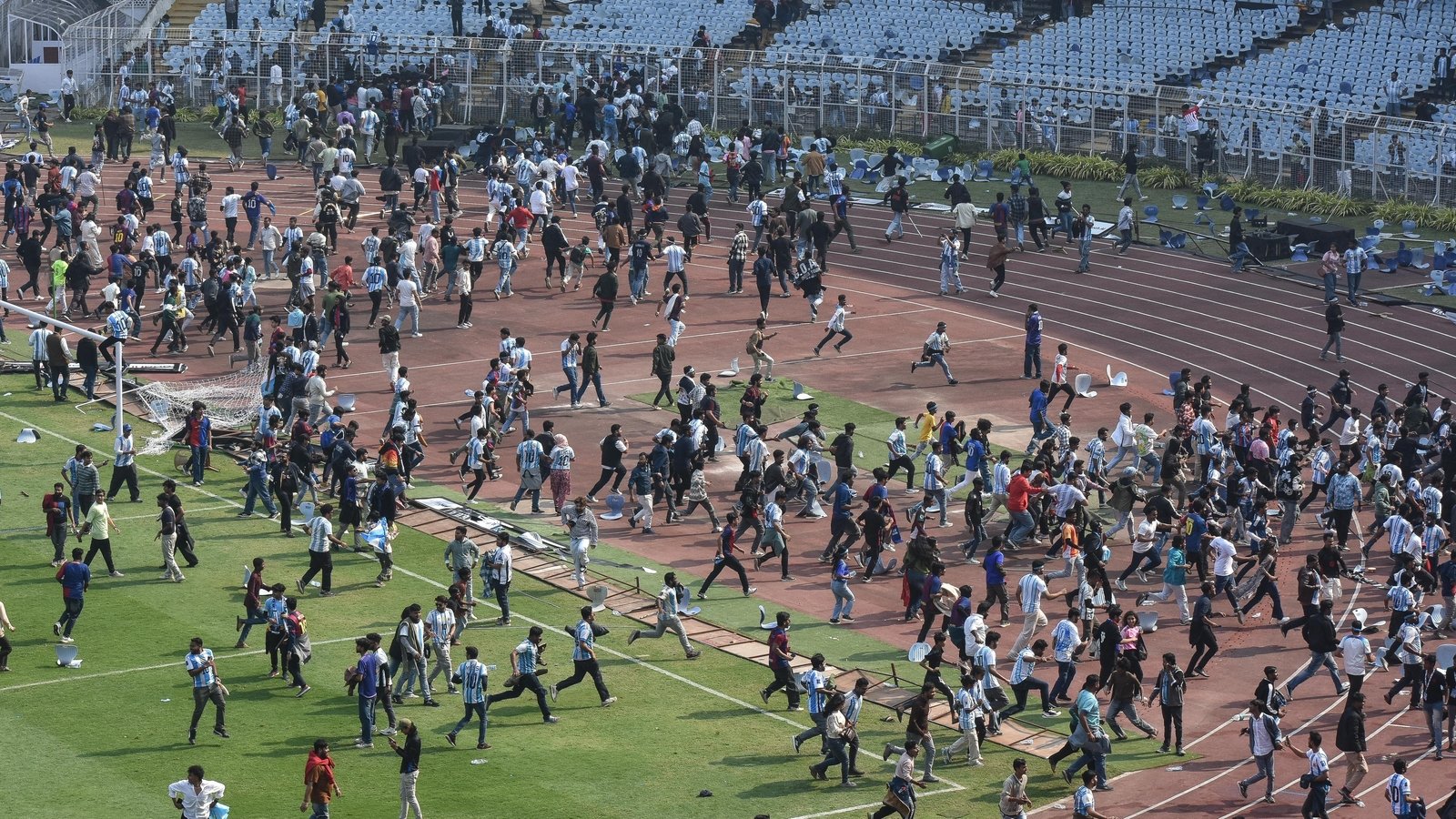
It began like a carnival and ended like a cautionary tale. Dawn light poured over Salt Lake Stadium as thousands gathered, chanting and craning necks for the slightest glimpse of Lionel Messi — the man who, for many here, has become as mythic as the football gods of old. But what was meant to be a 45-minute, ticketed appearance dissolved into chaos after roughly 20 minutes. Seats were ripped loose, netting was torn from a goalpost, and people spilled onto the turf in a frenzy that felt both ecstatic and dangerous.
“I’ve been waiting my whole life to see him close up,” said Eddie Lal Hmangaihzuala, who had traveled nearly 1,500km from Mizoram and camped through two days of train journeys and buses. “I paid more than I could afford. He left so fast — I barely saw him. It felt like we were cheated of something sacred.”
The Anatomy of a Stir
The official story, as briefed by West Bengal police, is blunt: Satadru Dutta, the chief organiser, has been detained. Director General Rajeev Kumar told reporters the police had already apprehended the man they hold responsible and would pursue action so “this mismanagement does not go unpunished.” Authorities also say organizers have pledged in writing to refund ticket-holders.
Ticket prices were tiered, but even the cheaper seats — around 3,500 rupees (roughly €33) — were a significant expense for many. Some attendees said they paid far more: one fan claimed he shelled out the equivalent of €110 after navigating a secondary market. To put that in context, for many Indian households that amount represents a sizable fraction of a week’s income.
For years Salt Lake — officially the Vivekananda Yuba Bharati Krirangan — has swallowed crowds of tens of thousands. Renovations over the last decade reduced its gargantuan pre-2011 capacity, but the stadium still holds an estimated 85,000 people, making it one of Asia’s largest football arenas. That scale magnifies both the euphoria and the risk when things go wrong.
From Idol to Instigator
Messi’s presence was supposed to be a gentle celebration: concerts, youth clinics, a padel tournament, charity initiatives across Kolkata, Hyderabad, Mumbai and New Delhi. For Kolkata, there was additional nostalgia woven into the event. The city remembers Diego Maradona’s rapturous visits; the Argentine legend twice visited, and his 2017 statue unveiling remains fresh in local lore. Messi himself has a history with this stadium — he captained Argentina there in 2011 during a friendly against Venezuela, and had recently been part of a virtual unveiling of a large statue in the city.
But the adoration that draws people can also overwhelm systems not built to manage it. Chairs were torn from their anchors and hurled; fans breached perimeter fencing and stormed the pitch. “I can’t believe there was so much mismanagement,” said one local vendor who has sold tea and biscuits outside the stadium for 20 years. “When crowds move, everything becomes dangerous — the old rails, the gates, even the turnstiles. Today it felt like everything gave way.”
Faces in the Crowd: Fear, Fury, and Faith
Walk past the souvenir stalls and you hear a chorus: desperation, devotion and indignation. A young mother clutches a squirming toddler and whispers, “My son’s been playing football on the terrace — we came so he could see his hero.” An elderly man in a faded Mohun Bagan scarf shakes his head: “We love football with all our hearts, but love isn’t chaos.”
“He left quickly — I think he felt unsafe,” Eddie said, his voice hoarse. “We came here with hope. Hope felt cheap today.”
Those on the ground and watching online wondered: Who failed first — the organizers, the security planners, the ticketing agents, or the crowd itself? The answer is likely a tangle of all of them.
Systemic Shortfalls and the Business of Fandom
Sports and celebrity appearances are an industry now, and the glut of global tours has collided with local realities. Events of this scale require meticulous crowd modeling, ticketing integrity, clear ingress and egress, and contingency planning for everything from weather to sudden surges. Experts warn that when tickets trade hands in opaque secondary markets, capacity planning becomes an exercise in guesswork.
“You cannot transplant a European model of fan management and expect it to work without ground-level adaptation,” said a longtime event security consultant who requested anonymity. “Kolkata’s passion is beautiful — but when passion mixes with poor planning, you invite trouble.”
India’s sporting landscape is changing fast. Football pockets in West Bengal, Kerala and Goa remain fervent islands in a sea dominated by cricket. The commercial rush to monetize celebrity appearances — concerts, clinics, brand tie-ups — is colliding with infrastructure that sometimes lags behind ambition.
Aftershocks: Politics, Promises, and Repairs
Mamata Banerjee, West Bengal’s chief minister, publicly apologized and said she was “deeply disturbed and shocked by the mismanagement” at Salt Lake. She ordered a formal inquiry committee to investigate, assign responsibility, and recommend measures to prevent recurrence.
“We must learn from this,” she wrote on X, adding that the government would ensure refunds and accountability. Her words were meant to calm, but the visuals of ripped seats and fans standing atop the turf carried their own weight.
For Messi and his team, the incident is a PR sting at a moment when football’s global stars are expanding their reach into new markets. For India, it’s a reminder: infrastructure and governance must keep pace with cultural and commercial ambitions. When a city like Kolkata opens its arms to global icons, the embrace must be matched by systems that protect both celebration and safety.
What Now? Reflections for Fans and Organizers
Will refunds heal the reputational damage? Will the detained organizer face legal consequences that deter future mismanagement? Those are questions for the courts and committees. But deeper questions linger for all of us: how do we move from spectacle to sustainable celebration? How do cities steward the fervor that makes them unique without letting it spiral into harm?
In the lull after the storm, voices from the street still hum with hope. “If Messi comes back, we will line the streets again,” said a teenager, eyes bright under the Salt Lake floodlights. “But next time, let it be about football and joy — not tears and broken chairs.”
For now, Kolkata tends its wounds and the world watches. This was not just an event gone wrong; it was a mirror. It showed the rapture of fandom and the brittle seams of planning. It asked whether a city’s love can be celebrated with dignity — and whether, the next time, we will do better.