Night of Light and Gunfire: Bondi’s Hanukkah Vigil Shattered
They had come to celebrate the small, bright miracle of Hanukkah under an unseasonably cloudy Sydney sky—families, tourists, the occasional lone surfer still dusty with salt, and a cluster of rabbis in coats against the chill. A giant menorah glowed against the sails of the Opera House like an invitation to hope. Then the small, sharp sounds arrived: first mistaken for fireworks, then—terrifyingly—recognizable as the staccato of gunfire.
By dawn, the stretch of sand between the Bondi Pavilion and the surf had become a crime scene and a memorial. Sixteen people lay dead, among them a 10-year-old girl, a Holocaust survivor and a rabbi who left behind five children. One of the alleged attackers, later identified as a 50-year-old man, was killed at the scene by police. His son, 24, lay in hospital in critical condition after also being shot. About 25 survivors were receiving care in Sydney hospitals.
Shockwaves from a Tourist Shore
Bondi Beach is shorthand for relaxed Australian summer life—lifeguard towers painted like beacons, weekend markets selling flaky pastries and strong coffee, joggers tracing the cliff path to Bronte. Most days the biggest drama is a swell that challenges a novice boarder. On the night the shooting happened, the violence felt impossibly distant from that easy rhythm.
“I heard the bangs and I thought it was a pile-driver, then people ran past me with their coats on their heads,” said a local café owner who asked to be named only as Lina. “We shoved customers behind the counter, locked the door. For a while you couldn’t tell whether the day would end.” Her voice shook; her business sits two streets back from the Pavilion, a block that in summer thrums with languages from across the world.
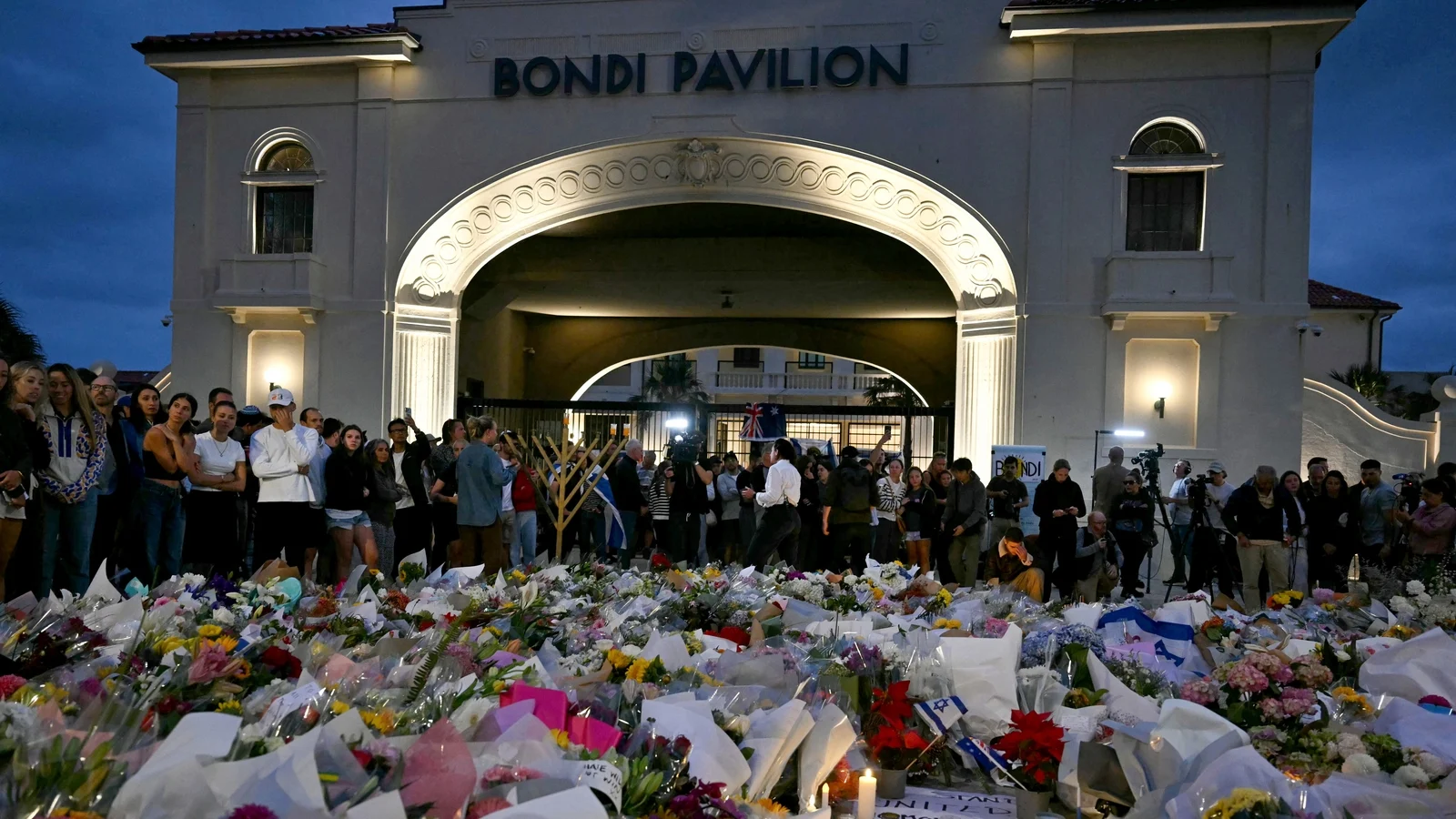
In the early hours, mourners left flowers and children’s drawings by the Pavillion. Candles guttered in the wind. A menorah image that had been projected on the Opera House sails was suddenly a national spotlight on grief.
Father and Son, and a Trail to the Philippines
Police described the attack as brutally precise and shockingly brief—about ten minutes of chaos during which the alleged perpetrators opened fire at the crowd. Authorities say the pair had traveled to the Philippines in the weeks before the assault; Philippine police confirmed they are investigating the men’s recent visit.
Australian investigators have said early indications suggest the attack was inspired by Islamic State. Investigators reportedly found improvised explosive devices and homemade flags linked to that group in a vehicle registered to the younger man.
“What we are looking at are the actions of two people who appear to have aligned themselves with a violent ideology,” said a counterterrorism analyst who asked not to be named. “This looks like a case of local actors drawing inspiration from global extremist narratives—online and offline networks that nurture radicalization across borders.”
The Philippines’ southern island of Mindanao has harbored Islamic State–linked networks in recent years. Once capable of holding a city—the 2017 Marawi siege being the most dramatic example—those networks have been degraded but not eradicated, reduced to small, mobile cells. Security experts warn that diminishing territorial control does not erase reach; it often disperses it.
Homefront Aftershocks: Antisemitism, Guns and Policy
For Australia, this was the worst mass shooting in nearly three decades, and it has prompted unease and urgent debate. The attack was explicitly targeted at a Jewish festival, and leaders from the Jewish community have called for stronger protection.
“We can no longer take for granted our ability to gather, to pray, to teach our children in public,” said a Jewish community leader in Sydney. “This was not a random act; it was calculated and symbolic.”
Questions about gun policy followed quickly. Police revealed the older man held a firearms licence and owned six registered guns; the licence had been issued in 2023. The federal government announced an immediate review of firearms regulations and possession rules—prompting comparisons to the sweeping reforms after the Port Arthur massacre in 1996, when Australia tightened gun ownership laws in response to one of its darkest days.
“Gun control is not a silver bullet,” said a criminologist at the University of Sydney. “But when incidents like this happen, we must ask whether existing checks on licensing, storage and mental health assessments are robust enough.”
Heroes and Heartache
Among the shrapnel of grief, stories of courage emerged. A 43-year-old man—described by relatives as a father of two—charged one of the attackers and wrested a rifle away, sustaining gunshot wounds. He remains hospitalized. A GoFundMe established to help with his recovery had raised nearly A$1.9 million within days, a testament to the powerful instinct of strangers to repair what violence has shattered.
“We’re not here to make heroes out of people,” said a local paramedic. “We’re here because ordinary people did extraordinary things in the worst of times.”
Internationally, representatives visited Bondi. An Israeli diplomatic figure laid flowers and spoke about fear and the urgent need to protect Jewish life in Australia. For families who lost loved ones, speeches and condolences only echo the central absence—an empty chair at a table, a toy unmoved, a book unread.
Why This Matters Globally
This tragedy is not only a local tragedy; it is part of a broader pattern. Across democracies, Jewish institutions have experienced a spike in threats. The phenomenon of “lone actor” terrorism—individuals or small cells radicalized remotely while inspired by transnational extremist propaganda—has complicated traditional intelligence work. The internet has turned isolation into a marketplace of grievance and instruction.
So what are societies to do? Strengthen intelligence cooperation across borders. Address online radicalization with both tech policy and community-based prevention. Bolster protections around vulnerable gatherings without turning those spaces into chapels of fear. And, crucially, confront antisemitism and all forms of hate as public-health problems: contagious, corrosive and requiring collective inoculation.
After the Candles Go Out
On Bondi’s sands, the surf continued to rhythmically fold itself into shore as if nothing had happened. Tourists trickled past the memorials, heads bowed. Local surfers came to leave flowers tied to their wetsuits’ ankle straps. In lifeguard towers, people spoke in low voices about the need for community and vigilance.
“I keep thinking about that girl, about the children,” said a woman who had come to light a candle. “How do we explain this to them? How do we help them feel safe again?”
There are no easy answers. But as the city gathers evidence and the courts prepare to process the facts, the scene at Bondi remains a raw tableau of what happens when ideology collapses into slaughter. It also stands as a reminder that bravery and compassion frequently blossom in the same soil as grief.
How will we choose to remember this night—and what will we change so it never repeats? That question now hangs over Sydney as steadily as the winter light over the Tasman Sea.