A beachside grief: Bondi’s Hanukkah turned from light to mourning
Bondi Beach is a place of movement: the crash of surf, the chatter of tourists, the sculpted lines of lifeguards jogging along the sand. It is also where a celebration meant to illuminate winter nights became the site of unimaginable loss. Two community leaders—young rabbis who had built a life together in the eastern suburbs—were among 15 people killed in a mass shooting that has stunned Sydney and reverberated well beyond Australia’s shores.
The names are now being carried from synagogue doorways to the footpaths of Bondi: Rabbi Eli Schlanger, 41, and Rabbi Yaakov Levitan, 39. Schlanger had recently become a father for the fifth time; Levitan leaves behind a wife and four children. They worked side by side at Chabad of Bondi—one described as the visionary, the other, the executor—and their connection went deeper than the office. Their wives have been friends since high school, a small, human detail that makes the loss feel intimate in living rooms and in the cafés that line Bondi Road.
“They were never one without the other”
“Eli had the visions and the ideas,” Rabbi Yakov Lieder wrote in an obituary. “Yaakov figured out how to get it done.” The line captures what those who gathered at the synagogue on the day of Schlanger’s funeral tried to hold onto: the ordinary, practical tenderness of two men who turned religious conviction into action—Shabbat meals, prison visits, late-night counseling for young people—and in doing so braided themselves into the social fabric of their neighbourhood.
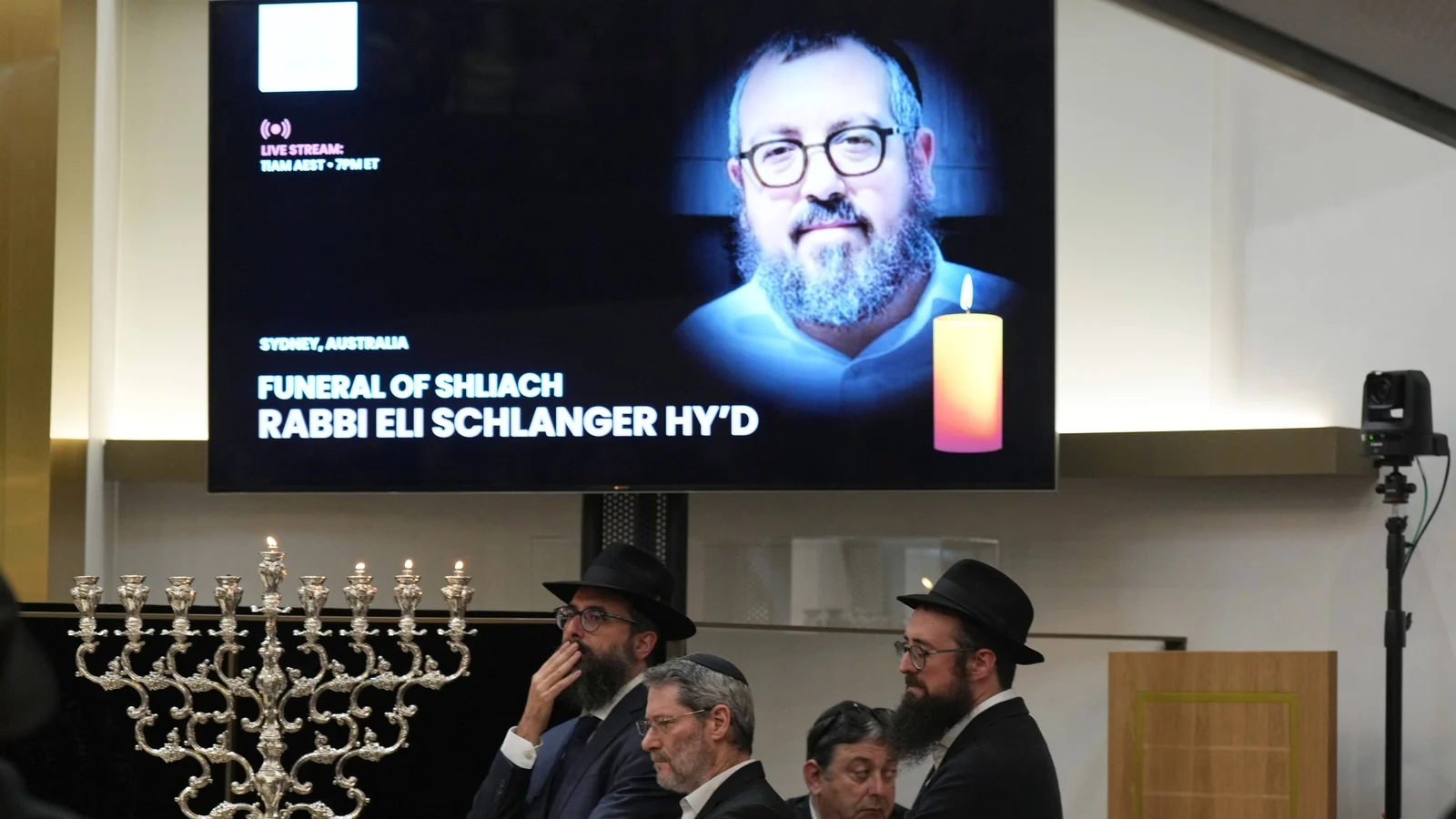
Inside the small Bondi synagogue, the room could not contain the grief. People spilled out onto the pavement; others watched the service on phones, huddled in groups, the live stream buffering and then steadying like a lifeline. Prayers moved between Hebrew and English. Rabbi Yehoram Ulman, Schlanger’s father-in-law, spoke through tears and then steadied himself with a message of defiance that was also a plea: do not let fear shrink whole communities from living and celebrating.
“You became everything to me,” Ulman said, voice cracking. “My hands, my feet. Your dedication knew no limits.” He promised a public menorah lighting at the site of the shooting at the close of Hanukkah—an act meant to reclaim a shore many thousands of visitors walk each year.
The scene, the songs, the security
Outside, the city had transformed Bondi into a controlled corridor. Police and private security patrolled the street. Bag checks were performed at synagogue entrances. Eight officers in ceremonial dress formed an honour guard as the hearse left, leading a procession that paused midway down the street for a communal lament. Men gathered against the hearse and sang a nigun—an unworded tune—that swelled and broke and then rose again, the sound like a shared breath.
“He’d drive four hours to see someone in prison, if that’s what it took,” said a mourner I spoke with afterwards, a volunteer who had worked with the rabbis on outreach programs. “He didn’t care whether you were rich or poor. He’d show up.”
Also present were civic leaders: New South Wales Premier Chris Minns, federal opposition figures and the area’s members of parliament—small public acknowledgements of a sorrow that is both private and political. Prime Minister Anthony Albanese later said he would attend funerals if invited; for many in the crowd, the presence of elected officials mattered as a visible sign that the city and the nation were watching.
Public rituals against private ruin
The Chabad “Chanukah by the Sea” event had been a simple idea: a menorah, candles, latkes perhaps, families gathered on the sand as darkness fell. Hanukkah itself is about illumination—eight nights to remember light in dark times. Now, at the same site, the community plans once more to light candles. “That is not the answer,” Rabbi Ulman insisted to the congregation, meaning fear and withdrawal. “We can never allow them to succeed.”
It is a familiar posture for diasporic communities: to make ritual the remedy to violence, to stitch the social fabric with prayer and food and memory. But it is also a complicated one, because ritual cannot alone answer the questions that crimes like this raise about security, about the weapons that made it possible, and about why public spaces—beaches, markets, places of worship—have become venues of trauma in so many parts of the world.
Why this matters beyond Bondi
Australia’s relationship with guns is different from many other nations. Sweeping laws introduced after the 1996 Port Arthur massacre dramatically tightened ownership and led to buybacks. Mass shootings in Australia have been far less frequent since. That is part of why this weekend’s events feel singular here: a rupture in a national narrative that for decades rested on decisive reform.
At the same time, the attack speaks to global patterns—antisemitic violence and the targeting of faith communities have climbed in many countries over recent years, according to civil society observers. When a festival of light becomes the site of bloodshed, it forces a broader conversation about how democracies protect minority communities, how they balance openness with safety, and how people heal in public.
“There’s a rawness that doesn’t go away,” said Dr. Amal Farouk, a sociologist who studies communal resilience. “Public rituals help. So does policy. But reconciliation and security need both—and that’s politically difficult.”
Faces of a community
At the funeral in Macquarie Park for Rabbi Yaakov Levitan, the mood held the texture of a small-town memorial inside a modern suburb: children clustering in the back of the room, relatives exchanging the same rehearsed phrases, an elderly woman smoothing the edge of her scarf. The two rabbis were not only partners at Chabad; they were neighbours in the sense that matters most—people who had touched many lives with consistent presence.
A local shopkeeper on Campbell Parade, who asked not to be named, told me she had watched the livestream outside her store. “They always had a smile,” she said. “Bondi is a place where everyone knows someone. This morning the surf looked the same, but it felt different.”
What comes next?
There will be investigations; there will be debates over weapons and public safety; there will be legal proceedings and inquiries. There will also be smaller, quieter reckonings—the consoling phone calls, the communal cooking of latkes this weekend, the menorah that will stand by the sea.
These rituals will not erase the pain. But they are how communities begin to stitch themselves back together: by naming the dead, by refusing to let violence dictate whether they keep loving, gathering, and belonging to the places they call home.
So I ask you, reader: when a public space becomes a place of mourning, how should we respond—what balance should we strike between vigilance and openness? And how do we ensure that the rituals of one community are not diminished by the fears of another? These are not simple questions, but they are urgent ones, and they demand more than slogans. They demand the messy, difficult work of common life.
In Bondi, as candles will be lit again at the sea, the small light will flicker against a very large dark. For now, the community clings to that light, and to the memory of two rabbis who spent their lives trying to kindle it in other people.