A Christmas Check, a World Cup Dream, and an Election Clock: Inside a Night of Big Promises
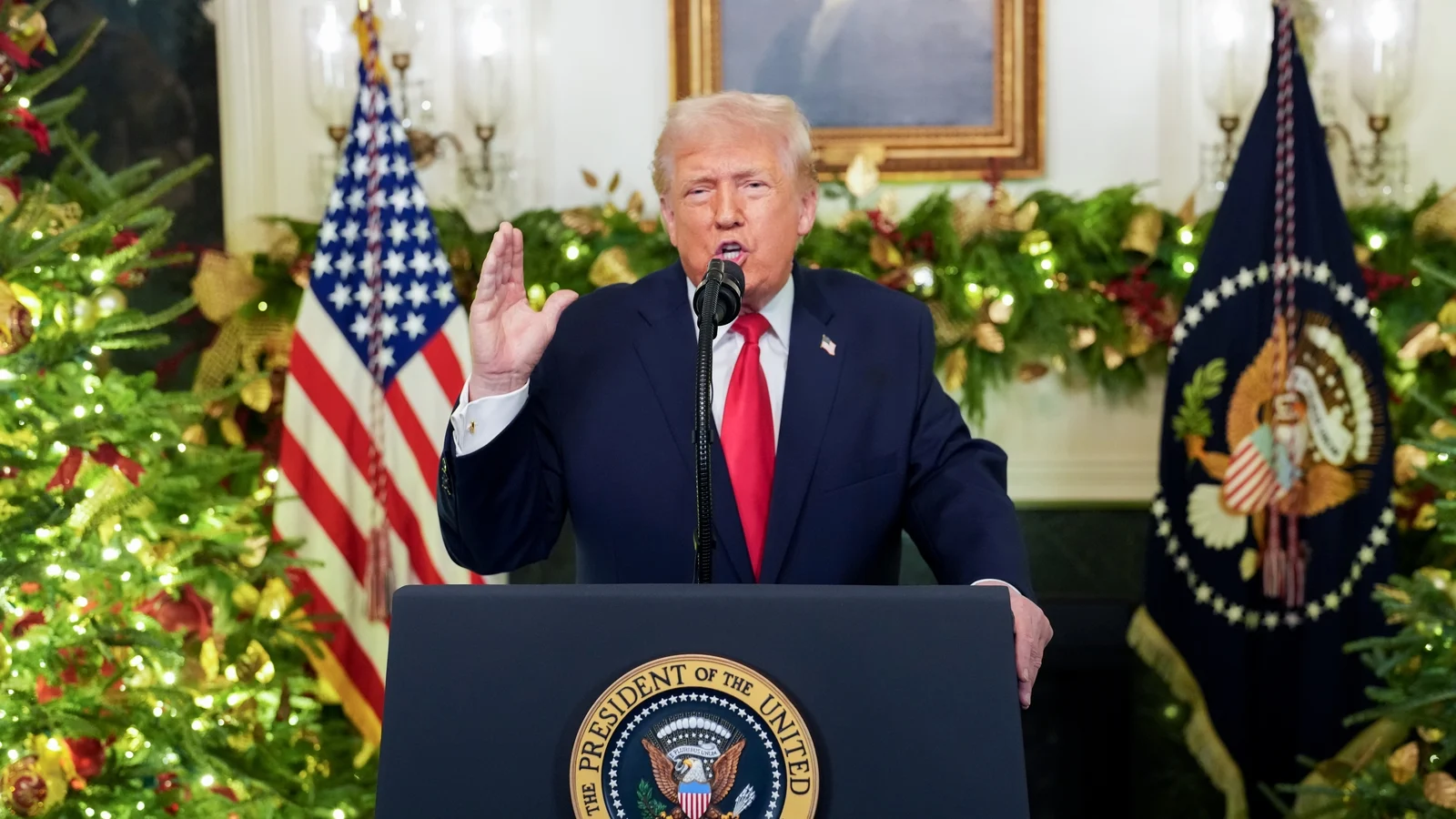
It was the kind of televised address that trades on spectacle as much as substance: a winter night at the White House, a president who speaks in broad strokes and rally lines, and a country listening through the cacophony of rising grocery bills and political fever.
“Eleven months ago I inherited a mess, and I’m fixing it,” the president began—an opening line that reads like a headline and resonates like a campaign slogan. But between the bravado and the promise of “an economic boom the likes of which the world has never seen,” there were details that sounded both carefully staged and expressly political: a surprise bonus for uniformed service members, a dollar figure chosen for symbolism, and an insistence that his critics and the previous administration were to blame for the daily pinch felt at the pump and in the supermarket aisles.
The Pitch: Bonuses, Tariffs, and a Year to Remember
In an announcement that mixed patriotism with politics, the president said roughly 1.45 million active-duty service members will receive what his team calls a “warrior dividend”—a one-time check of $1,776 to be distributed before Christmas. The number was framed as symbolic: 1776, the founding year of the United States, and a nod to the nation’s upcoming 250th anniversary.
“This is about honoring service and sending a message,” a White House aide told reporters before the speech. “It’s also about reminding Americans that our priorities are security and prosperity.”
He tied the payout to tariff revenues, saying the bonuses would be paid from funds raised by the import levies his administration has expanded since taking office. That link—between trade policy and direct payments—was part political theater, part economic assertion. It also raised immediate questions about long-term strategy: are tariffs an instrument to power domestic programs, or are they a tax on everyday buyers?
Symbolism and Substance
Numbers matter in politics. The $1,776 figure struck a chord with supporters who relish historical references; critics called it a photo-op dressed as policy. “It’s clever theater, but it doesn’t change the fundamentals of the economy,” said Dr. Lenora Martinez, an economist who researches fiscal policy and inequality. “Tariffs can raise government revenue for a time, but they often shift costs onto consumers and businesses. For households living paycheck to paycheck, symbolic checks are small comfort if the price of basics keeps rising.”
Under the Hood: Polls, Prices, and Political Anxiety
If the president’s speech was meant to reassure, the polls suggest a different currency is in play: public anxiety. A PBS News/NPR/Marist survey published this week found 57% of Americans disapproved of his handling of the economy, a striking number for a leader selling confidence. Another poll by YouGov showed 52% of respondents thinking the economy was getting worse under his watch.
“People are hurting,” said Maria Alvarez, who runs a corner bodega in a small Rust Belt town. “My customers ask about eggs and flour. They’re not asking about trade policy or geopolitics. They want to know how to feed their kids tomorrow.”
Inflation—once a central post-pandemic headache—remains a living issue for many households. Economists caution that measures like tariffs can reduce demand for some imported goods, but they can also increase costs for manufacturers and consumers, particularly for products with global supply chains. In short: policy choices produce visible consequences in the grocery aisle.
Rhetoric at the Border and the World Stage
Another pillar of the speech was the familiar, fiery rhetoric about migration and law. “They stole American jobs,” the president said, returning to a line that has animated base supporters for years. He also touted foreign policy wins—from ceasefires to increased pressure on nuclear programs—and framed military and security actions as part and parcel of his administration’s agenda.
Those themes weave together two realities. Domestically, migration and job security are political potentates that drive voter sentiment in heartland towns and border states alike. Internationally, military and diplomatic maneuvers create an impression of strength, but also demand resources and attention that some critics say detract from bread-and-butter issues.
Voices from the Ground
“We want our kids to be safe and to have jobs,” said Jamal Reed, a factory supervisor in Pennsylvania, echoing a sentiment that cuts across party lines. “You can do both, but actions speak louder than words. Show me the investments in jobs, training, and affordable essentials.”
On the other hand, a veteran in North Carolina who asked not to be named for privacy reasons said the bonus felt personal. “My unit was in harm’s way,” she said. “A little recognition matters. But we also want real care—good VA services, real housing help, not just checks on TV.”
Tariffs, Trade, and the Bigger Picture
Experts are divided on whether the president’s tariff-first approach can deliver the kind of broad-based affordability he promises. History suggests tariffs can be blunt tools—effective at protecting certain domestic industries but costly for consumers and downstream manufacturers.
“Think of tariffs like a toll on a bridge: they raise money by slowing some traffic, but everyone pays to cross,” said Dr. Marcus Klein, a trade scholar. “Revenue can be redirected, but the economic distortions are real.”
Beyond the immediate effects, the speech illuminated larger global themes: the reconfiguration of supply chains after the pandemic, the politics of protectionism, and the rising impatience of electorates everywhere who expect governments to deliver not only security but affordability and dignity.
Election Math and the Road to 2026
With midterm-style elections looming and the U.S. set to co-host the FIFA World Cup in 2026 alongside Canada and Mexico, the administration signaled both a domestic push and a global spectacle it hopes will translate into political momentum. The promise of an economic renaissance timed with a global sporting event is a narrative as tempting as it is audacious.
“Political calendars shape policy choices,” observed pollster Ellen Harper. “When the electorate is worried about prices, candidates pivot to demonstrate control over the economy. But voters also notice authenticity. Long-term trust is built in kitchens and checkouts, not just on podiums.”
Questions to Carry Home
So where does this leave a country so often divided about means but united in anxieties? Can symbolic gestures and tariff-funded bonuses mute the hum of rising costs? Will geopolitical posturing translate to pocketbook relief? And crucially: what happens when politics meets the everyday reality of families strategizing how to make a paycheck stretch another week?
These are not small questions. They are the currency of democratic legitimacy—one that governments worldwide are currently trying to buy with policies that must, in the end, convert into real, lived improvements.
As you read this, somewhere a grocery cart is nudging a toddler who points at cereal boxes; an enlisted sailor is packing for leave; a small-business owner is tallying receipts. What do you think will matter to them more: the symbolism of a holiday check or the steady lowering of the price of milk and gasoline? The answer will probably define politics for the next cycle.
“People want proof, not promises,” said Maria Alvarez, the bodega owner. “Show us fewer empty shelves, cheaper bread, safer streets. That’s how you win hearts.”
Will the administration deliver that proof? Only time—and the polls, the tills, and the travel logs—will tell.