Miami at Dusk: Negotiators, Palm Trees and the Heavy Business of Making Peace
The sun slipped behind Biscayne Bay as a convoy of black SUVs pulled up to a glassy hotel where, for three days, representatives from Washington, Kyiv and Brussels gathered to attempt something the world has been waiting for since February 2022: a credible path to end the war in Ukraine.
It was not a summit with fireworks or fanfare. Instead, it was the small, intense theater of modern diplomacy — boardrooms, back corridors, guarded coffee breaks and late-night scribbling on notepads. Steve Witkoff, the U.S. special envoy who has been shepherding a U.S.-drafted 20-point framework, called the conversations “productive and constructive” on social media. That phrase, repeated like an anchor in official readouts, barely captured the strain in the room: the tug-of-war between pressure for a deal and the grit of a country unwilling to give up the ground its people have bled to defend.
Who was in the room
The line-up read like a cross-section of postwar diplomacy. U.S. envoys — including Jared Kushner as an advisor to the president’s team — sat across from Ukrainian negotiators led by Rustem Umerov. European diplomats joined at various points. There were also reported exchanges with Russian representatives earlier in the week, including a meeting with Kirill Dmitriev, though U.S. officials have been sparing on details.
“We have been aligning our approach between Ukraine, the United States and our European partners,” Witkoff said, signaling that the exercise was as much about common cause among allies as it was about persuading an adversary to sign on.
The contours of a fragile plan
At the heart of these talks is a U.S.-drafted 20-point plan that seeks to square an almost impossible circle: provide Kyiv with enough security guarantees to feel safe, persuade Moscow to stop fighting and set the stage for Ukraine’s economic recovery.
Negotiators focused especially on timelines and sequencing — the delicate choreography that determines who gives what, when, and how to ensure a temporary lull does not become permanent humiliation for one side or a prelude to renewed violence for the other.
- Further development of the 20-point plan — clarifying legal text, timelines and verification mechanisms.
- A multilateral security guarantee framework — involving NATO allies and partners to underwrite Kyiv’s defenses.
- US-specific security guarantees — a separate, bilateral reassurance package from Washington.
- Economic reconstruction and prosperity measures — a roadmap for rebuilding infrastructure, restoring livelihoods and attracting investment.
“Peace must be not only a cessation of hostilities, but also a dignified foundation for a stable future,” Witkoff said — words that sounded more like a resolution for how the peace should feel than a legal clause.
On the ground, the cost is unmistakable
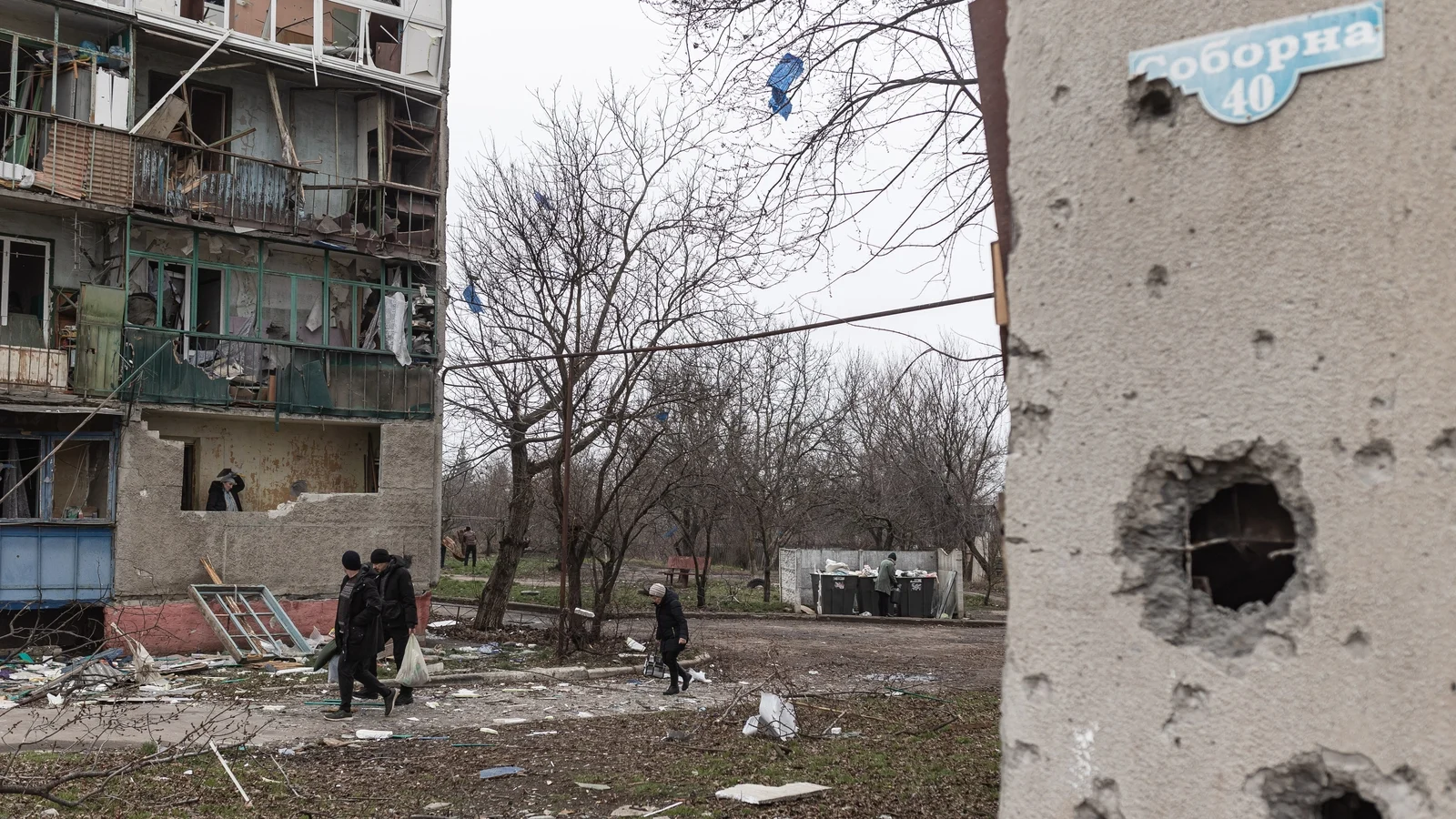
To understand the stakes in those Miami rooms, walk through the scarred streets of Druzhkivka or the ruined outskirts of other towns along the front. Firefighters still haul hoses through rubble; mothers sweep shards of glass from doorways. A photograph that circulated from the weekend showed a woman standing amid the jagged remains of her living room, her hands on the window sill where a child once leaned to watch the snow fall.
“We want to sleep at night without the sound of drones,” said Olena, a woman who lost her kitchen in an early-2024 strike and now volunteers at a community shelter. “Not a deal that trades our lives for maps.”
Numbers underscore what the eyes already see. Millions of Ukrainians have been uprooted — both internally displaced and those who sought refuge beyond the country’s borders. UN agencies have documented mass movements of people and the destruction of housing, schools and hospitals; estimates of lives lost vary, but the human toll is vast and intergenerational.
Reconstruction won’t be cheap
Global institutions warn that rebuilding Ukraine will require hundreds of billions of dollars and a decade or more of sustained effort. Patchwork investments will not suffice; what’s needed is a coordinated plan that protects human rights, preserves cultural heritage and rebuilds an economy so families can return home and thrive.
Where the deal stumbles
There is a blunt reality in every peace negotiation: one side’s victory is another’s grievance. In this conflict, Russia has demanded to keep territory it seized over the past years. Kyiv, having watched communities resist and soldiers die to keep those lines, has rejected ceding sovereign land as the price of peace.
U.S. intelligence assessments shared privately in recent months, according to sources familiar with those conversations, suggest President Vladimir Putin still harbors ambitions of territorial control. At the same time, intelligence officials caution those ambitions meet logistical and political limits — the ability to occupy and pacify large swaths of a determined, populous country is not infinite.
“Ambition meets capacity,” a European security analyst in the room told me. “That tension underpins everything: will Moscow accept a compromise or double down?”
Domestic political pressure and hard alternatives
Back in Washington, politics nudge policy. President Donald Trump has publicly urged both sides toward a quick resolution, while some lawmakers want harder lines if Moscow refuses to budge.
Senator Lindsey Graham has urged stronger measures if Russia rejects the current proposal — even suggesting tougher enforcement against oil shipments tied to sanctions and proposing harsher labels for actions he described as criminal. “If the Kremlin won’t take the deal, then we must turn policy into pressure,” he said in a recent statement to reporters.
Other voices argue for patience, insisting that a rushed peace that leaves Ukraine insecure would be a longer-term strategic failure. “A peace without fairness is simply a pause before the next round,” said an adviser to Kyiv’s delegation.
What would a credible security guarantee look like?
That question animates much of the drafting. Diplomats are weighing models from past post-conflict arrangements — treaty-like safeguards, NATO-style partnerships short of full membership, or international observer missions with robust verification mandates. For Ukraine, the guarantees must be tangible and rapid: equipment, patrols, legal assurances, and pathways to rebuild defensive capacity.
For the broader international community, the debate is about deterrence versus escalation. How do you promise protection to a country while avoiding a spiral into a larger war?
Questions for us all
As readers around the world, what do we want this moment to represent? A pragmatic bargain that ends immediate bloodshed but leaves deep scars? Or a principled settlement that binds justice and sovereignty together, even if it takes longer to achieve?
There are no easy answers. There are only choices, and the faces behind them: a mother in Druzhkivka sweeping glass from her floor; an envoy in a Miami conference room drafting clauses on deadlines; a senator on the Capitol steps urging pressure. Each has a different calculus, and each is right in their own register.
Diplomacy rarely looks like what we imagine — it is messy, incremental and stubbornly human. Still, the scenes in Miami remind us that peace is not an inevitability; it is a project that requires imagination, courage and above all, a willingness to stand in the discomfort of compromise while protecting the dignity of those who will live with its consequences.
What do you think: should the world opt for a fast ceasefire with minimal concessions, or wait for a more durable, but harder-won settlement? The answer we choose will shape not only Ukraine’s future, but the rules by which nations live together in the years to come.