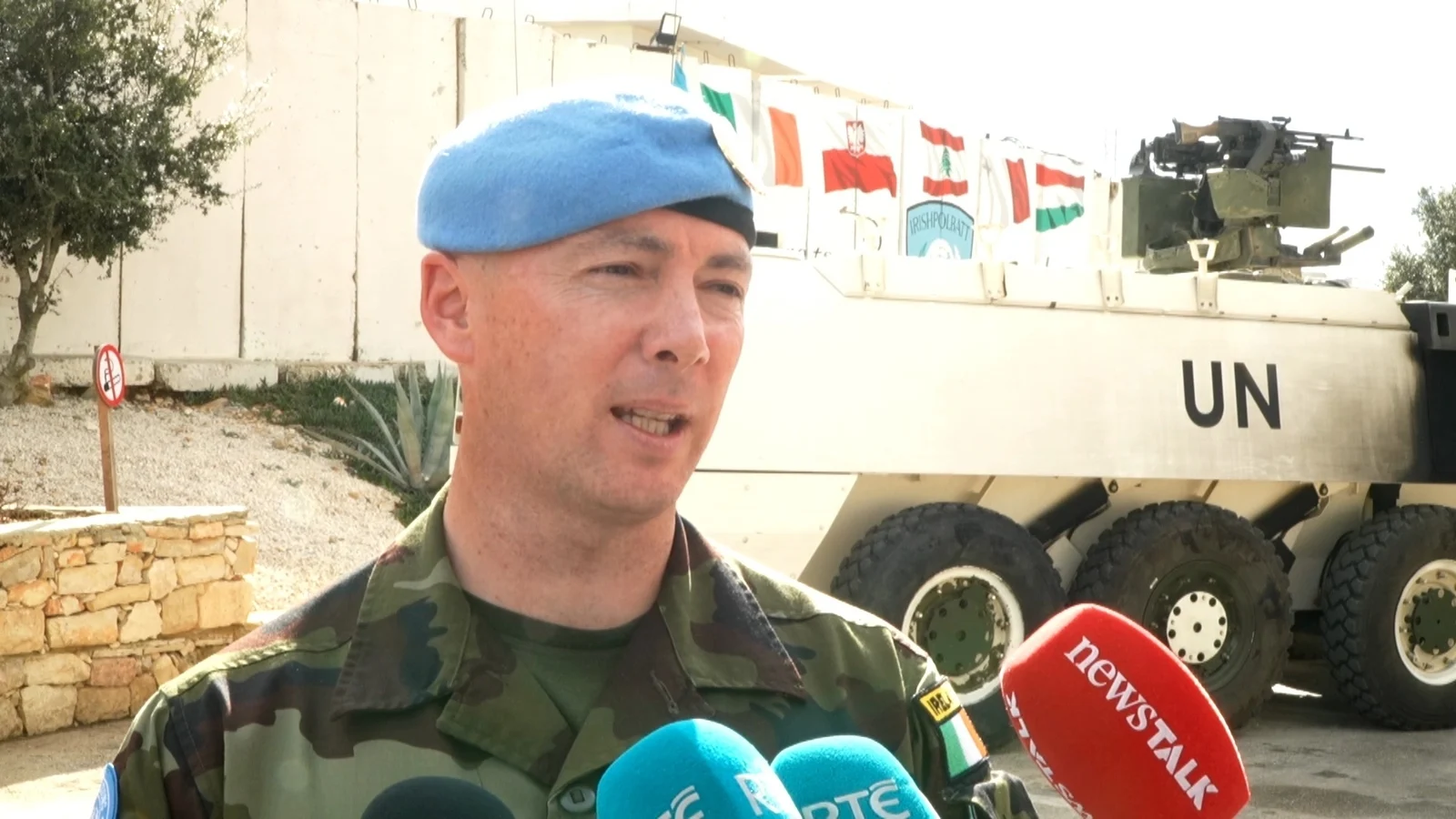
A Quiet Christmas Under Olive Skies: Ireland’s Peacekeepers at Camp Shamrock
The sun falls quickly in southern Lebanon. By late afternoon, the hills around Camp Shamrock are a wash of rose and dry grass, the air carrying the faint scents of citrus and diesel, cedar and dust. For more than 300 Irish soldiers stationed there, Christmas will arrive wrapped in a different kind of silence — not the hush of home churches or family living rooms, but the careful, watchful stillness of a peacekeeping post.
I visited the camp over the weekend. It is a place of tidy routines and improvisation, of laminated notices on mess-hall doors and hastily strung fairy lights over sandbagged parapets. Inside the tents and prefab buildings, people are busy — the very busyness that keeps the mood steady when the calendar says it should be festive and hearts say otherwise.
Keeping the peace, keeping busy
Camp Shamrock is part of UNIFIL, the United Nations Interim Force in Lebanon, a multinational mission originally formed to restore peace in the wake of conflict. The force today is tasked with monitoring a tense ceasefire line between Israel and Hezbollah, supporting the Lebanese Armed Forces, and helping to create the conditions for lasting calm.
“We try to make it as normal a day as possible,” a battalion sergeant major told me, speaking with the blunt, steady humour you get from people who have learned to keep perspective. “For the soldiers, the work itself — the patrols, the radio checks, the logistics — that structure keeps the weight light. It’s harder, often, for the families back home.”
Indeed, while more than 300 of Ireland’s soldiers will be on duty at Camp Shamrock this Christmas, thousands of peacekeepers from more than 40 nations serve across different sectors of UNIFIL. For those who trade their kitchen tables for rations and radars each year, the holidays are less a holiday than a different kind of service.
Small rituals, big meaning
Holiday in a military camp is not one thing. It is a stitched-together mosaic of gestures: a makeshift tree squashed into a transit container, a pot of stew simmered on a camp stove, a Christmas Mass celebrated beneath a corrugated roof. These are the things that make a place feel like home, even when the lights of Dublin are a world away.
- At dawn, some will go on patrol — a frozen landscape of checkpoints and watchtowers that nonetheless sees a lot of ordinary life: shepherds moving flocks, children playing in olive groves.
- In the late morning, hot food is served. Men and women in uniform carve up turkey or chicken, share slices of Christmas cake sent from families, or tuck into something as simple as stew and soda bread.
- In the evening, there will be video calls, folded letters, and the quiet exchange of photographs — portraits of smiling nieces, screenshots of living-room trees, the little particulars of a life paused at home and continued here.
“You miss the smell of your mum’s cooking,” one corporal admitted, the corner of his mouth lifting into a rueful smile. “But there’s also a sense of being part of something bigger. The lads from Argentina and Ghana — they’ll put on carols in Spanish and in Ewe. We’ll sing along. It sounds different here, but it’s still Christmas.”
Voices from two worlds
Back in County Cork, a mother I spoke with said it was “strange and quiet” without her son around the dinner table. “We Skype and he sends pictures of the decorations,” she said. “But you can’t hug over a screen. There’s a trade-off — proud and worried at the same time.”
Locals near the Blue Line — the buffer zone monitored by UNIFIL — offered their own perspective. A fruit seller in a small town south of the camp shrugged and said, “They are our neighbours in uniform. We see them on patrol, and sometimes they help fix things. For us, Christmas is about family. For them, maybe it is too.”
And a UN liaison officer noted the fragility that hangs over the region. “The ceasefire is more than an absence of bullets,” she said. “It’s a set of agreements, a network of trust between forces and communities that must be nurtured every day. These soldiers are not only watching borders; they’re watching the fragile threads that keep peace possible.”
Why these small sacrifices matter
Why should we care about a hundred or three hundred soldiers spending Christmas abroad? Because peacekeeping is the quiet seam of international order—often invisible, sometimes thankless, but crucial. Tensions along Israel’s northern border flare regularly; every patrol that reports a safe village, every supply convoy that arrives on time, every tense conversation defused before it becomes violent, helps keep that thin line intact.
Ireland has a long tradition of contributing to UN missions. While numbers ebb and flow, the symbolic weight of a small nation sending personnel to stand in dangerous places is significant, reminding the world that stability is a collective responsibility.
Comforts, and the cost of distance
There are comforts. There are extra blankets, a warm mess hall, chaplains who lead Christmas services, and care packages from home. There are also the kinds of things no kit can fix: the empty chair at a kitchen table, the child who will unwrap a present and turn to find their parent absent, the partner who must make do with messages and memories.
“We tell them to call home,” a senior NCO said. “We set up the tech, we hand out the timezones, and we make sure they get a hot meal. But mostly, we listen. That matters.”
What are we willing to ask of those who ask to help keep the world safe?
As you read this, ask yourself: what would it mean to spend a holiday in the service of something larger than your own celebration? Would you want to? Would you pay the price of distance for the chance to stand between communities and conflict?
The men and women at Camp Shamrock answer that question in small, continuous ways. They trade home comforts for discipline, family dinners for shared ones, the certainty of their own traditions for the improvised, multinational tapestry of a peacekeeping camp.
Their Christmas will be quieter, different, and full of small, human moments that matter a great deal to people in a place that is trying to keep the peace. That simple fact — the ordinary heroism of a Thursday patrol on a holiday — is, perhaps, the most potent reminder that peace is maintained not by headline, but by habit.
May their lights burn bright tonight, and may the conversations they keep alive here lead to safer mornings for everyone who lives under these olive skies.