A Mar-a-Lago Sunset and the Unfinished Business of War
On a warm Florida afternoon that tasted of salt and citrus, two presidents sat not in a formal palace but at the baroque edge of Mar-a-Lago, inches from a seaside that has seen far gentler disputes than the one that has torn through eastern Europe. The scene felt cinematic: palms leaning like question marks, gold light sliding across marble, and behind the carefully staged smiles, the hum of unfinished negotiations.
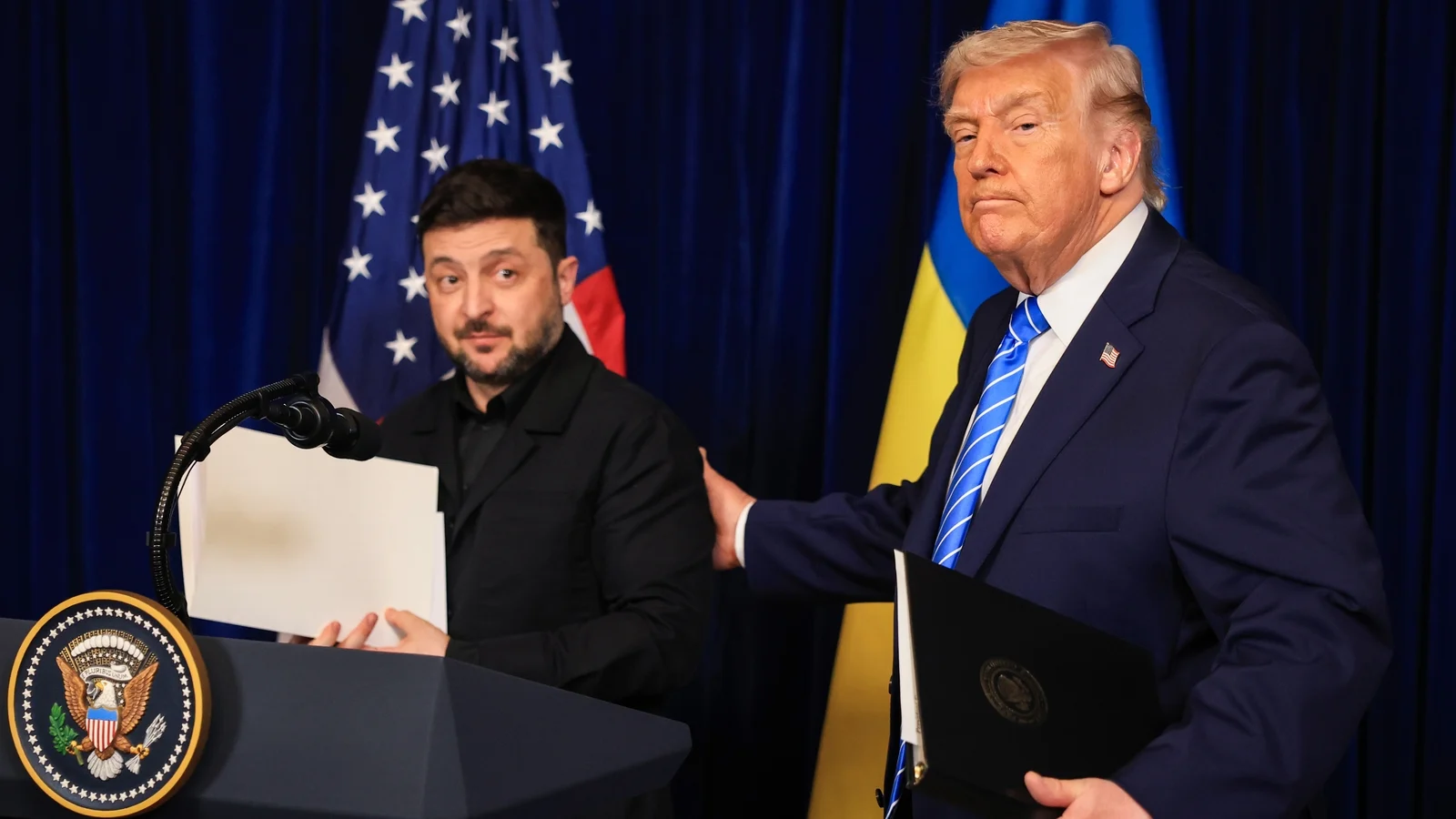
“We’re getting a lot closer, maybe very close,” President Donald Trump told reporters, his voice carrying that mixture of triumph and caution familiar to those who have watched him negotiate. Beside him, President Volodymyr Zelenskiy — still the wartime leader who has become a global symbol of resistance — nodded as if measuring each syllable for the weight it would carry back to Kyiv.
This was not the sort of summit that ends wars. It was, rather, the sort of summit that keeps faith with the most fragile of possibilities: that between hard, painful lines on a map lies a bargain people can live with. And it exposed, cruelly and clearly, the two stubborn truths of the moment — that security guarantees and the fate of the Donbas remain the twin axes around which any settlement must turn.
An Unlikely Table: What Was Said — and What Was Not
Details were scarce. For all the flash of cameras and the choreography of official statements, both leaders offered more of a draft than a contract. Zelenskiy declared that “an agreement on security guarantees has been reached,” a line that will be parsed for weeks by diplomats and deputies, while Trump tempered the mood: he said they were “95% of the way” there and predicted European partners would shoulder much of the postwar security burden.
French President Emmanuel Macron — who joined parts of the meeting remotely — hinted at concrete follow-ups, announcing on social media that a “Coalition of the Willing” would meet in Paris in early January to finalize their contributions. “Europe is ready,” wrote Ursula von der Leyen, echoing a refrain that has been repeated across capitals: security guarantees must be “ironclad.”
“We had frank conversations about what it will take for Ukraine not merely to survive but to be secure,” Zelenskiy told aides after the meeting. “Any deal will be subject to our parliament, perhaps to a referendum. That is not negotiable.” His emphasis on domestic consent reflects an acute sensitivity: peace imposed from above would not satisfy a nation that has bled to stay sovereign.
The Donbas Dilemma: Territory, Identity, and a ‘Tough Issue’
If security guarantees are the scaffolding for peace, the Donbas is the stubborn foundation that refuses to shift. Moscow demands the entire Donbas, Kyiv asks that the front line be frozen where troops currently stand, and middle-ground proposals — including a U.S. concept for a free economic zone if Ukraine withdraws — remain deeply problematic and vague.
“It’s unresolved, but it’s getting a lot closer,” Trump said, adding, “that’s a very tough issue.” He acknowledged “a few thorny issues” around territory that must be resolved before signatures are inked. Zelenskiy’s position is politically fraught: to concede land would be to affront many Ukrainians who view territorial integrity as non-negotiable.
A senior Ukrainian lawmaker, speaking on condition of anonymity, described the conversations as “intense and, at times, painfully practical.” “No one here wants to trade citizens for short-term peace,” she said. “We need guarantees that will not evaporate the moment a crisis is forgotten.”
What the Numbers Say
Territorial claims remain contested, and even reported figures can be political. Russian estimates — cited by officials at the meeting — suggest Moscow controls around 12% of Ukrainian territory, including most of the Donbas and large parts of Zaporizhzhia and Kherson. Whether those numbers reflect battlefield reality or negotiating postures matters less than the human cost: millions displaced, towns shredded, and an economy reeling.
Zaporizhzhia: Nuclear and Negotiation Hotspots
One subject that stopped the small-talk was the Zaporizhzhia nuclear plant, Europe’s largest. The International Atomic Energy Agency has brokered local ceasefires and overseen power line repairs, but the plant remains a tinderbox in international eyes. U.S. negotiators floated the idea of shared control — an arrangement meant to reduce the risk of a catastrophic accident while also keeping the facility functioning for civilian needs.
“We have to treat Zaporizhzhia as more than a bargaining chip,” said Dr. Elena Markov, a Kyiv-based nuclear safety expert. “Stability there is a public good, not a point to trade for short-term territorial gains.” Her blunt assessment underscored the global stakes: a mishap would be felt not only across Ukraine but across the continent.
Echoes of War While Negotiations Unfold
The talks in Florida unfolded against the dissonant backdrop of more missiles and drones. The day before Zelenskiy’s arrival, Russian strikes knocked out power and heat in parts of Kyiv, a reminder that ceasefires can be fragile and that military pressure often increases when diplomacy appears to gain traction.
“It felt cruelly timed,” said Olena, a schoolteacher in Kyiv, who watched news of the Mar-a-Lago meeting between candlelit stove-top kettles and generator-powered lamps. “You hear ‘progress’ and then the sky lights up. How are we supposed to believe in ‘getting closer’ while houses burn?”
For his part, Trump reported a lengthy phone call with Vladimir Putin before Zelenskiy’s arrival, calling the talk “productive” and saying Putin pledged to help with reconstruction and energy supplies should a deal be struck. Moscow’s side described the call in warmer tones, suggesting Russia appreciated U.S. mediation efforts.
Voices from the Ground
Back in Palm Beach, a local hotelier watched the procession of limousines and diplomats with bemused curiosity. “This is a place of deals — sometimes big, sometimes small,” he said, wiping his hands on a towel. “But even here you can feel the absurdity: peace talks with missiles still flying half a world away.”
A Ukrainian veteran in Kyiv sent a voice note through a mutual contact: “We want peace. We want to wake up without sirens. But peace without dignity is surrender. Don’t mistake our fatigue for readiness to give up.” His short sentence captured the tension that diplomats must translate into clauses and guarantees.
So, What Comes Next?
Both presidents spoke of a timeline measured in weeks rather than years. Trump said it will be “clear in a few weeks” whether the negotiations will succeed. Macron’s Paris meeting in early January, along with other European consultations, will shape the architecture of any security guarantees — who contributes troops, funds, training, or emergency response — and how they will be enforced.
Important questions remain: Who watches the watchers? How binding are these guarantees? And how will the voices of ordinary Ukrainians be heard in corridors of power from Florida to Paris to Kyiv?
Perhaps the most urgent question is moral: can the international community build a peace that is not only durable but also just? Can a nation be asked to accept borders that feel imposed rather than chosen? These are not abstract dilemmas; they are decisions that will determine whether a generation rebuilds with dignity or with resentment.
Beyond Florida: The Global Stakes
What happened at Mar-a-Lago was never going to be the final act. It was, instead, another scene in a long drama that has tested alliances, reconfigured geopolitics, and forced ordinary people to imagine futures they did not choose. The stakes extend far beyond Ukraine: credibility of institutions, the precedent for resolving territorial conflict, and the moral calculus of postwar reconstruction are all on the table.
As you read this, ask yourself: what would you accept to stop a war? What would you refuse? And who, in the end, should get to decide? The answers will shape not only maps, but the lives of millions who just want to live without the sound of sirens.
- Key threads to watch: security guarantees, the Donbas settlement, the role of the “Coalition of the Willing,” Zaporizhzhia’s status, and European follow-up meetings in early January.
- Human reality: displacement, power blackouts, and still-unsettled political processes in Kyiv that require parliamentary or popular approval for any deal.
The Mar-a-Lago meeting opened a door, just a crack. Whether that crack will widen into a corridor to lasting peace — or slam shut under the pressure of missiles and mistrust — depends on choices to be made in the weeks ahead. For now, both hope and skepticism walk the same thin line beneath the Florida sun.