Dawn over the Yellow Sea: A Message Launched from Pyongyang
The sun barely had time to warm the morning when radar operators along South Korea’s eastern shoreline recorded streaks across the sky. At 07:50 local time, South Korean defence officials said, “several projectiles, presumed to be ballistic missiles” were launched from near Pyongyang and arced out over the East Sea — the waters that stitch the Korean Peninsula together with Japan and the wider Pacific.
It was a short, sharp punctuation to a tense political calendar. Hours later, South Korea’s president, Lee Jae-myung, was due to board a plane for Beijing to meet Xi Jinping. For many in Seoul and beyond, the timing felt deliberate — a reminder that Pyongyang can, and will, use missile tests as a way to influence diplomacy from a distance.
What happened — and why it matters
South Korea’s defence ministry said its forces were on full alert, reinforcing surveillance and preparing for the possibility of further launches. Japan’s defence ministry also reported detecting what it called a “possible ballistic missile” that landed in an unspecified area. Global observers registered the launches as North Korea’s first ballistic missile test since November — a period of relative quiet that now seems brittle.
“This is a calibrated signal,” said Dr. Jae‑Hyun Park, a professor of strategic studies at Seoul National University. “Not an all-out provocation, but enough to remind regional capitals that Pyongyang remains a chess player rather than a bystander. It’s about deterrence, about domestic politics, and about negotiating leverage.”
Those three threads — deterrence, domestic politics, diplomatic leverage — weave through every North Korean test. For decades, Pyongyang has insisted its nuclear and missile programs are defensive, a bulwark against alleged plans to topple the regime. Washington has repeatedly denied harbouring such intentions. Yet the rhetoric rarely quiets the rumour mill or the missile technicians.
Numbers and nuance: how big is the threat?
Hard figures on North Korea’s arsenal are estimates, not certainties. Analysts broadly place the number of nuclear warheads in Pyongyang’s possession in the low dozens; many Western assessments put the figure roughly between 40 and 60 warheads, with delivery systems — short-, medium- and long‑range ballistic missiles — increasing in both variety and technical sophistication.
“We’re not talking about a static threat,” said Maria Gutierrez, a policy analyst who follows proliferation risks. “Over the last decade, missile tests have allowed North Korea to improve guidance systems and diversify the means of delivery. Even if the headline number of warheads seems modest compared with the great powers, the combination of mobile launchers, underground facilities and solid-fuel missile research complicates any rapid military response.”
Recent years have seen Pyongyang shift from occasional big displays to more frequent, targeted tests designed to refine specific capabilities: precision strikes, solid-fuel efficiency, and multiple launch systems. Analysts also note the possible economic incentives: missiles and missile technology are export commodities in clandestine arms markets, and North Korea has signalled interest in entangled military-industrial ties with states like Russia.
Inside Pyongyang’s calculus
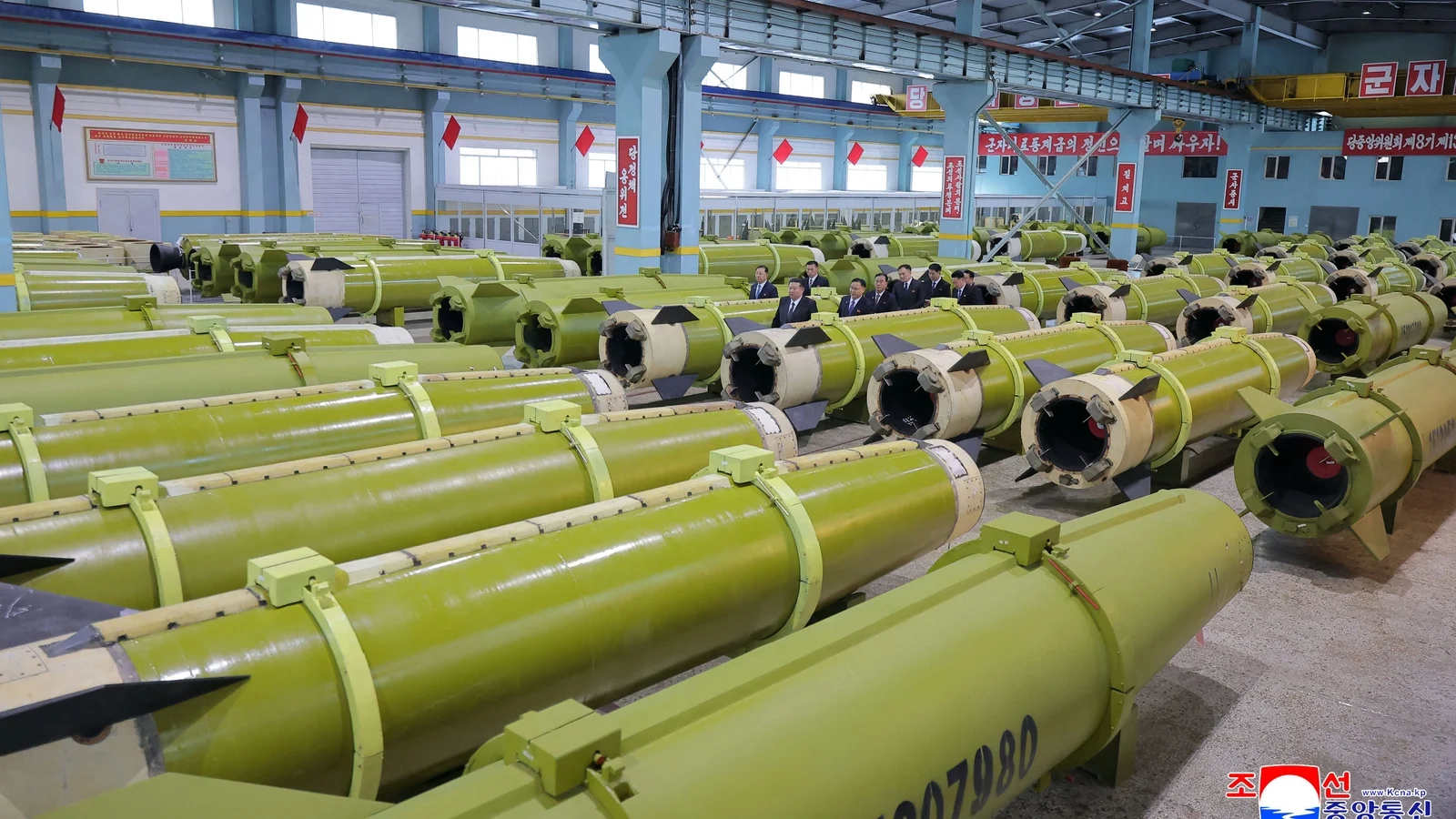
State media in Pyongyang had its own version of the story. KCNA reported that Kim Jong Un visited a facility producing tactical guided weapons and ordered a 250% expansion of output. The detail — and the number — was deliberate, meant to be both boast and bet: if the factories expand capacity, Pyongyang can produce more missiles, train more technicians, and, if pressed, flood the region with more hard-to-track launches.
“For them, it’s about survival and prestige,” said Hong Min, an analyst at the Korea Institute for National Unification. “The message to their own people is clear: the leadership is expanding defenses and ensuring national dignity. The message to outsiders is also clear: attacking North Korea would not be as straightforward as some might assume.”
Local voices: fishermen, commuters, and quiet worry
On the docks of Pohang, where the sea smells of iron and diesel, fishermen shrugged as if the sky’s new streaks were part of the day’s weather. “We worry about our nets, not politics,” said Mr. Choi, a 58‑year‑old who has spent decades at sea. “But every time these things fly, you feel it — like a stone dropped into your lives.”
In a cramped coffee shop near Seoul Station, a young office worker named Minji tapped her cup and said quietly, “I’m going to China next week for work. I’m not scared, but I think about kids, about what would happen if there was a panic. We’ve learned to live with this strange rhythm of tension.”
Such reactions capture the odd normalcy of the situation: people carrying on, while the strategic temperature fluctuates above them. It is a kind of frozen anxiety, always present but predictable enough to fit into routines.
Diplomatic ripples: Lee heads to Beijing
President Lee Jae‑myung’s trip to Beijing now carries new weight. South Korea hopes to harness China’s influence over Pyongyang to nudge the North toward restraint. China remains North Korea’s largest trading partner and a crucial lifeline — but Beijing is also wary of instability on its northeastern border.
“China doesn’t want a collapsed Korea on its doorstep,” an unnamed diplomatic source in Seoul told me. “But Beijing values stability first. Pressure that could crack the regime is not their preferred route. This is exactly why Seoul keeps reaching out to China, even when tensions spike.”
The summit will likely revolve around economic cooperation and regional security calculus. For Lee, the challenge is to persuade Xi that Beijing can and should play a constructive role in deterring Pyongyang’s most dangerous impulses without coercion that might lead to unpredictable outcomes.
Looking out: what comes next?
There are no easy answers. A missile arc in the sky is an expression of capability; the policy response must be an exercise in patience, deterrence, and diplomacy. Would more sanctions, more military exercises, or more diplomatic isolation change Pyongyang’s behaviour? History says not necessarily. Engagement without naiveté — that is the hard sell.
We have to ask ourselves: how do we prevent escalation when provocations arrive in the hours before diplomatic exchanges? How do communities live normal lives under the shadow of these strategic messages? And how do democratic societies balance vigilance with the fatigue of perpetual crisis?
“We need a dual track: credible defence and creative diplomacy,” said Dr. Park. “The first keeps people safe today; the second creates the conditions for safety tomorrow.”
Quick facts
- Launch detected: 07:50 local time near Pyongyang.
- First ballistic missile test since November, according to regional ministries.
- Estimated North Korean nuclear warheads: widely assessed by analysts to be in the range of roughly 40–60; delivery systems expanding in capability.
- North Korean state media (KCNA) reported Kim Jong Un ordered a 250% expansion in tactical guided weapon production.
At the end of the day, these tests are more than metal and propulsion. They are language — crude, loud, and often frightening — in which a closed regime speaks to the world. How the world replies will shape not only the Korean Peninsula, but the rules and rhythms of 21st‑century diplomacy. Will we respond with escalation, or with a steadier hand aimed at reducing risk and opening avenues for dialogue? That choice will define the years to come.